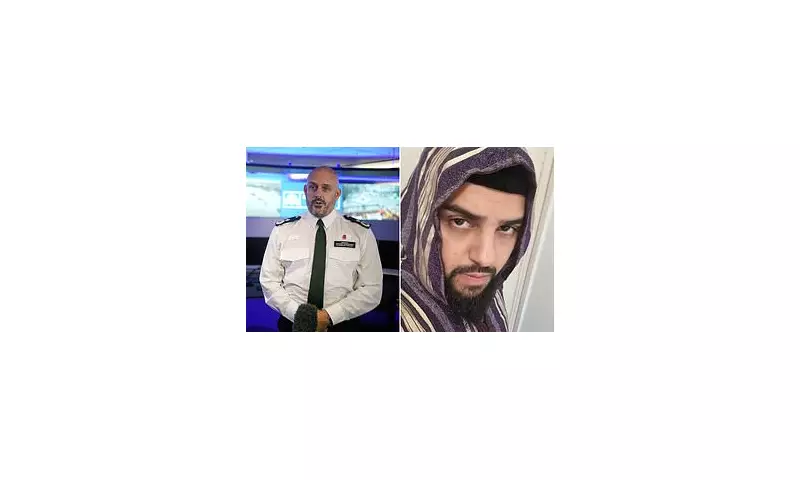
Scotland Yard's senior counter-terrorism officer has made a stark revelation about the ongoing threat to national security, disclosing that police have successfully thwarted 19 'late-stage' attack plots within the United Kingdom over the past five years. Assistant Commissioner Laurence Taylor, who leads the Metropolitan Police's counter-terrorism command, provided this critical insight during an interview with The Crime Agents podcast, highlighting the persistent dangers facing the nation.
Goal-Line Saves Against Imminent Threats
In a powerful analogy, Mr Taylor described these crucial interventions as 'goal-line saves', emphasising how close these planned atrocities came to being executed. He confirmed that counter-terror police are currently monitoring approximately 1,000 dangerous extremists across the country, representing a significant ongoing security challenge that requires constant vigilance and resource allocation.
ISIS Regrouping and Growing Ambitions
The Assistant Commissioner issued a sobering warning about the resurgence of terror group ISIS, which has managed to regroup over the last six years despite the death of its leader Abu Bakr al-Baghdadi in 2019. 'The threat that we saw 20 years ago has never gone away,' Mr Taylor stated. 'It kind of ebbs and flows. In terms of capabilities overseas, the influence to get things done abroad, we've definitely seen an uptick in some of that.'

He elaborated further on the persistent danger: 'There's no question that their ambition has always been to attack the West. We know that their ambitions have grown and we are seeing people who are still intent on doing that sort of activity. It just has never gone away.'
Current Operational Challenges
Mr Taylor revealed that counter-terror police are currently managing approximately 800 active cases, with a substantial 75 per cent of these investigations linked to Islamist terrorism. He acknowledged that while no further plots have been disrupted since the Manchester Synagogue attack in October, the threats facing Britain remain 'broad, complex, and some of those traditional threats still exist and are challenging for us'.
The Manchester Synagogue Attack
The October attack on the Heaton Park Hebrew Congregation Synagogue serves as a tragic reminder of the real-world consequences of extremist ideology. ISIS-supporter Jihad Al Shamie, aged 35, deliberately crashed his car outside the synagogue during Yom Kippur, the holiest day in the Jewish calendar, before attacking worshippers with a knife. The assault resulted in the tragic deaths of Melvin Cravitz and Adrian Daulby, highlighting the devastating human cost of terrorism.
Prevent Programme Under Strain
Mr Taylor expressed concerns about the Government's deradicalisation programme, Prevent, which is expected to receive approximately 10,000 referrals this year. He questioned whether the programme 'has got the capacity to deal with the volume of things that are going through it now', pointing to systemic challenges in addressing complex radicalisation cases.
'Prevent was set up to deal predominantly with Islamist ideologies and also now looks at extreme right wing,' he explained. 'If you don't have an ideology or you've got mixed ideologies, Prevent is not the right place for you. And that's one of the challenges.'
Online Radicalisation and Tech Company Responsibility
The counter-terror chief identified online radicalisation as a growing and particularly challenging aspect of modern extremism. He specifically criticised social media platforms and their leadership, taking aim at X and Meta bosses Elon Musk and Mark Zuckerberg for 'not doing nearly enough' to prevent algorithms from 'pumping' extremist content to vulnerable users.
Mr Taylor highlighted the personal dimension of this challenge, admitting: 'I have no idea what my own two sons are looking at on Tiktok and Snapchat, so how do we keep our young people safe online?' He called for greater corporate responsibility, stating: 'It comes down to what their moral perspective is, how they're running their business. I would put huge pressure on tech bosses to manage this more effectively. And we need to. But we also need laws to do this.'

Recent Counter-Terrorism Successes
The revelations come against a backdrop of significant counter-terrorism operations. Last May, police and MI5 successfully foiled a suspected plot by Iranian terrorists to carry out a major attack on British soil. In a 'highly significant' operation, counter-terror officers and Special Forces raided two suspected Iranian cells, addressing growing hostile state activity within the UK.
Sources indicated the alleged plot targeted UK premises and represented a 'major attack' that could have led to imminent threats to life. Home Secretary Yvette Cooper described the arrests as reflecting 'some of the biggest counter-state threat and counter-terrorism operations we have seen in recent years', underscoring the scale and importance of these security interventions.
Looking Forward
Assistant Commissioner Taylor concluded with a realistic assessment of the current security landscape: 'I think at the moment we are probably in one of those more upward trajectories but the more activity we do, potentially we can disrupt that.' His comments serve as both a warning about the persistent nature of terrorist threats and a testament to the ongoing efforts of counter-terrorism professionals working to keep the public safe from harm.