Mass Arrests at Palestine Action Protest in Central London
Police officers have arrested more than 90 individuals during a Palestine Action demonstration in Trafalgar Square, London. This marks the first mass protest since the high court ruled the group's proscription as unlawful, leading to heightened tensions and a significant police presence.
Demonstrators Gather in Trafalgar Square
Hundreds of protesters assembled in Trafalgar Square on Saturday afternoon, unveiling signs with messages such as "I oppose genocide. I support Palestine Action." Many sat on camping chairs or the ground, holding placards aloft. The Metropolitan Police reported that those arrested ranged in age from 27 to 82, highlighting a diverse cross-section of participants.
Some attendees dressed as suffragettes, while others wore masks depicting Keir Starmer. Notable figures included Mike Higgins, a blind disabled man whose previous arrests have sparked public outrage, and Qesser Zuhrah, a former Palestine Action-affiliated prisoner who endured a 48-day hunger strike. Zuhrah criticized the ban, stating, "The entire world is against it," and echoed sentiments from UN human rights chief Volker Türk, who condemned the proscription as "chilling."

Police Response and Arrests
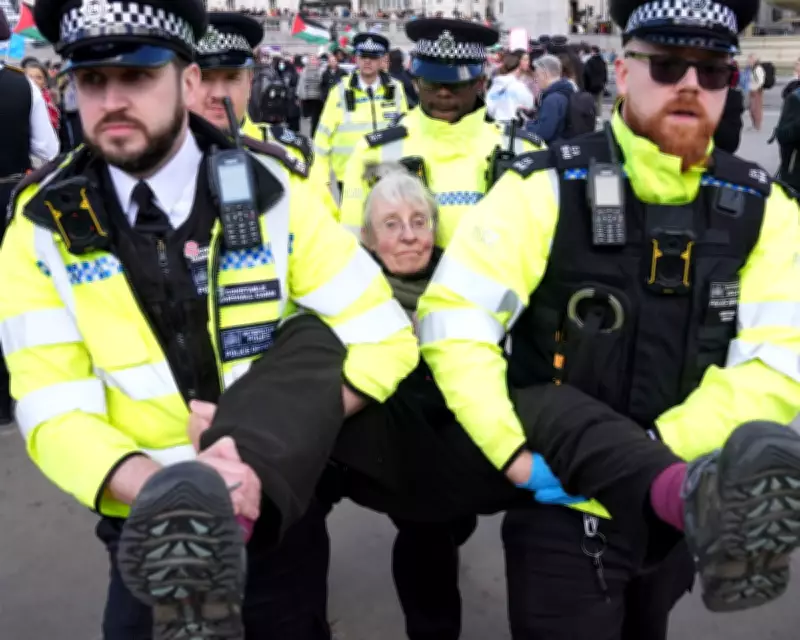
Shortly after 1 pm, officers began making arrests on the edges of the demonstration. Several protesters were seen being carried away by police, including an elderly woman using walking sticks. One woman remarked to officers as she was escorted, "You could be on your way catching real criminals." By 2:50 pm, the Met confirmed 92 arrests.
Defend Our Juries, the organizers, accused the police of acting unlawfully, noting that the high court had invalidated the ban. They stated, "The Met are choosing to make arrests despite the government's ban being ruled unlawful by the high court." In response, Met commander Claire Smart warned beforehand that showing support for a proscribed organisation is an offence under the Terrorism Act, and the force would not hesitate to act.
Legal and Political Context
In February, the high court declared the government's proscription of Palestine Action "disproportionate and unlawful," arguing that most activities did not meet the threshold for terrorism. However, after Home Secretary Shabana Mahmood was granted permission to appeal, the Met revised its enforcement approach, describing its initial stance as an "interim position." Mahmood's appeal is scheduled for hearing on 28 and 29 April.
Protesters expressed frustration with the government's actions. Ally, a 72-year-old sculptor, called the proscription "blatantly absurd," adding, "It's getting really scary about what this government is doing about free speech and the right to protest." Andy Simons, a 73-year-old retired curator, wore a sign reading "Free, free speech" and emphasized the importance of nonviolent expression.
Broader Implications and Reactions
The demonstration underscores ongoing debates over protest rights and free speech in the UK. Kamran Ahmed, who participated in a hunger strike for over 60 days, said he was there to support "righteous people taking righteous action against the government." Defend Our Juries denied allegations of obstruction or abuse, asserting their actions were "peaceful, dignified, and completely nonviolent."
As legal proceedings continue, this event highlights the complex interplay between activism, law enforcement, and judicial oversight in contemporary British society.