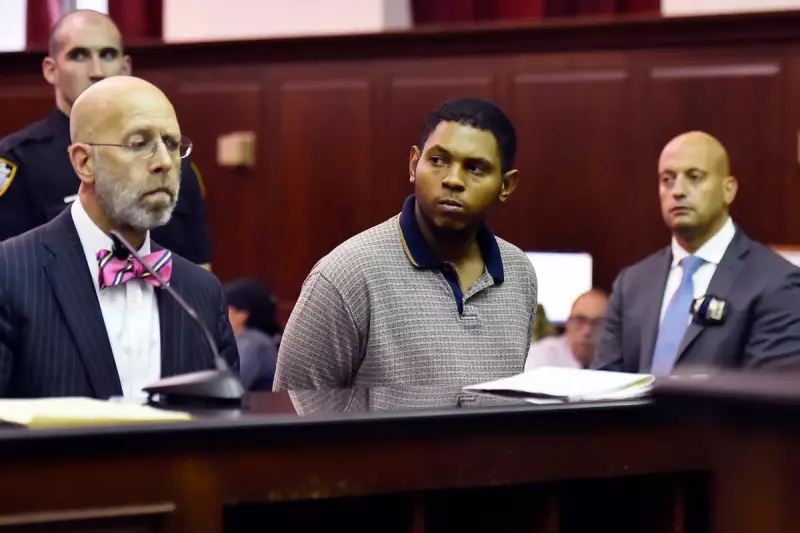
Man Who Killed Four Homeless Men Believed He Had to Murder 40 to Save His Life
A man currently on trial for the brutal bludgeoning deaths of four homeless individuals in New York City was suffering from severe schizophrenia and believed he needed to kill forty people to preserve his own life, a jury heard this week. Randy Santos, aged 31, is asserting an insanity defence in Manhattan state court, with his legal team arguing that mental illness rendered him incapable of criminal responsibility.
Voices Commanded Violent Acts to Prevent Death
During opening statements, Santos's lawyer, Marnie Zien, revealed that her client was "hearing voices telling him he needed to kill 40 people or he would die too." She explained that Santos felt he had no alternative, stating, "He needed the voices to stop. He needed to save his own life. He saw no other way out." The defence contends that schizophrenia had profoundly "polluted his mind with irrational thoughts and left him prone to violence."
Santos has pleaded not guilty to multiple charges, including first-degree murder for the deaths of Florencio Moran, Nazario Vásquez Villegas, Anthony Manson, and Chuen Kok. He also faces attempted murder charges for assaults that left two other men with severe injuries. These tragic incidents contributed to the 319 killings recorded in New York City during 2019, with 52 occurring specifically in Manhattan.

Graphic Evidence Presented in Court
Assistant District Attorney Alfred Peterson provided jurors with harrowing details of the attacks, which took place in the early hours of October 5, 2019. Surveillance footage captured Santos "repeatedly lifting the bar up over his head and bringing it down on the head" of one victim. A couple on a date witnessed him beating another man with the same weapon on Manhattan's Bowery street.
Police apprehended Santos while he was carrying the blood-stained bar, which forensic testing later confirmed contained his DNA on one end and blood from his victims on the other. Peterson emphasised that Santos "knew exactly what he was doing and the consequences of what he was doing — that he was killing these men." The prosecutor described how Santos looked around to ensure the coast was clear before attacking and even paused to allow a potential witness to leave the area.
Complex Legal Battle Over Insanity Defence
The trial centres on whether Santos can be held criminally responsible given his mental health condition. If the jury accepts the insanity defence, he could be committed to a psychiatric treatment facility indefinitely instead of facing life imprisonment. However, prevailing with such a defence in New York is notoriously challenging, requiring proof that the defendant did not comprehend the consequences of their actions or distinguish right from wrong.
Peterson urged jurors to look beyond the mental health claims, noting that Santos recognised himself in surveillance video after his arrest, telling police, "Yea, that's me." The prosecutor argued this demonstrated awareness of his actions.
History of Violence and Missed Treatment Opportunities
Santos, a native of the Dominican Republic who moved to New York as a child, has a documented history of violent behaviour. Police records indicate at least six prior arrests, including allegations of assaulting a tourist on a subway, choking a man at an employment agency, and punching a homeless man in a Brooklyn shelter.
During his last incarceration before the killings, Santos was diagnosed with schizophrenia. Released in August 2019, he was given referrals for treatment and prescriptions for medication but never utilised them. Previously, he had been diagnosed with schizophreniform, a shorter-term condition, and had visited a hospital complaining of hearing voices, yet did not receive the necessary intervention.
The defence highlighted that the Chinatown rampage was the culmination of escalating violent episodes, beginning with a conflict with his grandfather. Santos had even conducted a "trial run" about a week earlier, severely injuring another man with a wooden stick in a different Manhattan neighbourhood.

Broader Context of Insanity Defences in New York
Insanity defences have yielded mixed results in New York courts. In 2022, a man who drove his car through crowds in Times Square, killing a tourist, was found not responsible and sent to a mental health facility. Conversely, in 2018, a Manhattan nanny was convicted of killing two children despite claims of undiagnosed mental illness and hallucinations.
As the trial proceeds, the jury must weigh the compelling evidence of premeditation against the profound impact of Santos's schizophrenia. The outcome will determine whether he receives life imprisonment or long-term psychiatric care, highlighting the complex intersection of mental health and criminal justice.