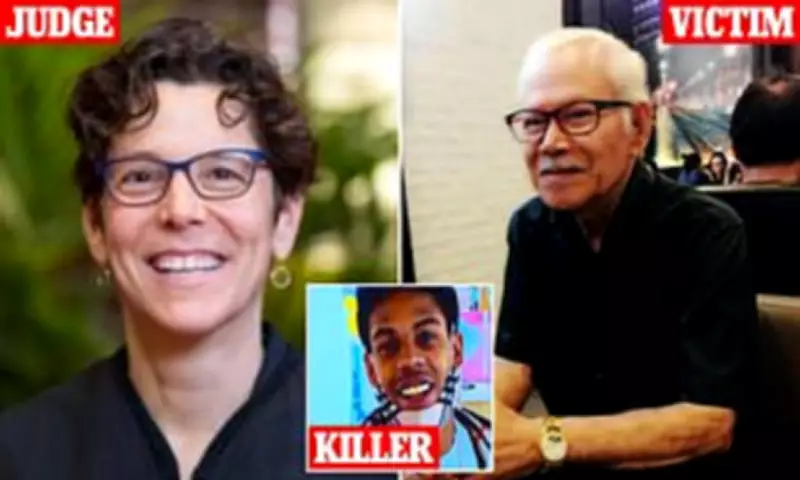
San Francisco Judge Releases Man Convicted in Asian Grandfather's Death
A San Francisco judge has released a man convicted of fatally assaulting an Asian grandfather, sparking significant outrage from community advocates and the victim's family. Judge Linda Colfax announced that Antoine Watson, 25, was granted probation just two months after a jury convicted him of involuntary manslaughter and assault.
Case Details and Court Proceedings
The hearing took place on Thursday in the Superior Court of California. Watson violently pushed 84-year-old Vicha Ratanapakdee on the streets of San Francisco in 2021, with the case later becoming a high-profile incident within the Stop Asian Hate movement. After a month-long trial, a jury convicted Watson of involuntary manslaughter and assault, while acquitting him of first and second-degree murder charges.
Watson has already served five years in county jail. Judge Colfax ruled earlier this week that the remainder of his sentence could be served on probation, allowing him to return to his mother's home.

'I think both Mr Watson and public safety would be served were Mr Watson on probation rather than parole,' Judge Linda Colfax said during the hearing, as reported by the San Francisco Chronicle. 'My goal is to do everything within my very limited powers to protect our community from any future violent acts by Mr Watson,' she added.
Judge's Reasoning and Defense Arguments
Colfax released Watson after he expressed remorse, and a jury found that he posed no danger to society. She stated in court that continuing his prison sentence would likely have a 'poor impact on Watson.' Colfax further explained that the parole system was 'stretched thin' and that Watson would have better access to mental health programs while on probation.
Watson's attorneys argued that he did not know Vicha was Asian. The defense painted a distressing picture of Watson's emotional state before the attack, claiming he had left an 'upsetting family situation' the night before and was involved in a car accident with his girlfriend.
Evidence presented showed an officer had pointed a gun at Watson and handcuffed him after the accident before releasing him with a citation. Watson was then seen punching another parked car and running down the street while yelling and crying. Witnesses testified they heard him screaming and said it sounded like 'something was terribly wrong.'
Watson testified that he 'wasn't thinking right' and was in distress when he violently pushed Vicha.
Prosecution and Community Response
The District Attorney's office determined there was insufficient evidence to charge Watson with a hate crime. Witnesses said during the trial that Vicha's race was unclear during the assault because he was wearing a mask and a baseball cap.
District Attorney Sean Connolly asked the court for the maximum sentence of nine years in state prison, arguing that Watson had never been held accountable for his actions and that imprisonment would be the best way to achieve this.
The court's decision has provoked outrage among Vicha's family and community members. His daughter, Monthanus Ratanapakdee, called the attack that ultimately resulted in her father's death 'cruel' and 'unprovoked.'
'This outcome reflects a pattern of prior leniency, where probation was previously given, and now it has again resulted in devastating consequences,' Monthanus said in a statement. 'This is not about revenge—it is about accountability. When consequences do not match the harm, it sends the wrong message about protecting our seniors and public safety.'
She expressed concern about what the court's decision meant for other families, adding that her father's legacy should be 'honored with dignity, public safety, and the protection of seniors, so future generations learn respect for the elderly.'
Community Reactions and Final Statements
Frances Tai, 65, a volunteer with a Chinatown public safety patrol group, told the San Francisco Chronicle he was disappointed with Watson's acquittal and probation. 'If you tackle a person to their death, for me, it’s murder, it’s 25 years to life. Our justice system has no sense of justice.'

Watson advocated for his probation, telling the court that being locked up would not help him rehabilitate. 'Prison is a dehumanizing and traumatizing environment that will not be rehabilitative. I know my actions ruined lives. I want to make up for it by becoming a better person,' he said.
Deputy Public Defender Anita Nabha stated in a release that the court's decision marked an 'important day for everyone impacted by this case.' She noted that both Watson and his mother read statements expressing remorse and compassion for the Ratanapakdee family, and that the judge rightfully considered individual factors such as Watson's age at the time and legal directives focusing on rehabilitation rather than just punishment.
The surprising decision concludes a years-long, highly publicized case that gained national attention as the 'Grandpa Vicha' case, with his family believing it was racially motivated. Vicha Ratanapakdee died two days after the assault, and harrowing video footage circulated showing Watson charging at him before violently pushing the elderly grandfather to the ground.