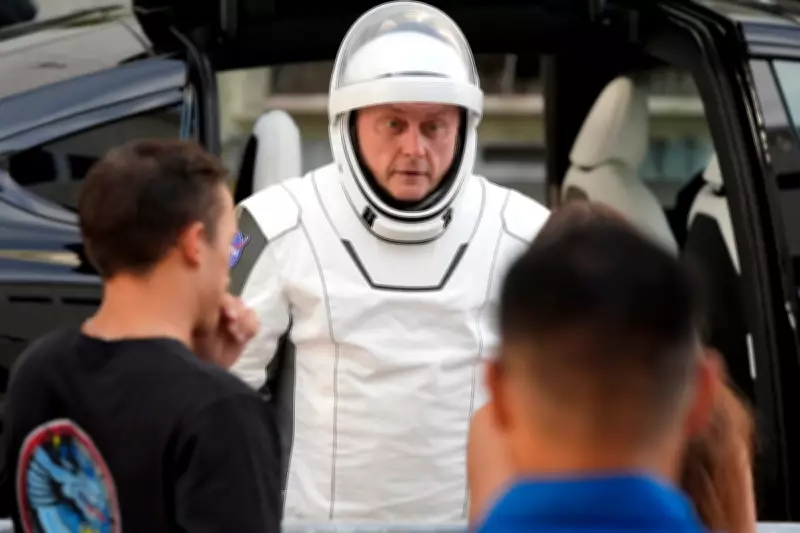
NASA Astronaut Details Baffling Medical Crisis Aboard International Space Station
The astronaut at the centre of NASA's unprecedented medical evacuation from the International Space Station has disclosed that physicians remain perplexed by the sudden illness that afflicted him while in orbit earlier this year. Four-time space veteran Mike Fincke has provided a detailed account of the alarming incident that occurred on January 7th during what should have been a routine evening meal preparation before a scheduled spacewalk.
Sudden Onset of Mysterious Symptoms
Fincke, a 59-year-old retired Air Force colonel, described experiencing a sudden and complete loss of speech capability while having dinner aboard the space station. "It was completely out of the blue. It was just amazingly quick," Fincke recounted from Houston's Johnson Space Center during an interview with The Associated Press. The veteran astronaut emphasised that he felt no pain during the episode, which he characterised as striking "like a very, very fast lightning bolt."
The mysterious medical event lasted approximately twenty minutes, during which Fincke's crewmates immediately recognised his distress and swiftly alerted flight surgeons on Earth. "My crewmates definitely saw that I was in distress," Fincke recalled, noting how all six crew members gathered around him within seconds. "It was all hands on deck within just a matter of seconds."

Medical Investigation and Unanswered Questions
Since returning to Earth, Fincke has undergone extensive medical testing, with physicians having ruled out both heart attack and choking as potential causes. Medical professionals continue to investigate all other possible explanations, including a potential connection to Fincke's cumulative 549 days spent in weightlessness across his multiple space missions. The incident occurred five and a half months into his latest space station assignment.
Fincke highlighted the crucial role played by the space station's ultrasound equipment during the emergency response. NASA has since initiated a review of other astronauts' medical records to identify any comparable incidents that may have occurred during previous space missions.
Operational Consequences and Crew Support
The medical emergency resulted in significant operational changes, including the cancellation of a planned spacewalk that would have marked Fincke's tenth extravehicular activity and the first for crewmate Zena Cardman. Additionally, Cardman and two other crew members returned to Earth aboard a SpaceX spacecraft on January 15th, over a month ahead of their originally scheduled return date. Upon landing, the astronauts were immediately transported to a medical facility for evaluation.
Fincke, who publicly identified himself last month to address mounting speculation about the incident, initially expressed regret about the mission disruptions. "I've been very lucky to be super healthy. So this was very surprising for everyone," he acknowledged. However, he ceased apologising after receiving direct instruction from NASA administrator Jared Isaacman, with colleagues reassuring him that "This wasn't you. This was space, right? You didn't let anybody down."
Looking Toward Future Space Exploration
Despite the unsettling medical episode, Fincke maintains his characteristic optimism about future space exploration opportunities. The veteran astronaut continues to express hope for another journey into space, demonstrating the resilience that has characterised his distinguished career. The incident has highlighted the ongoing challenges of maintaining human health during extended space missions and the importance of robust medical response capabilities aboard the International Space Station.
NASA's investigation into the mysterious medical event continues as the agency works to better understand the physiological effects of prolonged spaceflight on the human body. The episode represents a significant milestone in space medicine, marking the first time NASA has conducted a medical evacuation from the International Space Station since the laboratory began continuous human occupation over two decades ago.