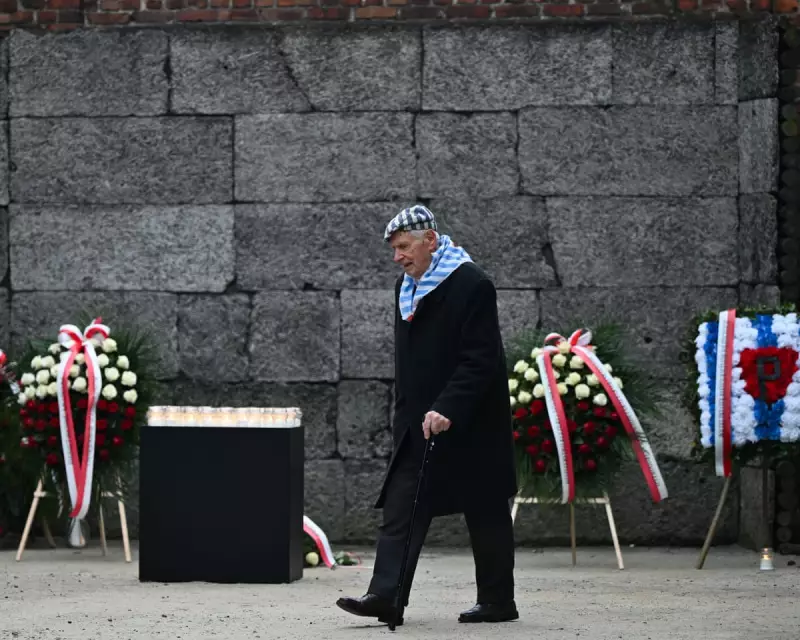
On a bitterly cold Tuesday, twenty-four former prisoners of Auschwitz braved the freezing temperatures to lay wreaths at the infamous 'Wall of Death'. This solemn act formed part of commemorations across Europe marking the 81st anniversary of the liberation of the Nazi concentration camp, a pivotal moment remembered on International Holocaust Memorial Day.
Survivors Issue Stark Warning Against Forgetting
As the world paused to remember the systematic murder of an estimated six million Jews, alongside millions of other victims, the dwindling number of survivors delivered a powerful and urgent message. They warned against the perils of forgetting history and urged ordinary citizens to stand firm against the rising tides of populism and political extremism.
One such voice is that of Tova Friedman, an 87-year-old survivor who is scheduled to address the German parliament, the Bundestag, on Wednesday. In her speech, she plans to confront the far-right Alternative für Deutschland (AfD) party directly. "I want very much to face up to them, not to hide away from them," Friedman stated, questioning the party's stance with the powerful words: "How dare you? Who do you think you are?"

Commemorations Across a Continent
Ceremonies took place from the snow-covered grounds of Auschwitz-Birkenau in Poland to the stark, grey concrete blocks of Berlin's Memorial to the Murdered Jews of Europe. Candles were lit and white roses laid in silent tribute. Polish President Karol Nawrocki joined survivors for a ceremony at the vast Birkenau site, where over a million people, primarily Jews, were transported to be murdered in gas chambers.
Beyond formal memorials, informal gatherings occurred across European towns and cities at 'Stolpersteine' – small brass plaques embedded in pavements that mark the former homes of Jews deported to their deaths. Present-day residents laid candles and flowers in remembrance.
A Call for Education and Vigilance
The need for continued education was starkly highlighted by a survey in Ireland, which found that 15% of young people had never heard of the Holocaust, with 10% of those aged 18-29 considering it a "myth". In response, the Irish government announced increased funding for Holocaust education in schools.
This educational imperative is being carried forward by a new generation. Survivors' relatives, like Tova Friedman's 20-year-old grandson Aaron Goodman, are increasingly taking up the mantle. Together, they run a TikTok account, 'TovaTok', to share her story and combat the growth of antisemitism online.
Confronting Modern Threats to Memory
European leaders joined survivors in expressing deep concern over contemporary threats. The EU's top diplomat, Kaja Kallas, warned that antisemitism is more rampant now than at any time since the Holocaust, "taking on new and disturbing forms". She specifically highlighted the danger of AI-generated content designed to distort historical truth and undermine collective memory.
This warning was echoed by the Frankfurt-based Anne Frank Educational Centre, which reported a "flood" of AI propaganda used to ridicule victims and trivialise the Holocaust.
A Community Under Pressure
Josef Schuster, president of the Central Council of Jews in Germany, called for "civil courage" to defend democracy. He warned of considerable forces seeking to push the Jewish community out of public life, stating, "These forces will continue to grow stronger if society fails to stop these threatening developments."
The fragility of remembrance was underscored by a vandalism attack on a memorial at the site of a destroyed synagogue in Kiel, Germany. Flowers and candles placed there were crushed and scattered, a act currently under police investigation.
The Weight of a Survivor's Story
Tova Friedman's personal history embodies the horror and chance of survival. Deported to Auschwitz-Birkenau at just five years old, she likely survived due to a technical malfunction of the gas chambers. "I represent one and a half million children who were murdered and who are not here to speak for themselves," she told German media. "My story is representative of all their stories... I was simply luckier than them, because I survived."

Now a successful therapist living in the US, Friedman directly links her past to present dangers, warning against the rise of populist far-right parties like the AfD, which advocates ending Germany's "culture of guilt" over Nazi crimes.
As the global population of Holocaust survivors continues to decline—now estimated at 196,600, down from 220,000 just a year ago—their final warnings and the duty to remember their stories carry an unprecedented weight on this day of solemn reflection.