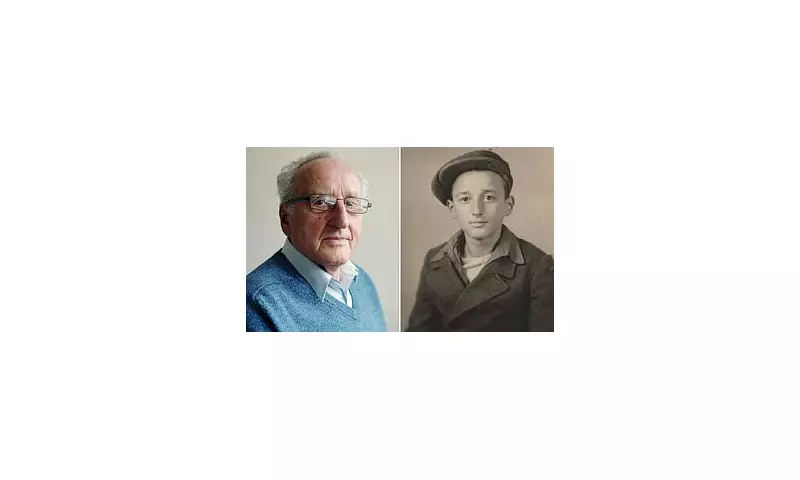
Auschwitz Survivor Ivor Perl's Haunting Warning on Holocaust Memorial Day
Ivor Perl was merely twelve years old when he first encountered the gates of Auschwitz-Birkenau, a place he continues to describe as 'literally hell on earth'. The Hungarian-born survivor endured the unimaginable agony of losing his parents and seven siblings to Nazi brutality, narrowly cheating death on multiple occasions before Allied forces liberated him. His incredible tale of survival has now been transformed into a feature-length animation, but the horrific memories remain vividly etched in his mind.
A Sad Indictment on Humanity's Failure to Learn
Speaking from his home in north-west London ahead of Holocaust Memorial Day, the 93-year-old delivered a sobering assessment: 'Humanity doesn't seem to have learnt anything'. Holocaust Memorial Day is observed annually in the UK on January 27th, marking the liberation of Auschwitz in 1945. This solemn occasion commemorates the six million Jewish victims of the Holocaust, along with millions more murdered under Nazi persecution and victims of subsequent genocides in Cambodia, Rwanda, Bosnia, and Darfur.
For over five decades, Ivor struggled to speak about his experiences. Since finding his voice, he has dedicated his life to Holocaust education, delivering more than one hundred talks to schools and organisations across the country. Despite receiving a British Empire Medal in 2015 for his efforts, Ivor believes far more work remains urgently needed.

Alarming Decline in Holocaust Commemoration
Ivor's concerns gain particular resonance against a troubling backdrop. A recent report reveals that the number of UK schools commemorating Holocaust Memorial Day has more than halved since the October 7th attacks on Israel. In 2023, over two thousand secondary schools participated in HMD events, continuing an annual increase since 2019. However, participation plummeted to fewer than twelve hundred schools in 2024 and just eight hundred fifty-four in 2025 – representing a nearly sixty percent reduction.
Chief Rabbi Sir Ephraim Mirvis expressed deep concern about these figures, suggesting teachers might be following 'the path of least resistance' amid opposition from parents and pupils. Writing in The Sunday Times, Mirvis emphasised that Holocaust Memorial Day represents 'an act of human memory' rather than a platform for political debate. He warned: 'If we cannot teach our children to remember the past with integrity and resolve, then we must ask ourselves what kind of future they will inherit.'
From Hungarian Childhood to Auschwitz Horror
Born Yitzchak Perlmutter in Mako, Hungary in 1932, Ivor's childhood was brutally disrupted by Nazi occupation. His father and older brother were initially taken as forced labourers, while he and his remaining siblings moved into a ghetto with their mother. They were subsequently deceived into boarding transport supposedly heading east for farm work, only to arrive at Auschwitz in late April 1944.
At this notorious Nazi death camp in Poland, where 1.1 million people perished including one million Jews, Ivor became prisoner number 112021. He survived multiple brushes with death – evading Dr Josef Mengele's experiments, avoiding selection for gas chambers, overcoming deadly typhus, and enduring a five-hundred-mile death march to Kaufering and Dachau. By liberation, only Ivor and his brother Alec remained alive from their family, arriving in England among 'The Boys', a group of nearly eight hundred orphaned child survivors granted British asylum.
A New Life and Lasting Legacy
Ivor rebuilt his life in England, meeting his future wife Rhoda at eighteen and establishing a clothing manufacturing business in 1953. The couple married, raised four children, and now enjoy four grandchildren and six great-grandchildren. Despite this full life, the loss of his mother left the deepest void. In his poignant memoir 'Chicken Soup Under The Tree', published in 2023, Ivor recalls their final moments at Auschwitz when she pushed him toward his brothers, an act that saved his life but separated them forever.

'One could never, ever truly describe what actually happened at Auschwitz,' Ivor reflects. 'The Holocaust is something you could never exaggerate. I could never truly talk about everything I witnessed because to do so would be cruel. It was so horrific that death was a welcome end, rather than something we feared.'
Animation Brings History to New Generations
Ivor's story has been transformed into the emotionally powerful animation 'Survivor', now available on ITVX. Twenty-five-year-old animator Zoom Rockman spent a year hand-drawing characters based on hundreds of photographs of real Auschwitz inmates. The film features meticulous attention to historical detail, with locations, events, and conversations drawn from Ivor's memoir. The haunting soundtrack was composed by Erran Baron Cohen, while Rockman's mother Kate Lennard wrote the screenplay.
Both Ivor and Rockman believe the film provides a vital way to engage Generation Z and younger audiences with Holocaust history – an increasingly urgent mission as firsthand witnesses diminish. Rockman, who became Beano's youngest artist at twelve and later worked as a Private Eye cartoonist, was determined to create a work of Holocaust fact rather than fiction. 'I was equally aware of the attitudes, the Holocaust denial that is out there, especially on the internet,' he explained. 'It feels like the trend is towards more denialism and misrepresentation as we go on.'
A Message for Humanity
When Ivor first viewed the completed film, he passed Rockman a private note stating simply: 'Dear Zoom, now I know why I survived.' Reflecting on this moment, Ivor explained that the film transcends being merely about one Jewish boy's experience. 'At my age I think to myself, why am I here now, why did I survive? What am I here for? But when I saw the film, I thought maybe that was the reason. Perhaps people will see it and realise what can happen to society – to humanity. They will watch it and know this is what happens when they lose control of themselves.'
As Holocaust Memorial Day approaches, Ivor's message carries renewed urgency. 'The world still hasn't learned,' he insists. 'Some would say we talk too much about the Holocaust, but I would say we haven't spoken enough. When it comes to the Holocaust there could never be overkill, there could never be enough that we could say about it. You would think the world would have changed by now, but it hasn't.'
He emphasises the universal relevance of Holocaust remembrance: 'The Holocaust is something far wider than Jews and non-Jews. When society deals with hatred, it's the whole of humanity that suffers. Hatred is something that never begins and ends against just one group.' With rising antisemitism and declining educational engagement, Ivor's lifetime of testimony serves as both memorial and warning for generations to come.