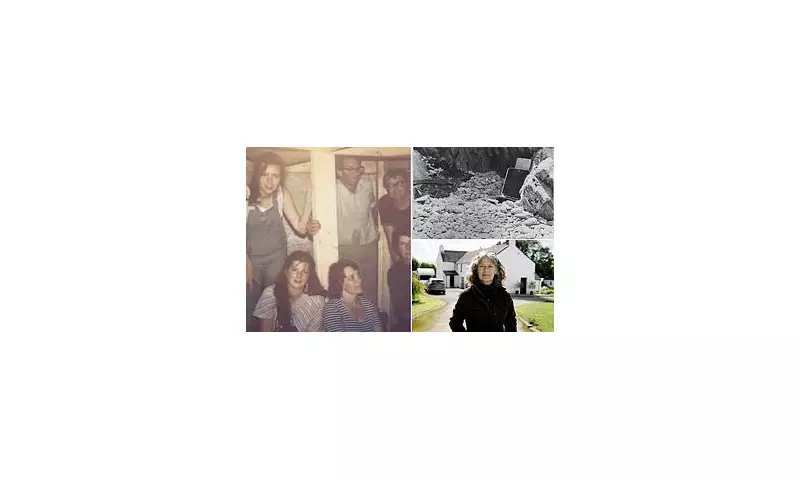
In the summer of 1983, a simple request from her father plunged 19-year-old Sue Warner into the heart of an international drug-smuggling conspiracy that would captivate Wales and baffle police. What began with following a suspicious stranger on a country lane ended with the exposure of a multi-million pound trafficking ring and a secret bunker hidden beneath a Pembrokeshire beach.
The Suspicious Stranger and the Farmer's Hunch
It was June when Sue's father, dairy farmer John Weston-Arnold, received an urgent call from neighbour Gary Yates. A weary-looking man with a rucksack had been apprehended trespassing on his land. John and Sue jumped into their farm truck and raced a mile and a half down the road. "They were talking to this small, thin, rather weary-looking gentleman," Sue recalls. The man claimed sore feet and a desire to get to Newport. After he was sent on his way, John turned to his daughter and issued a startling instruction: "Follow him."
Sue, thinking it bizarre but exciting, obeyed. She tracked the man's direction before he vanished. This single act of vigilance provided police with a crucial description. Within hours, a resident spotted a man matching it hiding in long grass. He was arrested and identified as Robin Boswell, a man already known to British customs for suspected drug smuggling.

A Community on High Alert
Sue's family were not the only locals noticing unusual activity. Across the picturesque Pembrokeshire coastline, a network of watchful residents began piecing together a strange puzzle. In Newport pubs, strangers flashed £50 notes—more than some locals earned in two months—ordering lavish meals and buying rounds. Flashy cars, including a Porsche and even a white Rolls-Royce, appeared in rural lanes.
Fishermen reported tampered lobster pots. Then, fisherman Andy Burgess and his daughter made a critical discovery in a cove known as Seal Bay. What looked like a rock was actually a tarpaulin concealing expensive boating equipment. A stranger on the beach claimed to be on a 'secret expedition' to Greenland, prompting Andy to alert the coastguard.
The Discovery of the Secret Bunker
The most astonishing find came on the very day Boswell was arrested. Local farmer Peter Smith, part of a volunteer search party, spotted a slat of wood buried flush into the pebbles of Traeth Cell Hywel beach. Beneath it was a yacht hatch. Lifeguard volunteer John Havard turned the levers. "There was a hiss and a strong smell of fibreglass resin," he said. "I jumped down and was taken aback by how surreal it was."
They had uncovered a professionally engineered bunker, carved from the stone cliff and fibreglassed shut. Inside was pristine boating equipment, engines, a rucksack, and empty Pot Noodle containers. To locals, it was "straight out of a James Bond film." Police, suspecting drug smugglers, launched Operation Seal Bay.
Unravelling an International Network
The investigation quickly escalated. Boswell's boots were coated in the same resin used in the bunker. He was the wealthy son of a Royal Navy officer, educated at Marlborough College. Police soon intercepted a speeding white Range Rover on the M4. The driver, Kenneth Dewar, was also covered in resin and gave the same London address as Boswell, despite denying they knew each other.
Officers then tracked a man fleeing a nearby caravan. He claimed to be Sam Spanggaard from Denmark, but was in fact Soeren Berg-Arnbak—an international drug smuggler, prison escapee, and one of Europe's most wanted men. Nicknamed 'the man with the rubber face', he lived a millionaire lifestyle with villas and a luxury yacht. His radio equipment had received a message from a 'mother ship' offshore waiting to land its cargo: three tonnes of Lebanese cannabis worth £7 million.
Back in Pembrokeshire, Sue's sharp eyes spotted another suspect: a man in a cream safari suit marching purposefully. Her family alerted police, who identified him as Donald Holmes, a drug dealer linked to a white Rolls-Royce seen locally and to Boswell's ex-wife, Susan.

The Trial and Lasting Legacy
The final breakthrough came from a Welshman known as 'Jim', who gave a 36-hour interview detailing the entire plan after Susan Boswell led police to him. He described moving equipment from Hampshire and his awe at the hidden cave. "It was stunning - a whole cave built under the pebbles," he said.
The case reached Swansea Crown Court in 1984. Sue testified, confirming where she had seen Boswell and Holmes. Her father was the first prosecution witness. After a trial lasting 385 days, the ringleaders were jailed: Boswell for ten years, Berg-Arnbak for eight, and Dewar for five. Susan Boswell received an eighteen-month sentence.
Operation Seal Bay was cracked not by sophisticated technology, but by the collective vigilance of a close-knit rural community. From farmers and fishermen to pub staff and coastguards, the people of Pembrokeshire proved that local knowledge was the ultimate defence against one of the era's most audacious crime plots. Reflecting over 40 years later, Sue Warner concludes: "It was without a doubt the veracity of the locals that helped put these people away."