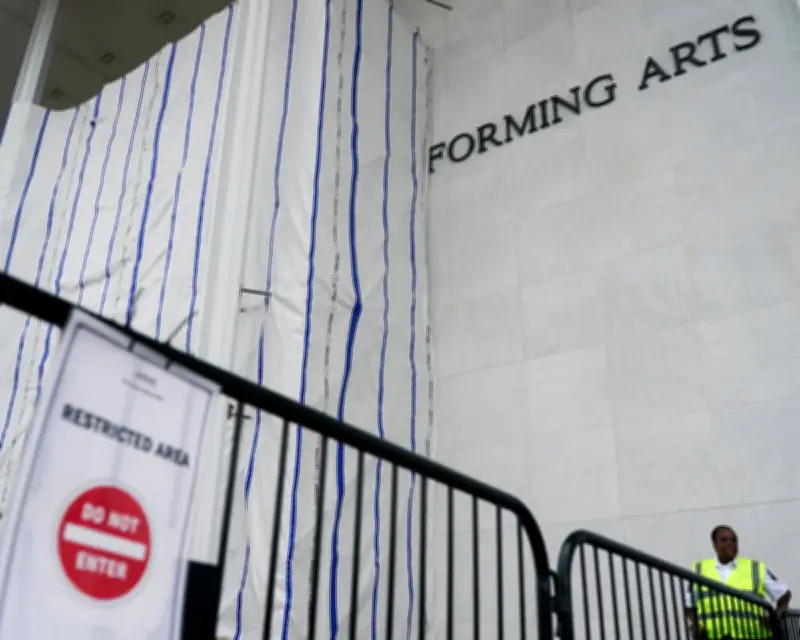
A federal judge has ruled that former President Donald Trump's name must remain on the John F. Kennedy Center for the Performing Arts, rejecting a lawsuit that sought to remove it. The decision, issued on Wednesday by U.S. District Judge Timothy J. Kelly, upholds the center's board decision to keep Trump's name on its donor wall.
Lawsuit Challenged Trump's Presence on Donor Wall
The lawsuit was filed by a group of plaintiffs, including former Kennedy Center board members and arts advocates, who argued that Trump's name on the wall violated the center's mission and standards. They claimed that Trump's actions, particularly his role in the January 6 Capitol attack, made him unworthy of such recognition. The plaintiffs sought to have his name removed from a prominent display honoring major donors.
Judge Kelly, a Trump appointee, ruled that the Kennedy Center's board had broad discretion in making such decisions. He stated that the board's decision to retain Trump's name was not arbitrary or capricious, and that the plaintiffs lacked standing to challenge it. The ruling emphasized that the center is a private institution and its donor recognition policies are not subject to judicial review in this context.
Kennedy Center Board's Decision Upheld
The Kennedy Center's board had voted in 2022 to keep Trump's name on the wall, despite calls for its removal. The board cited its policy of not removing donor names based on political or personal controversies. The center's president, Deborah F. Rutter, had previously stated that the institution's mission is to celebrate the arts, not to engage in political disputes.
The plaintiffs argued that Trump's name on the wall damaged the center's reputation and contradicted its values. However, the judge found that the board's decision was reasonable and within its authority. The ruling noted that the center had consistently applied its donor recognition policies without regard to the political affiliations or conduct of donors.
Trump's Response and Broader Implications
Trump celebrated the ruling on his social media platform, calling it a victory against what he described as "cancel culture." He said the decision reaffirmed his legacy and contributions to the arts. The Kennedy Center declined to comment further on the ruling, but sources close to the board indicated that they were satisfied with the outcome.
The case has broader implications for how cultural institutions handle donor recognition in politically charged times. Legal experts say the ruling reinforces the principle that private organizations have wide latitude in managing their affairs, unless there is clear evidence of illegal or discriminatory conduct. The decision could also affect similar disputes at other institutions, such as museums and universities, where donors' names have become subjects of controversy.
According to court documents, Trump donated between $100,000 and $250,000 to the Kennedy Center over the years, which qualified him for a spot on the donor wall. The plaintiffs had argued that the donation was not the sole basis for the recognition, but the judge noted that the center's policy did not require a minimum donation amount for such honors.
The ruling is final and cannot be appealed, as it was issued by a federal district court. The plaintiffs' attorney expressed disappointment but acknowledged the legal hurdles. The Kennedy Center's board is expected to review its donor policies in light of the case, but no immediate changes are anticipated.