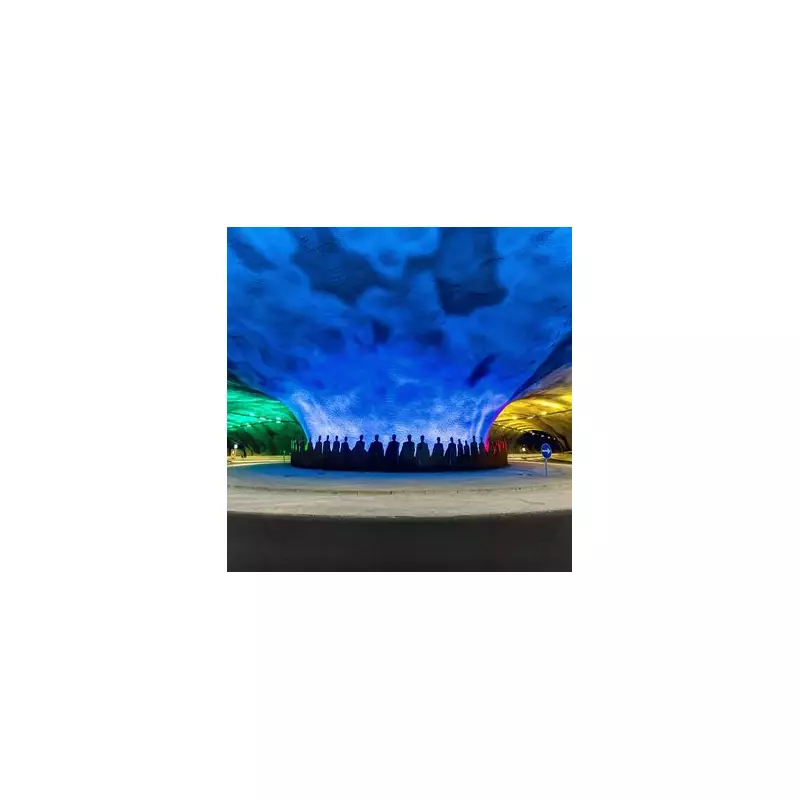
Deep beneath the choppy waves of the Atlantic Ocean lies a unique feat of engineering that has become an unlikely tourist draw: the world's first and only underwater roundabout. Located within the Eysturoyartunnilin subsea tunnel in the Faroe Islands, this colourful traffic circle is playfully designed to resemble a jellyfish and sits a staggering 72 metres below the surface.
An Engineering Marvel Beneath the Waves
The Eysturoyartunnilin tunnel stretches for 6.9 miles (11.1km) and directly connects the two largest islands in the Faroe archipelago, Streymoy and Eysturoy. Drivers can traverse the entire tunnel in approximately eight minutes, but the journey's centrepiece is the remarkable roundabout where three tunnel tubes converge. At its lowest point, the tunnel descends to 189 metres (620 ft) beneath the water's surface.
The tunnel project, constructed by the Faroese company Eystur- og Sandoyartunlar, was completed in just four years and opened to traffic on 19 December 2020. It represents the largest single investment in Faroese history, with a total cost of around €260 million (approximately £230 million).

Art and Symbolism in the Deep
The roundabout itself is an artistic installation as much as a functional piece of infrastructure. At its heart stands a giant central pillar of natural rock, left intact during construction and illuminated with dynamic, colour-changing lights in shades of blue, red, and green.
Renowned Faroese artist Tróndur Patursson decorated the space, encircling the central pillar with an 80-metre steel sculpture. The artwork features life-sized, faceless figures holding hands and facing inwards towards the light. Patursson explained that the figures symbolise moving from darkness into light, representing the core Faroese belief that "by joining hands and working together we achieve great things."
Transforming Travel and Society
The primary practical impact of the tunnel has been a dramatic reduction in travel times across the islands. The driving journey between the Faroe Islands' two largest cities, Tórshavn and Klaksvik, has been halved from 70 minutes to just around 35 minutes. This has been hailed as a transformative project for Faroese society, connecting communities, regions, and economies in unprecedented ways.
To use the tunnel, drivers pay a toll of 75 Danish kroner (about £8.60) for each crossing, which is automatically billed via number plate recognition cameras. The income generated is earmarked to fund future tunnel projects on the islands.
Guðrið Højgaard, director of Visit Faroe Islands, expressed hope that the new infrastructure would help spread tourism benefits more widely and encourage local businesses to cater more to visitors. The unique 'jellyfish' roundabout, with its eerie yet beautiful atmosphere, has already captured significant attention online, adding a must-see modern wonder to the North Atlantic nation's attractions.