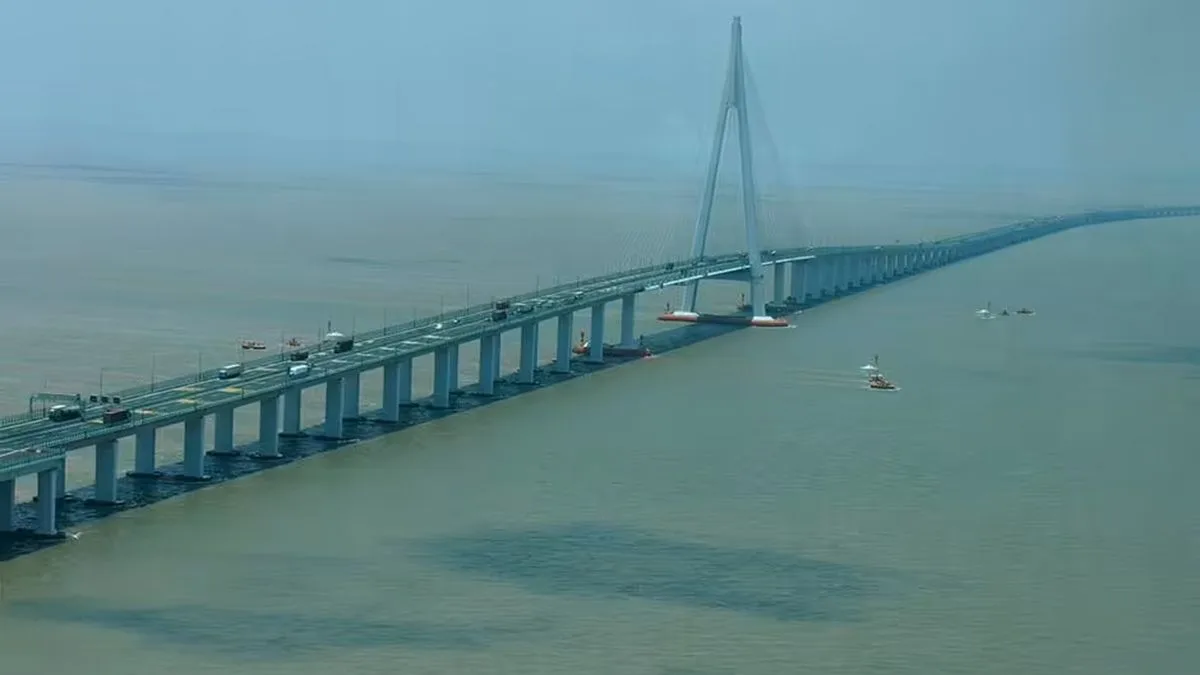
The Danyang-Kunshan Grand Bridge in China holds the title of the world's longest bridge, stretching over 100 miles and requiring two hours to traverse. This railway viaduct connects Shanghai and Nanjing, forming a key part of the Beijing-Shanghai High-Speed Railway.
Construction began in 2006 and was completed in 2011 at a cost of $8.5 billion (£6.4 billion), equating to roughly $51 million (£38.6 million) per mile. The bridge was designed to protect the land beneath it, which is rich in rivers and rice fields, and runs parallel to the Yangtze River for most of its length.
Its curvature mimics the river's natural shape, and it spans Yangcheng Lake for over five miles. Before the bridge, train journeys between Ningbo and Jiaxing took four and a half hours; now they take just two, with passengers enjoying scenic views.
The bridge has revolutionised travel, reducing the 1,000-kilometre (621-mile) journey between Beijing and Shanghai to just 4 hours and 48 minutes. Built to the highest anti-seismic standards, it can withstand earthquakes and collisions from ships passing beneath.
Beyond its practical benefits, the Danyang-Kunshan Grand Bridge has become a tourist attraction due to its record-breaking status. China has also recently opened the world's highest bridge, the Huajiang Grand Canyon Bridge in Guizhou province, which cuts travel time from two hours to two minutes and stands 625 metres above the surface.