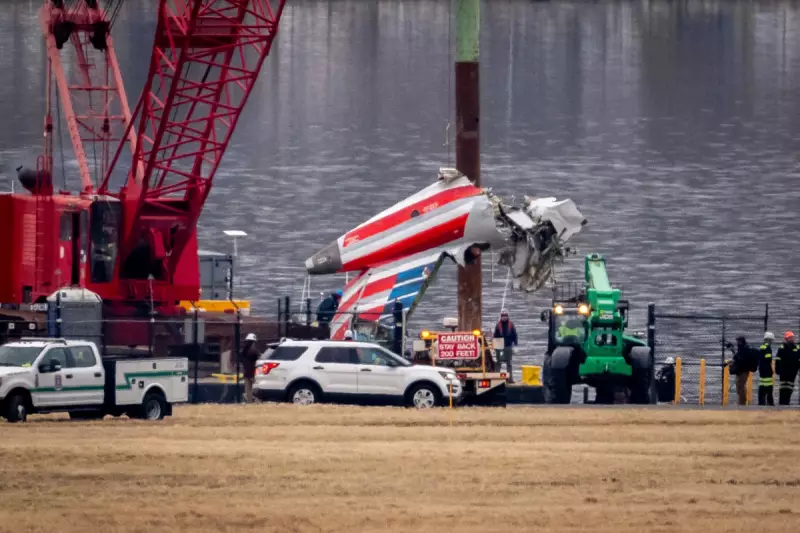
One year after a catastrophic mid-air collision over Washington D.C. claimed sixty-seven lives, the National Transportation Safety Board is preparing to release its comprehensive findings. The tragic incident, which occurred in January 2025, involved an Army Black Hawk helicopter and an American Airlines passenger jet, marking the deadliest United States air disaster since the September 11th attacks.
Investigative Findings and Systemic Failures
The forthcoming NTSB report, scheduled for discussion this Tuesday, reveals multiple layers of failure that contributed to the disaster. Investigators have determined that the Army helicopter was flying at an altitude exceeding its authorised limit, while simultaneously relying on a faulty altimeter that provided inaccurate height readings. Compounding these issues, the Federal Aviation Administration had received repeated warnings about the inherent risks within Washington's congested airspace, yet failed to implement necessary safety measures that could have prevented the tragedy.
In response to the disaster, the FAA has made permanent several temporary restrictions initially imposed after the crash. These include prohibiting helicopters and fixed-wing aircraft from sharing the same airspace around Reagan National Airport, banning air traffic controllers from authorising visual separation procedures, and mandating that all military aircraft continuously broadcast their positional data.

Detailed Timeline of the Catastrophic Event
The Final Minutes Before Impact
On the evening of January 29th, 2025, American Airlines Flight 5342, carrying sixty-four passengers and crew, commenced its initial descent toward Reagan National Airport. At approximately 8:43 PM, air traffic control instructed the pilots to switch from Runway 1 to Runway 33 for their landing approach. Simultaneously, an Army Black Hawk helicopter, designated PAT25 by controllers, was flying southward over the Potomac River under clear night skies.
As the helicopter neared the airport, cockpit recordings reveal a concerning discrepancy: one pilot reported flying at 300 feet, while the instructor pilot stated they were at 400 feet. This altitude confusion went unresolved as the aircraft continued its descent toward an area where the maximum permitted altitude was just 200 feet.
Critical Communication Breakdown
At 8:46 PM, controllers radioed the Black Hawk crew to alert them about the approaching passenger jet, referred to as CRJ, circling at 1,200 feet. The helicopter pilots acknowledged visual contact with the aircraft and requested permission to maintain visual separation, a procedure allowing closer proximity than standard separation rules. Controllers approved this request.
Twenty seconds before impact, with a conflict alarm sounding in the background, the controller urgently radioed: "PAT25, do you have the CRJ in sight?" followed immediately by "PAT25, pass behind the CRJ." Investigators later determined the helicopter pilots likely never received this critical instruction.
One second later, the passenger jet's collision avoidance system activated with the warning "Traffic! Traffic!" Moments after, a crew member on the helicopter reaffirmed visual contact and repeated the request for visual separation. As the plane descended past 313 feet, its pilots executed a sharp evasive maneuver just one second before the fatal impact.
Immediate Aftermath and Recovery Operations
The collision produced a visible flash in the night sky before both aircraft plunged into the icy Potomac River. Radio transmissions captured the stunned reaction: "Tower, did you see that?" In the subsequent hours and days, emergency crews conducted extensive search operations in the frigid waters.
By January 30th, authorities confirmed there were no survivors. Recovery teams had retrieved the bodies of all three soldiers from the helicopter. Approximately two miles downriver, environmental patrols discovered debris including flight manual pages, cabin wall fragments, and numerous American Airlines sugar packets. Both aircraft's black boxes were recovered and sent to NTSB laboratories for analysis.

Investigation Developments and Regulatory Changes
Throughout February 2025, investigators focused on reconciling conflicting altitude data between the two aircraft. The Army identified the fallen soldiers as Staff Sgt. Ryan Austin O'Hara, Chief Warrant Officer 2 Andrew Loyd Eaves, and Capt. Rebecca M. Lobach, described by colleagues as "brilliant and fearless." By February 4th, authorities confirmed all sixty-seven victims had been recovered.
Significant findings emerged in early March when the NTSB revealed the helicopter's Automatic Dependent Surveillance-Broadcast system was deactivated at the time of the collision. Federal investigators subsequently recommended banning certain helicopter flights near Reagan National Airport, describing the existing configuration as posing "an intolerable risk." Transportation Secretary Sean Duffy implemented these recommendations, noting helicopters would no longer be "threading the needle" beneath landing aircraft.
Broader Aviation Safety Implications
The Washington collision triggered nationwide aviation safety reviews. In April 2025, a federal assessment prompted by the disaster identified dangerous conditions at Las Vegas's Harry Reid International Airport, leading to new helicopter restrictions that reduced collision alerts by thirty percent. The FAA committed to implementing similar measures at any airport where concerns were identified.
In May, the Army temporarily suspended helicopter flights near Reagan Airport after two commercial jets aborted landings due to a Black Hawk operating in the area. This incident occurred as the 12th Aviation Battalion had just begun gradually resuming operations.
Infrastructure Overhaul and Congressional Scrutiny
Transportation Secretary Duffy announced a comprehensive plan to modernise America's ageing air traffic control system, parts of which still rely on obsolete floppy disk technology. The multi-billion dollar overhaul calls for six new control centres and nationwide technology upgrades by 2029, with Congress approving an initial $12.5 billion toward the project.
During July hearings, NTSB investigators questioned FAA, Army, and airline officials, revealing that controllers had warned the FAA years earlier about helicopter dangers in Washington's crowded airspace. NTSB Chairwoman Jennifer Homendy delivered a stern rebuke to agency officials: "Are you kidding me? Sixty-seven people are dead! How do you explain that? Our bureaucratic process? Fix it. Do better."
The investigation highlighted additional factors including the helicopter pilots' night vision goggles impairing their ability to spot the passenger jet, and systemic failures in addressing known safety risks around the nation's capital.