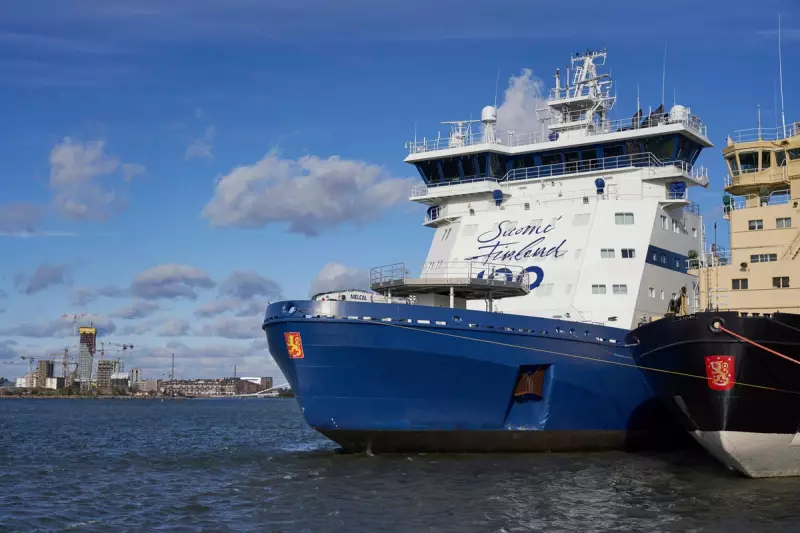
Icebreakers represent the indispensable technological key to unlocking Greenland's frozen potential, yet the United States finds itself in a precarious position with a severely limited domestic fleet. These colossal vessels, equipped with reinforced hulls and powerful engines capable of crushing through thick ice, are essential for navigating the treacherous Arctic waters that surround the Danish territory. Without them, accessing the island's vast mineral wealth or establishing strategic military positions becomes virtually impossible for much of the year.
The Arctic Access Dilemma
The cold, hard reality confronting American, NATO, and European plans for Greenland is the pervasive ice that chokes harbours, entombs valuable minerals, and transforms shorelines into hazardous fields of jagged white and blue shards. This formidable natural barrier threatens shipping operations throughout all seasons. Currently, the United States possesses only three operational icebreakers, with one vessel considered so decrepit that it is barely functional. While agreements are in place to acquire eleven additional ships, Washington faces a stark sourcing dilemma: it must turn to either strategic adversaries or allies it has recently alienated.
Strategic Ambitions and Technological Shortfalls
Despite moderating his public statements, former US President Donald Trump has consistently emphasised American interests in securing Greenland for both security and economic purposes. His objectives include preventing what he termed "the big, beautiful piece of ice" from falling under Russian or Chinese influence, establishing a strategic Arctic foothold for US assets, and extracting the island's considerable mineral resources, including rare earth elements. Speaking at the World Economic Forum in Davos, Switzerland, Trump highlighted the challenge, stating that accessing these resources requires navigating "hundreds of feet of ice."

Alberto Rizzi, a fellow at the European Council on Foreign Relations, underscores the severity of the capability gap. "Even if they decided to surge US material into Greenland tomorrow, they would have two or three years gap in which they're not really able to access the island most of the time," he explained. "On a map, Greenland looks surrounded by sea, but the reality is that the sea is full of ice."
Limited Global Suppliers
If the United States seeks to expand its icebreaker capabilities, it faces only four realistic options: the shipyards of strategic adversaries China and Russia, or those of longstanding allies Canada and Finland. Both Canada and Finland have recently endured blistering criticism and tariff threats from the Trump administration regarding Greenland, complicating diplomatic relations. Icebreakers are extraordinarily expensive to design, construct, operate, and maintain, requiring specialised workforces found only in certain northern regions.
Northern Expertise and Geoeconomic Leverage
Finland, with expertise forged in the frigid Baltic Sea, has constructed approximately sixty percent of the world's fleet of over two hundred and forty icebreakers and designed half of the remainder. "It's very niche capabilities that they developed as a necessity first and then they have been able to turn it into geoeconomic leverage," Rizzi noted. Russia maintains the world's largest fleet with around one hundred vessels, including colossal nuclear-powered ships. Canada follows as second, with plans to double its fleet to approximately fifty icebreakers, according to a 2024 report by Helsinki-based design firm Aker Arctic.
Jari Hurttia, business manager at Aker Arctic, reported robust demand, stating, "Our design and engineering work order books are pretty full at the moment and the near future looks promising," attributing this to the firm's "unrivalled special competence which is not available anywhere else in the world."

Rapid Chinese Advancement and American Catch-Up
China currently operates five icebreakers compared to America's three and is rapidly constructing more as it expands its Arctic ambitions. Marc Lanteigne, a professor at the University of Tromsø in Norway who frequently teaches at the University of Greenland in Nuuk, observed, "China is now in a position to develop indigenous icebreakers, and so the US feels it must do the same." This sentiment is echoed by security analysts who note Washington must accelerate its efforts to close the capability gap.
Sophie Arts, a fellow at the German Marshall Fund focused on Arctic security, highlighted the urgency, noting that President Trump "has really bemoaned this lack of icebreakers, especially in comparison to Russia." She described the current US fleet as "basically past their life cycle already," emphasising that "both Canada and Finland are really, really vital to this. Cooperation is what makes this possible ... the US doesn't really have a pathway to do this on its own at this time."
The Ice PACT and Construction Plans
During his first administration, Trump prioritised military acquisition of ice-capable vessels, a strategy continued by the Biden administration through the Ice PACT agreement with Helsinki and Ottawa. This pact aims to deliver eleven icebreakers constructed by corporate consortiums using Finnish designs. Four vessels will be built in Finland, while seven will be constructed at a Canadian-owned "American Icebreaker Factory" in Texas and a jointly owned US-Canadian shipyard in Mississippi.
Economic Realities and Diplomatic Considerations
Any mining of critical minerals in Greenland would face exorbitant costs due to harsh maritime and terrestrial conditions, with investments potentially requiring decades to yield returns. Even with adequate icebreaking capability, establishing and maintaining mining or defensive facilities—such as the proposed $175 billion Golden Dome missile defence network—would entail enormous expenditure. Danish Prime Minister Mette Frederiksen has expressed openness to strengthening Arctic security, including the Golden Dome programme, "provided that this is done with respect for our territorial integrity."
Market Dominance and Strategic Leverage
While both the United States and the European Union have pledged increased investment in Greenland, it remains evident which entities currently possess the hard-power capability to access the vast territory, roughly three times the size of Texas. Rizzi pointed to the potential for European leverage, suggesting that while Finland is unlikely to scrap deals over political disputes, Europe could theoretically say, "We're not going to give you any icebreakers and good luck reaching the Arctic, or projecting power there, with those two old ships that you have."
European Commission President Ursula von der Leyen reinforced this point at Davos, highlighting the EU's technological foundation for Arctic operations. "Finland—one of the newest NATO members—is selling its first icebreakers to the US," she stated. "This shows that we have the capability right here, in the ice so to speak, that our northern NATO members have Arctic-ready forces right now, and above all, that Arctic security can only be achieved together." Following an emergency EU summit in Brussels, she announced increased defence spending for Greenland, including additional icebreaker commitments.