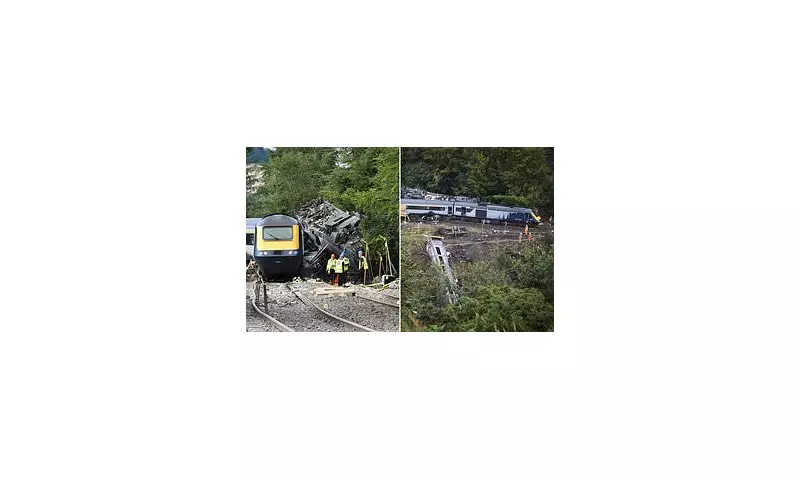
A fatal accident inquiry into the devastating train derailment near Stonehaven in Aberdeenshire has been told that the three men who lost their lives suffered injuries that were immediately unsurvivable. The tragic incident, which occurred on August 12, 2020, resulted from the train striking debris that had been washed onto the track by exceptionally heavy rainfall, leading to catastrophic consequences.
Details of the Fatal Incident Emerge in Court
The inquiry, which commenced at Aberdeen Sheriff Court, heard harrowing details about the crash at Carmont. The victims were identified as 45-year-old train driver Brett McCullough, 58-year-old conductor Donald Dinnie, and 62-year-old passenger Christopher Stuchbury. In addition to these fatalities, six other individuals sustained injuries in the accident.
Alex Prentice KC, serving as Crown counsel for the inquiry, presented post-mortem examination findings to the court. He stated that all three men had sustained multiple blunt force injuries during the derailment. Mr Prentice emphasised that these injuries were judged to be non-survivable, with death likely occurring instantaneously. This grim assessment was part of a joint minute read aloud during the proceedings.

Personal Tributes and Emotional Impact
The inquiry also heard poignant personal statements from the families of the deceased, highlighting the profound human cost of the disaster. Diane Stuchbury, the wife of Christopher Stuchbury, revealed in her written statement that her husband died on their wedding anniversary. She described him as "the most loving, kind, wise, and loyal man you could ever wish to meet" and expressed that they had been robbed of their future together.
Similarly, the family of Donald Dinnie shared that he was "loved and adored by all his family and friends" and would be forever missed. These testimonies underscored the lasting grief and emotional devastation wrought by the crash.
Operational and Systemic Failures Revealed
Nick Bucknall, an inspector of rail accidents, provided technical evidence to the inquiry. He explained that the passenger train, travelling at approximately 73 miles per hour, collided with debris that had been washed from a drain onto the track near Carmont. This occurred following very heavy rainfall at around 9.37 am on the day in question.
Mr Bucknall summarised the factors that led to the derailment, noting that the drainage system was unable to accommodate the flow of surface water, and the gravel in the drainage trench was vulnerable to washout. Crucially, he pointed out that Network Rail did not have arrangements for additional operational mitigation, and the speed of the train was not restricted despite the adverse weather conditions.
Emergency Response and Subsequent Investigations
The inquiry further heard that emergency crews who attended the crash site on the morning of August 12, 2020, were confronted with a "highly complex incident." During the course of the operation, two firefighters sustained injuries, adding to the toll of the disaster.
In the aftermath, a criminal prosecution saw Network Rail fined £6.7 million in 2023 after the organisation admitted health and safety failings related to the crash. A Rail Accident Investigation Branch report, published in March 2022, identified errors in the construction of a drainage system that had been installed by Carillion. This system was unable to cope with the heavy rain that fell on the morning of the crash. Carillion had entered compulsory liquidation in January 2018, prior to the incident.
The RAIB report made twenty recommendations aimed at improving railway safety, with many directed specifically at Network Rail. These findings highlight systemic issues that contributed to the tragedy.
Ongoing Inquiry and Future Proceedings
The fatal accident inquiry is expected to continue until February 13, with a final week of proceedings scheduled to resume on February 23. This ongoing process seeks to thoroughly examine the circumstances surrounding the derailment, with the aim of preventing similar incidents in the future.

The derailment near Stonehaven remains one of the most significant rail disasters in recent Scottish history, prompting widespread scrutiny of rail safety protocols and infrastructure resilience in the face of extreme weather events.