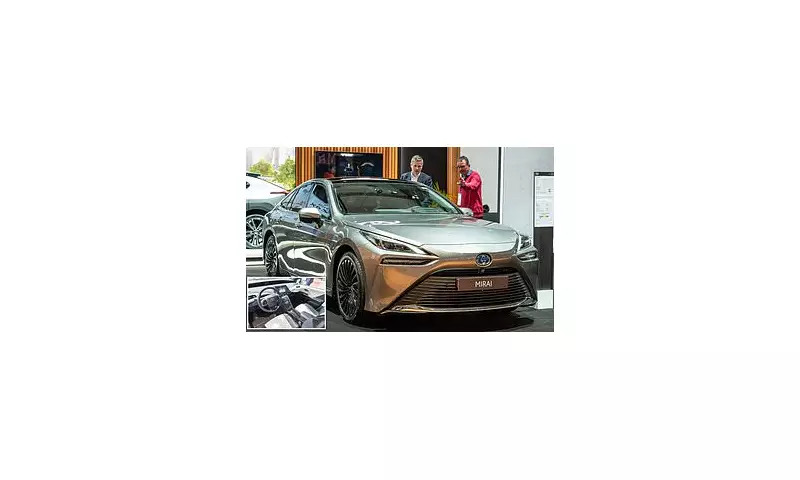
The ambitious vision of hydrogen-powered motoring is facing a severe crisis, as sales of Toyota's flagship Mirai sedan have plummeted following widespread complaints from owners who say the cars are nearly impossible to refuel reliably.
A Promising Revolution Stalls Dramatically
Touted as a revolutionary zero-emission vehicle that emits only water vapour, the Toyota Mirai was positioned as a fast-refuelling, long-range alternative to traditional battery-electric cars. However, the reality for owners has been starkly different. Sales figures reveal a dramatic slump: Toyota sold just 210 Mirai models in 2025, a staggering 57 percent drop from the 499 units sold the previous year in 2024.
The core issue, according to a growing number of disgruntled customers, is a crippling lack of infrastructure. Despite promises of a seamless transition from petrol, drivers report that hydrogen refuelling stations are scarce, frequently out of service, or often have no fuel to sell due to supply-chain problems.

Legal Battle and Financial Fallout for Owners
Frustration has boiled over into legal action. More than 140 plaintiffs have joined a class action lawsuit working its way through the US District Court in the Central District of California. The suit alleges Toyota misrepresented nearly every aspect of the Mirai, including its range, refuelling time, and the practicality of using hydrogen fuel.
The situation has escalated into a financial nightmare for some owners. Attorney Jason Ingber, representing plaintiffs in a related suit, claims that after Toyota allegedly advised some customers to pause loan repayments pending the lawsuit, the company then referred them to debt collectors, contradicting written assurances.
This has had devastating consequences for credit scores. Plaintiff Anthony Escobedo reported his 814 credit score fell by 100 points after Toyota flagged him for non-payment, preventing him from securing an interest-free loan for his wife's medical care. Another owner, Julie Doumit, saw her score drop 70 points under similar circumstances.
The legal process has been protracted. On January 7, a judge granted Toyota its fifth consecutive extension to reply to the suit's factual allegations, with a new deadline set for April 3, 2026.
The Daily Struggle with Hydrogen Reality
The lawsuit paints a picture of an impractical vehicle hobbled by infrastructure failures. The Mirai is sold exclusively in California, where most of America's hydrogen stations are located, primarily around Los Angeles and San Francisco. However, of the state's 57 hydrogen stations, eight were recently listed as 'temporarily non-operational'.
Owners describe being forced to travel long distances to find fuel, often requiring tows when their cars run out with no filling option in reach. The suit claims the scarcity makes the Mirai 'unsafe, unreliable and inoperable'. Even when reaching a pump, drivers report issues with pumps freezing and locking onto the car at the ultra-cold temperatures required for hydrogen storage, sometimes requiring 30-minute waits to detach.
Compounding the problem, the price of hydrogen has soared. According to the lawsuit, the cost per kilogram jumped from around $13 in 2021 to about $32 in 2024, now hovering between $30-$35. This surge drastically undermines the value of the $15,000 fuel allowance Toyota offers buyers, which the suit alleges now lasts closer to two years rather than the implied six.
Further allegations state Toyota knew the cars' tanks could never be completely full, typically holding 4.0kg versus the advertised 5.6kg capacity. This translates to a real-world range of up to 250 miles per tank, far short of the advertised 402 miles for the latest model.
For now, the future of Toyota's hydrogen car project appears clouded, as legal battles intensify and consumer confidence evaporates in the face of a broken refuelling promise.