

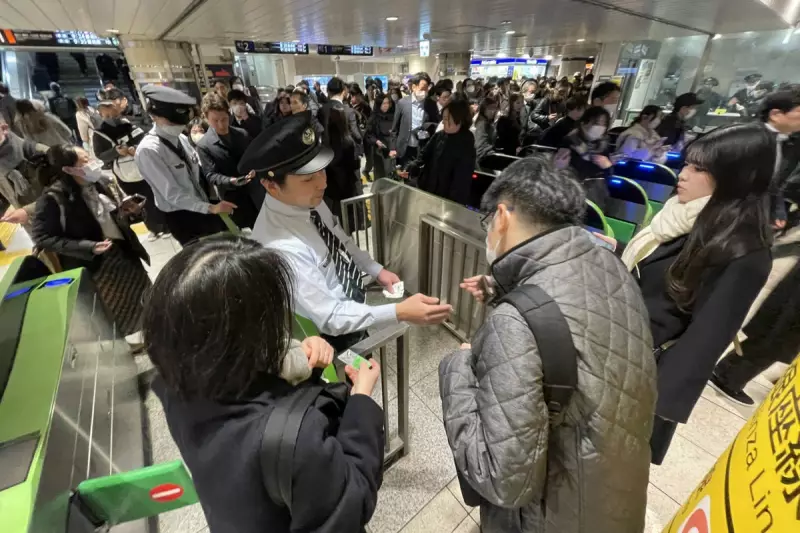
A rare and extensive power failure brought Tokyo's famously efficient metro system to a standstill on Friday morning, creating travel chaos for thousands of commuters during the peak rush hour. Services on several of the world's busiest rail lines were suspended for hours, forcing passengers to seek alternative routes in a city heavily reliant on its rail network.
System-Wide Suspension During Peak Hours
The disruption began in the early hours of Friday 16 January 2026. East Japan Railway, the operator, first detected a power issue at around 3:50 am local time as staff prepared for the day's first services. The situation worsened dramatically shortly before 8 am when a fire broke out on the tracks near Tamachi station.
State broadcaster NHK reported flames emerging from a transformer in the track area. Although firefighters extinguished the blaze within about 30 minutes, the damage to critical equipment forced the continued suspension of services throughout the crucial morning commute.

Key Commuter Lines Brought to a Halt
The outage had a severe knock-on effect across the capital's transport network. It impacted the vital Yamanote Line, which runs in a loop connecting major hubs like Shinjuku, Shibuya, and Tokyo Station. The entire Keihin-Tohoku Line, a crucial route linking central Tokyo with Yokohama and other urban areas, was also suspended. Sections of the Tokaido Line between Tokyo and Shinagawa stations were affected.
With no clear initial timetable for restoration, commuters faced major uncertainty. East Japan Railway later announced that services were expected to resume from 1 pm local time. Footage from NTV showed the scale of the disruption, with passengers disembarking from a stranded Keihin-Tohoku Line train and being guided along the tracks by railway staff and firefighters to safety. Thankfully, no injuries were reported.
Ripple Effects Across a Megacity
The consequences of the shutdown were profound. Stations like Shinjuku, which typically handles a staggering 3.5 million passengers daily, saw intense crowding as the disruption continued into the late morning. Major hubs including Shimbashi and Shinagawa became bottlenecks, with operators restricting platform access to manage surging passenger numbers.
The operator warned that even after services resumed, significant residual delays were likely to persist across the network. Authorities have launched an investigation to determine if the initial power outage and the subsequent fire at Tamachi station are connected.
Such large-scale rail failures are exceptionally rare in Tokyo, a city whose daily life and economy are intricately tied to the precision of its public transport. This incident underscores how quickly even a brief suspension can ripple out, causing widespread disruption for millions.






