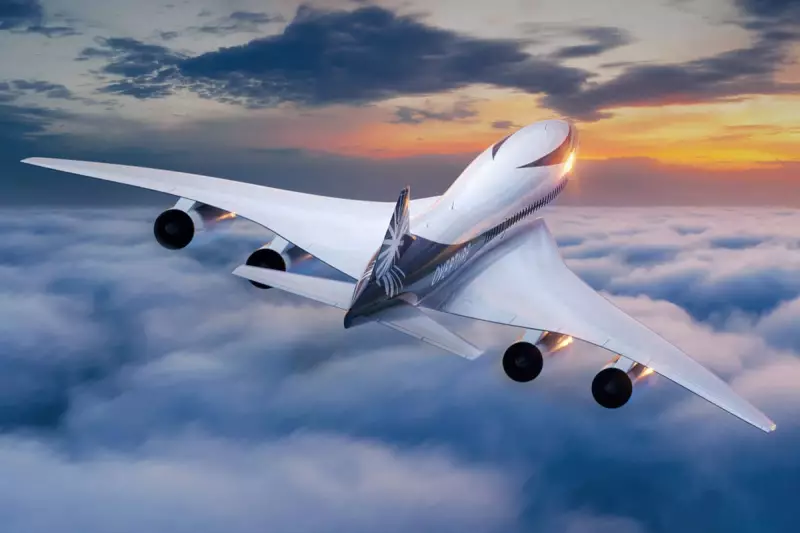
Supersonic passenger flight, absent from our skies for over two decades, could make a dramatic return by the end of this decade, promising to slash transatlantic journey times to a mere three-and-a-half hours. The ambitious vision comes from Boom Supersonic, a Denver-based aerospace company determined to succeed where the iconic Concorde left off, but with a crucial difference: affordability.
Picking Up Where Concorde Left Off
Fifty years after the Anglo-French Concorde first carried paying passengers faster than sound, entrepreneur Blake Scholl is on a mission to resurrect supersonic travel. The founder and CEO of Boom Supersonic told The Independent of his aim to make it "far more mainstream and accessible than Concorde ever was." This marks a potential rebirth for an era thought lost; both British Airways and Air France grounded their Concorde fleets in 2003, ending 27 years of supersonic passenger service.
Reflecting on the stagnation in aerospace speed, Mr Scholl expressed bewilderment. "From the Wright brothers in 1903 to Concorde's first flight in 1969, we were literally accelerating — and then we did something bizarre: we went backwards," he stated. He contrasted the technological optimism of 1969, a year that saw both Concorde's maiden flight and the Moon landing, with today's reality, where neither feat is currently possible for civilians.

The Overture Jet: Faster, Quieter, and More Practical
The company's flagship aircraft, named Overture, is designed to carry up to 80 passengers at Mach 1.7—about 1,300 miles per hour. While this is slightly slower than Concorde's Mach 2, the compromise is deliberate. "We optimised for 1.7 because of noise — specifically, takeoff and landing noise," Scholl explained. The company has committed to ensuring Overture is no louder than current subsonic aircraft during airport operations, a critical factor for community acceptance and practical viability.
A key historical barrier for supersonic travel over land has been the disruptive sonic boom. However, Scholl believes this is a solvable problem. Using real-time weather data and advanced algorithms, the flight path can be adjusted so the shockwave bends upward, making a "giant U-turn" in the atmosphere and sparing those on the ground. On optimal days, this allows for speeds of Mach 1.3 over land; on poorer days, Mach 1.05, which is still approximately 50% faster than conventional aircraft like the Boeing 737.
Affordable Luxury and Market Readiness
The most significant departure from the Concorde model is price. Where a seat on the legendary jet could cost £20,000, Boom Supersonic aims for Overture fares to be comparable to today's business class, around $5,000 (under £4,000) for a transatlantic round trip. Scholl asserts that modern technology and efficient design will allow airlines to be profitable at this price point, opening the experience to a far broader market.
The cabin design also learns from Concorde's criticisms. Overture promises a roomier interior with taller doors, wider seats, and a modern aesthetic, though it will notably lack flat beds—a trade-off Scholl justifies by highlighting the drastically reduced flight time. The aircraft's range is expected to be around 5,000 miles, enabling over 600 potential routes across the Atlantic, Pacific, and between US coasts, with London to New York being the flagship journey.
The project has already garnered significant industry interest, with 130 orders, pre-orders, and options from major carriers including American Airlines, United, and Japan Airlines. The development follows the successful sonic boom test of Boom's XB-1 demonstrator aircraft a year ago.
Not all reactions are positive. Environmental campaigners, such as Anna Hughes of Flight Free UK, argue that supersonic flight is "extremely energy-intensive" and that the fundamental need is to reduce flying overall. Others question the demand in an age of virtual meetings. Despite this, Blake Scholl remains passionately optimistic, framing flight as an inspiring human experience that should be reclaimed from the drudgery it has become for many. "Demand better," he urges, "faster, more comfortable, more human travel."