
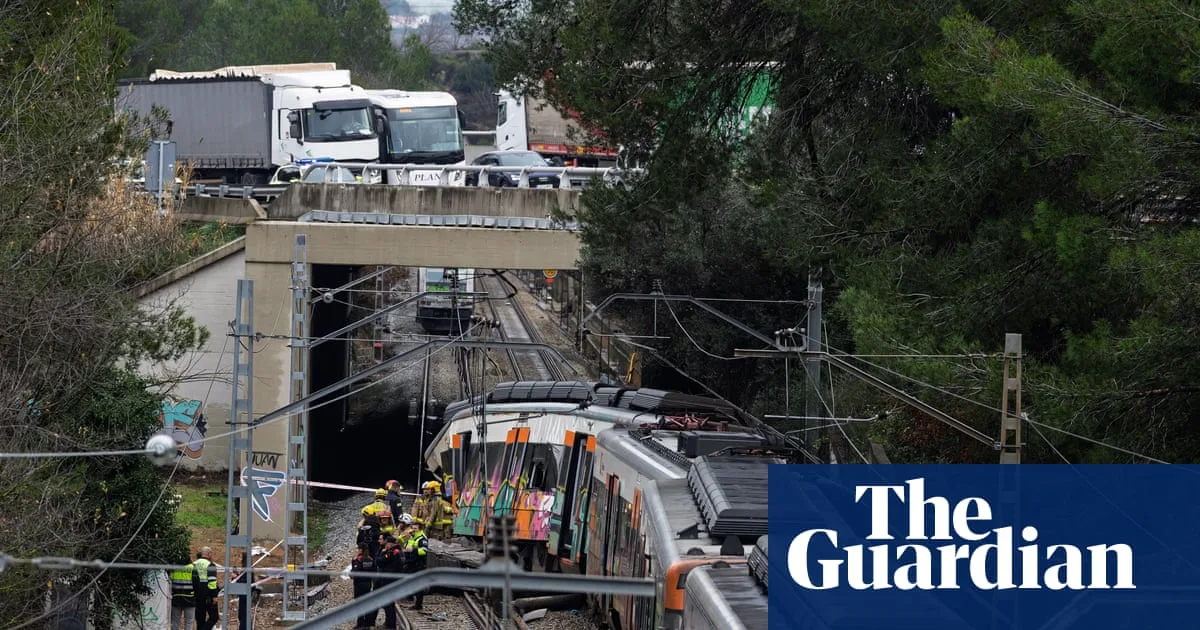
Spain’s rail network is facing renewed scrutiny after a commuter train derailed near Barcelona on Tuesday, killing a trainee driver and injuring 41 people. The incident occurred just days after a high-speed collision in southern Spain left at least 43 dead and 152 injured, raising concerns about safety across the country’s railway infrastructure.
The latest crash happened around 9pm near Gelida in Catalonia when a retaining wall collapsed onto the track, apparently due to heavy rainfall, derailing a local train. The deceased was identified as 27-year-old Fernando Huerta from Seville. Five of the injured remain in a critical condition. As a precaution, the regional network was shut down pending inspections, stranding hundreds of thousands of passengers and causing road chaos.
Earlier on Tuesday, a train on the Maresme coast north of Barcelona struck a rock on the track, injuring several people, though none seriously. The incidents have prompted Spain’s largest train drivers’ union, Semaf, to call for an indefinite strike, demanding criminal liability for those responsible for safety and urgent new measures to address what it described as the “constant deterioration of the rail network”.
The cause of Sunday’s collision at Adamuz, near Córdoba, remains unclear. Transcripts from the high-speed Iryo train’s black box, published by El País, show the driver contacted the control centre a minute after the crash, reporting a “snag” involving a disconnection from the overhead power source. The control centre later noticed the Alvia train had stopped and could not reach its driver. The Iryo driver then reported a derailment and called for emergency services.
Transport Minister Óscar Puente stressed the two accidents were “completely unrelated”, but opposition parties have piled on pressure. Popular Party leader Alberto Núñez Feijóo demanded an “immediate clarification” of the state of the railways, while Vox spokesperson Pepa Millán claimed Spaniards were now “afraid to get on a train”. Despite these incidents, EU statistics indicate Spain’s rail network remains one of Europe’s safest, with only one passenger death in 2024 compared to 20,000 road deaths across Europe.




