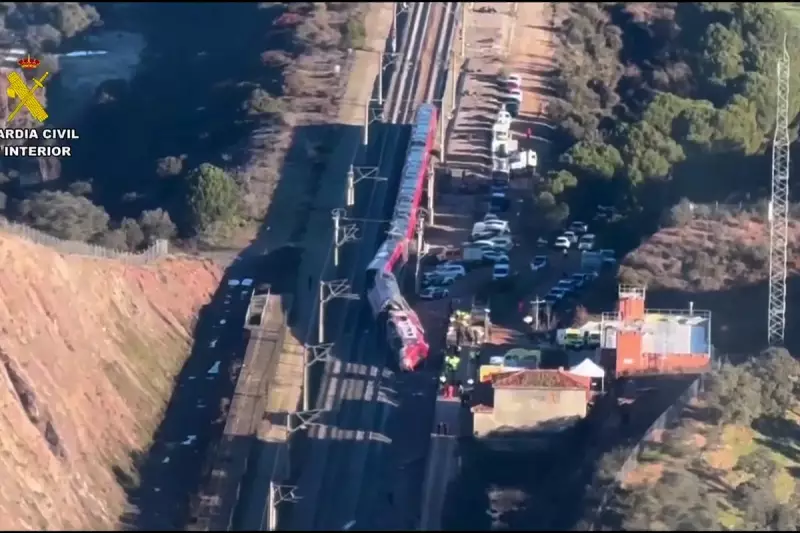
A catastrophic train collision in southern Spain has left at least 39 people dead and more than 150 injured, marking the country's deadliest rail disaster in over a decade. The high-speed train crash occurred on Sunday evening, 18 January 2026, near the town of Adamuz in the province of Córdoba.
The Moment of Impact
The derailment happened at precisely 7:45 p.m. local time. According to the rail infrastructure manager Adif, the tail end of an Iryo train carrying 289 passengers from Málaga to Madrid came off the rails. It then collided with an oncoming Renfe train travelling from Madrid to Huelva.
Spain's Transport Minister, Óscar Puente, stated that the second train bore the brunt of the impact. The force of the crash threw its first two carriages off the track and down a steep 4-metre (13-foot) slope. Puente indicated that the majority of the fatalities are believed to have occurred in these front carriages.

On Monday, the regional president of Andalusia, Juan Manuel Moreno, gave a grim update, revealing that the search for victims was expanding. "The impact was so incredibly violent that we have found bodies hundreds of metres away," Moreno said. Rescue operations are ongoing, and officials have warned that the death toll is likely to rise further.
An Investigation into a 'Strange' Accident
Authorities have launched a full investigation into the cause of the crash, with few immediate explanations available. Minister Puente described the incident as "truly strange", noting several perplexing factors.
The accident took place on a flat stretch of track that had been renovated as recently as May. Furthermore, the Iryo train that initially derailed was less than four years old. Iryo confirmed in a statement that the train was manufactured in 2022 and had passed its latest safety inspection just days before, on 15 January 2026.
Context: Spain's High-Speed Rail Ambitions
This tragedy strikes at the heart of a transport system of which Spain is profoundly proud. The country has invested heavily for decades, building the most extensive high-speed rail network in Europe, with over 3,100 kilometres (1,900 miles) of track designed for speeds exceeding 250 kph (155 mph).
Operated by the public company Renfe and private firms like Iryo, this network is a popular, affordable, and historically safe mode of transport, carrying millions of passengers annually. Sunday's accident is the first fatal crash on Spain's high-speed network since it opened in 1992.
The nation's worst rail disaster this century remains the 2013 crash in Santiago de Compostela, which killed 80 people. An investigation into that incident found the train was travelling at more than double the speed limit on a conventional, non-high-speed line.