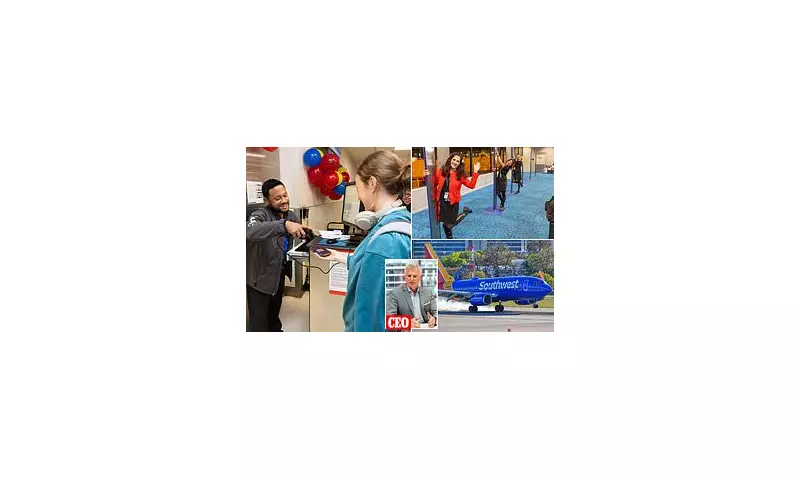
Southwest Airlines has officially retired its beloved 54-year-old open seating policy, marking the end of an era for the budget carrier. The transition was marked with celebratory fanfare including balloons, water-cannon salutes, and oversized novelty boarding passes at gates across multiple time zones. Southwest executives presented the overhaul as a major upgrade driven by customer demand, part of what they term an "elevated travel experience."
A Fundamental Shift in Boarding Philosophy
For over five decades, Southwest operated on a first-come, first-served boarding system that rewarded passengers who checked in promptly when online check-in opened 24 hours before departure. Under the old system, passengers received a boarding group (A, B, or C) and a number, then lined up at numbered poles at the gate before boarding in order and selecting any available seat once on the aircraft.
The new policy represents a fundamental philosophical shift for an airline that long prided itself on letting customers choose their own seats. Passengers must now board in assigned groups and occupy pre-allocated seats, bringing Southwest in line with other major US carriers including Delta, American, and United Airlines.

Customer Reactions: Celebration Versus Consternation
While Southwest management celebrated the change, many regular customers expressed significant dissatisfaction on social media platforms. "Did anybody from Southwest Airlines actually test this new boarding process? My god what a disaster," wrote one frustrated passenger on X.
Another long-time flyer lamented: "Today is the last day of open seating on Southwest Air. Losing that, and 2 free checked bags, makes SW no longer my first choice as there's no clear advantage between their airlines and others."
A third customer offered strategic criticism: "Most loyal customers did not care about assigned seating. We knew how to get great seats! Business 101, don't give up what differentiates you from the competition."
The New Boarding Structure Explained
Under the revised system, passengers are spread across eight boarding groups. Those paying extra for premium or preferred seating options will board first, while travellers on basic fares will find themselves toward the back of the boarding line. This represents a significant departure from the previous approach where checking in exactly 24 hours before departure or paying for early boarding virtually guaranteed a favourable position in Group A (positions 1-60) and access to preferred window or aisle seats.
Financial Pressures Driving Change
The seating policy overhaul represents one of the most substantial changes in Southwest's history and comes amid mounting pressure from investors to improve profitability. The airline, which once boasted a remarkable 47 consecutive years of profit before the pandemic, has struggled to regain sustained financial performance.
This drew attention from activist investors at Elliott Investment Management, who pushed for cost-cutting measures and operational changes they believed would boost profits. The seating policy revision follows several other significant alterations to Southwest's customer offerings, including last year's elimination of the carrier's long-standing "bags fly free" perk.
Additional Changes and Industry Context
Southwest now charges $35 for the first checked bag and $45 for the second, joining an industry trend that saw major US airlines collectively pocket $33.3 billion from baggage fees in 2023 alone—a sharp 15% increase from the previous year's $29 billion.
The airline has implemented additional cost-cutting measures, including reducing nearly a third of its flights to and from Atlanta last September and cutting 15% of its corporate staff in February 2023—the first layoffs since Southwest's founding in Texas in 1971.
As Southwest completes this historic transition, the airline faces the challenge of balancing operational efficiency with customer loyalty, having eliminated two of its most distinctive differentiators in less than two years. The long-term impact of these changes on Southwest's brand identity and market position remains to be seen as the carrier navigates an increasingly competitive aviation landscape.