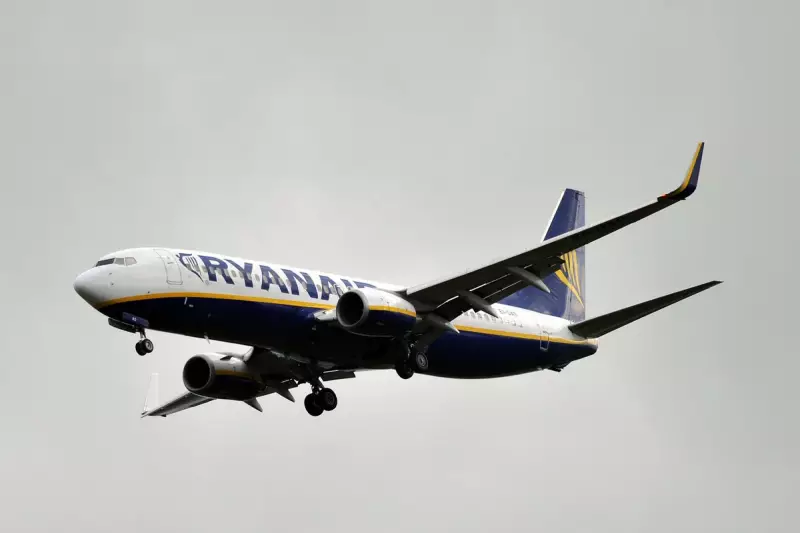
Ryanair has significantly upgraded its full-year outlook for both passenger numbers and air fares, signalling robust demand and operational improvements for the budget carrier. The Irish airline now anticipates stronger financial performance than previously guided, even as it navigates a substantial one-off provision related to a competition fine in Italy.
Enhanced Passenger and Fare Projections
The airline reported carrying 47.5 million passengers in its third quarter, representing a solid 6% increase compared to the same period last year. Buoyed by this performance and the earlier-than-expected delivery of new Boeing aircraft, Ryanair has revised its passenger growth forecast for the 2025-26 financial year upwards.
It now expects to fly approximately 208 million passengers, a 4% rise, which is an increase from its previous guidance of 207 million. This adjustment reflects the company's confidence in sustained travel appetite across its network.

Fare Increases Outpace Expectations
Average fares in the third quarter, which ended in December, rose by 4% to reach 44 euros (approximately £38.18). More notably, the carrier has elevated its full-year fare increase expectation. It now projects fares to rise by up to around 9%, surpassing the 7% growth previously forecast.
Chief Executive Michael O'Leary commented on the positive trend, stating, "While the fourth quarter doesn’t benefit from Easter, fares are trending ahead of prior year and we now believe full-year fares will exceed the 7% growth previously guided by 1% or 2%."
Profit Guidance Amidst Quarterly Challenges
Despite the optimistic annual outlook, Ryanair's third-quarter figures revealed a sharp decline in reported profits. Pre-tax profits plummeted by 83% to 24.4 million euros (£21.2 million). This was primarily due to a 256 million euro (£222 million) provision set aside following a fine imposed by Italy's competition authority in December.
The regulator alleged that Ryanair employed an "abusive strategy" to obstruct third-party travel agencies from purchasing flights on its website between April 2023 and at least April 2025. The airline has strongly contested the fine, labelling it "baseless" and expressing confidence it will be overturned on appeal.
Underlying Performance and Full-Year Forecast
Excluding the one-off Italian fine provision, underlying net profits for the quarter fell by a more moderate 22% to 115.4 million euros (£100.1 million). Looking ahead, Ryanair is providing what it terms "cautious guidance" for its full-year underlying profit after tax, projecting a range of 2.13 billion to 2.23 billion euros (£1.84 billion to £1.93 billion).
This represents a significant increase from the 1.61 billion euros (£1.42 billion) reported in the previous financial year. However, Mr O'Leary cautioned that this outcome "remains exposed to adverse external developments," including potential escalations of conflict in Ukraine and the Middle East, macroeconomic shocks, and further disruptions from European air traffic control strikes.
Long-Term Growth Strategy and Recent Controversy
The airline remains focused on its long-term expansion plans. O'Leary highlighted that "industry capacity constraints, combined with our widening cost advantage, strong balance sheet, low-cost aircraft orderbook and industry-leading operations resilience" are expected to support controlled growth towards a goal of 300 million passengers annually by the 2033-34 financial year.
The financial update follows a very public disagreement last week between Michael O'Leary and tech billionaire Elon Musk. The spat centred on the feasibility of using Musk's Starlink satellite internet system to provide wifi on Ryanair flights. After O'Leary dismissed the idea, Musk responded on social media platform X with personal insults and mused about potentially buying the airline.
In a lighter note, O'Leary claimed that this "PR spat" had actually driven a 2% to 3% increase in sales for the carrier, suggesting that even controversy can have a silver lining in the competitive aviation market.