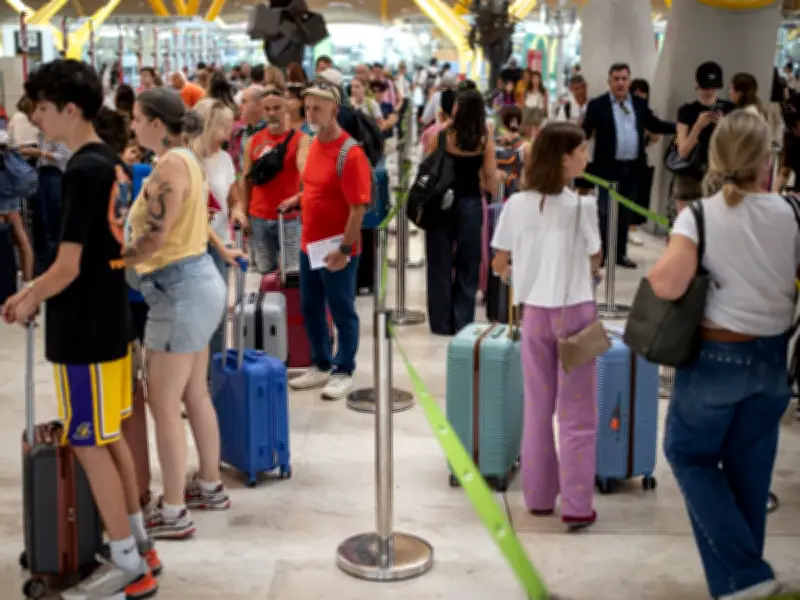
Spanish media are reporting that six-hour queues could hit airports this summer, with the International Air Transport Association (IATA) projecting major strain on the European Union’s new digital border system, the Entry/Exit System (EES). The Majorca Daily Bulletin highlighted concerns as the system, fully operational across the Schengen Area since April 10, is already producing long lines, missed flights, and growing alarm across the travel industry.
Recorded Delays and Projections
Airports Council International Europe reported that waits of up to three and a half hours have already been recorded during peak periods. IATA’s projection for the busiest summer months reaches six hours. Budget airlines from the UK, including Ryanair, easyJet, and Jet2, have all warned of missed departures, disrupted schedules, and rising operational costs.
Ryanair's Policy Change
Ryanair announced that passengers using its airport check-in or bag-drop services will need to complete the process 20 minutes earlier. The airline will close these services one hour before the scheduled departure, compared with 40 minutes currently, to give passengers more time to get through security and passport checks. This change, effective from November 10, aims to reduce the “very small number of passengers” who miss their flight while stuck in queues. Passengers can still check in online until two hours before departure. Ryanair’s website warns that those who fail to check in on time “may be denied boarding without refund.”
Jet2 and Wizz Air Advice
Jet2 check-in desks open exactly three hours before scheduled departure and will not open earlier, even with the new EES checks. The airline advises passengers not to arrive earlier to prevent congestion. Jet2 stated: “There may be longer wait times than usual when you arrive in destination and before your flight back to the UK. We’re really sorry for any inconvenience this may cause but unfortunately this is outside of our control.”
Wizz Air’s UK managing director Yvonne Moynihan advised British holidaymakers to arrive at European airports three hours before their flight home departs due to lengthy queues. She said: “When you land in the destination airport, there might be queues, so you should bring a portable charger or water.” She highlighted the risk of queues before flights back to the UK because EES information must be verified when leaving. “Because there is another passport check...that’s where we see that people have, again, experienced longer waiting times than anticipated,” she said. She noted that usual advice is two hours ahead, “but in these circumstances, we are advising three hours.”
easyJet and Industry Impact
easyJet said: “Airports across Europe may experience longer waiting times at passport control due to the new European Entry/Exit System (EES). This could mean you need to have your biometrics taken at border checks, including the scanning of facial images and fingerprints.”
Research from the World Travel & Tourism Council (WTTC) warned that up to 41 million visitor arrivals and $45.4 billion in spending could be lost if delays of three hours or more become routine. A May 2026 survey of 2,512 travelers in the UK, US, Canada, and Australia found that about one-third said regular three-to-four-hour waits would make them much less likely to visit the Schengen Area, or stop them altogether. British travellers are the most sensitive, with 39% saying they would be much less likely to travel, compared to 33% for Americans and Canadians and 27% for Australians.
Lack of Awareness
Awareness of the new system is low. More than half of those surveyed (55%) had heard little or nothing about EES, and 49% do not know what the border will require of them. In one incident, more than 100 passengers reportedly missed a flight from Milan to Manchester after getting stuck in passport queues.