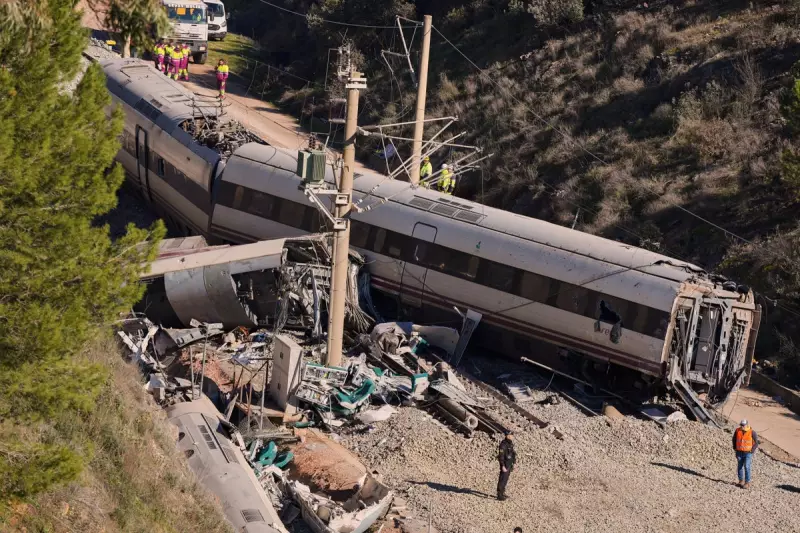
Rail Fracture Identified as Probable Cause in Spain's Deadly Train Disaster
Investigators have revealed that a rail fracture likely occurred before a devastating high-speed train derailment in southern Spain last Sunday, which claimed the lives of forty-five people. The preliminary report from Spain's rail accident investigating body, CIAF, was published on Friday, shedding initial light on one of Europe's most tragic rail incidents in recent years.
Preliminary Findings Point to Track Failure
The collision in Adamuz, within the Cordoba province, involved a train operated by the private consortium Iryo derailing and subsequently colliding with an oncoming high-speed service run by the state-owned operator Renfe. According to the CIAF report, "Based on the information available at this time, it can be hypothesised that the rail fracture occurred prior to the passage of the Iryo train involved in the accident and, therefore, prior to the derailment."
Investigators have emphasised that the precise causes for the rail breakage remain undetermined at this stage, with no potential factors being ruled out. This finding aligns with earlier reports from Reuters, which indicated a broken joint on the track. Neither Spain's Transport Ministry nor Iryo's majority owner, the Italian state-controlled Ferrovie dello Stato, provided immediate comments on these developments.

Evidence from Wheel Damage and Ongoing Analysis
The report detailed that investigators discovered uniform notches on several of the wheel treads on the right-hand side of the Iryo train. These marks were consistent with the wheels striking the top of a rail, and a visual comparison suggested that the wheel notches match the damage observed on the broken rail section at the derailment site.
Furthermore, CIAF noted that similar wheel damage was found on other trains that had passed through the area before the catastrophic crash occurred. However, the agency cautioned that these preliminary findings must be confirmed through further detailed calculations and comprehensive analysis before definitive conclusions can be drawn.
Search for Crucial Undercarriage Component
The report follows the discovery of a large piece of metal near the crash site, which investigators theorised might be the crucial missing undercarriage component they have been searching for to determine the accident's cause. Inaki Barron, the head of CIAF, highlighted on Monday that the investigation would focus on a missing part known as a bogie, describing it as the key point of contact between the speeding train and the tracks.
Reuters photographs from Tuesday showed the piece lying partly submerged in a small stream approximately fifteen metres below the train tracks and some three hundred metres from the crash site. A spokesperson for the Civil Guard police force confirmed that the component had been spotted by search teams using drones earlier in the week and had since been physically examined by investigators.
"We will look at it to determine what it is," the spokesperson stated, adding that due to its considerable size and weight, the piece had been left in place and had not yet been collected for further analysis.
Ongoing Investigation and Rescue Efforts
The crash occurred on Sunday night near the southern town of Adamuz, in a remote hilly area, marking one of Europe's most significant rail disasters. Rescue efforts and the investigation have continued for several days, with authorities cordoning off the area, meticulously marking and photographing every piece of evidence along the track.
As the investigation progresses, the focus remains on understanding the full sequence of events that led to this tragedy, with the rail fracture hypothesis providing a critical starting point for further inquiry into the safety and maintenance of Spain's high-speed rail infrastructure.