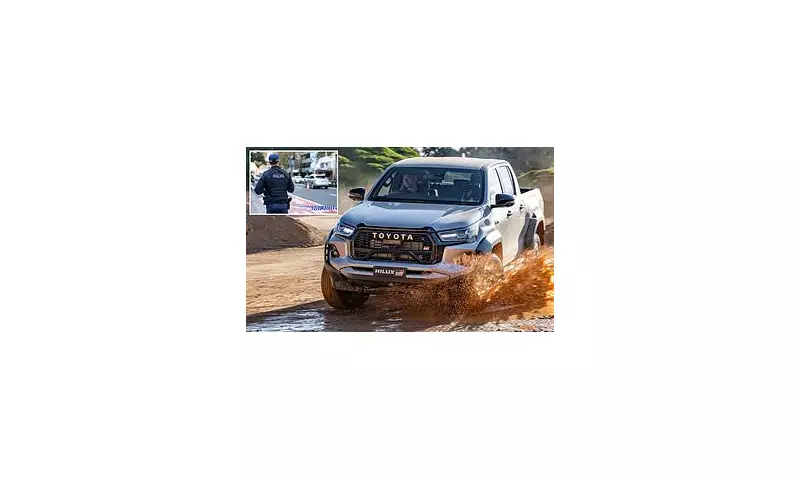
Growing concerns over vehicle 'mobesity' – the trend towards ever-larger cars – have triggered urgent calls for a new, specialised driving licence for operators of oversized vehicles in Australia. This push follows an analysis of two decades of British crash statistics, which starkly illustrates the heightened danger larger vehicles pose to pedestrians.
The Data: A Deadlier Impact
British crash data spanning 2004 to 2023 provides compelling evidence of the risks. The research found that while being struck by a Sport Utility Vehicle (SUV) slightly increased fatality risk for adults, the danger to children was significantly greater. This alarming finding comes as Australia grapples with its own road safety crisis, with 2025 marking the fifth consecutive year of rising road deaths nationwide.
Associate Professor Milad Haghani from the University of Melbourne highlighted the obvious yet critical point in The Conversation: 'We already know bigger cars cause greater impacts in collisions.' He noted the dramatic size inflation, pointing out that 'most SUVs and utes from a decade or two ago look small next to today's models.'

Proposed Policy Shifts: Licences and Penalties
Professor Haghani has proposed concrete changes to Australia's licensing framework. He criticised the current system where 'many drivers obtain their licence in a small sedan but can legally drive a two-tonne ute the next day.' His solution is twofold.
First, he advocates for a practical driving test taken in a vehicle comparable in size to what the driver intends to use regularly. Alternatively, he suggests a streamlined licence upgrade process for experienced drivers moving to a larger vehicle. 'This would acknowledge that added responsibility,' he stated.
Secondly, Professor Haghani called for Australia to adopt a tiered penalty system, where fines or demerit points are scaled according to vehicle size. 'A ute or SUV travelling 10km/hour over the limit carries greater kinetic energy and longer stopping distance than a small sedan,' he explained, arguing that such 'targeted, evidence-based adjustments' are essential if Australia is serious about reducing road trauma.
Market Trends and Tax Loopholes
The push for reform is set against a backdrop of soaring sales of large vehicles. According to RACV figures from July last year, SUVs now constitute 60 per cent of all new vehicle sales in Australia. Medium SUVs were the largest segment, with 149,167 sold in the first half of 2025 alone.
This trend is partly fuelled by tax policy, according to Teal MP Monique Ryan. On Tuesday, she announced plans to close a tax loophole she blames for the proliferation of oversized vehicles. 'There are twice as many utes as tradies in Australia,' Ryan claimed.
She targets the luxury car tax exemption, under which a 33 per cent levy applies to the portion of a car's price above roughly $77,000 (or $89,000 for fuel-efficient models). However, many large dual-cab utes escape this tax entirely, even when priced over $100,000, as they are classified as commercial vehicles.
Critics argue this rule, designed to assist genuine work use, now incentivises people to buy oversized, high-emission utes for personal use, while smaller, safer electric cars and hybrids remain subject to the tax. 'We need to remove the luxury car tax exemption,' Ryan said, 'which incentivises people to buy mega-utes instead of safer, cleaner, smaller cars and SUVs.'
The Department of Infrastructure, Transport, Regional Development, Communications, Sport and the Arts has been contacted for comment on the growing debate around vehicle size and safety regulation.