

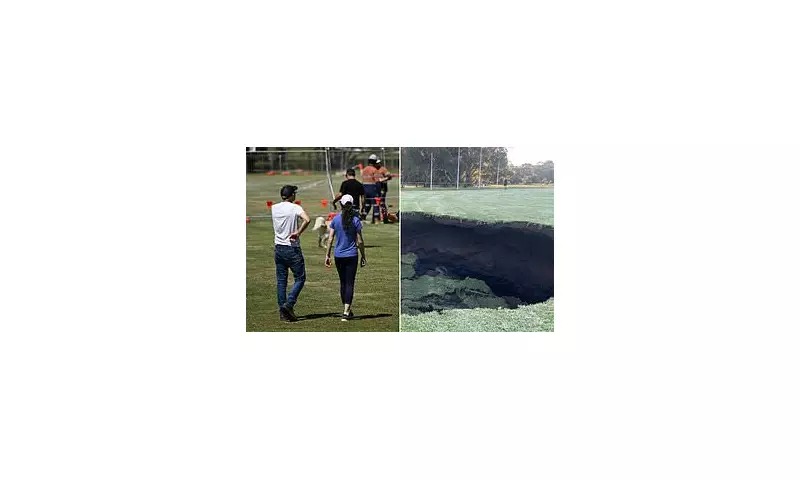
A significant sinkhole that suddenly appeared in a suburban Melbourne park has been directly linked to the massive state government tunnel project taking place beneath the surface. The incident has prompted a major safety review but work has now restarted.
Cause and Response to the Heidelberg Sinkhole
The hole, measuring several metres across, emerged on January 6 in the middle of AJ Burkitt Oval in Heidelberg, in Melbourne's northeast. Its location was alarmingly close to where tunnel-boring machines are excavating for the $26 billion North East Link project.
VIDA Roads, the Victorian government body managing the tunnel construction, has taken responsibility. An investigation found the ground collapse was triggered by two factors: the over-extraction of soil and a pressure test conducted near one of the giant boring machines.

Paul Roth, the interim CEO of VIDA Roads, stated the pressure test "should not have taken place" and labelled the event a "very serious incident." He expressed the organisation's disappointment and shared the community's frustration over the disruption.
Safety Assurances and Enhanced Protocols
Despite the alarming sight, authorities confirmed no injuries were reported and there was no immediate threat to nearby homes or the community. WorkSafe Victoria completed its investigation into the surface hole at AJ Burkitt Reserve.
Following the incident, the project partner, Spark, has implemented a series of strengthened controls. These include:
- Enhanced monitoring and system alerts.
- Doubling the frequency of safety review meetings.
- Improved operator training for tunnel-boring machine staff.
- Appointing an independent expert to oversee measures for the project's duration.
Independent experts have verified the site and approved the resumption of tunnelling, which restarted on the Friday after the incident. Repairs to the sinkhole itself are being undertaken concurrently.
Understanding Sinkhole Risks in Urban Projects
According to Guillermo Narsilio, a University of Melbourne infrastructure engineering expert, tunnelling can accelerate the formation of such holes. He notes that while sinkholes occur naturally, they are more noticeable in urban environments.
"As population grows and infrastructure ages, like leaking water pipes, together with changes in weather patterns and heavier rainfall, we are going to learn of more sinkhole appearances globally," Professor Narsilio explained earlier this month.
He clarified that most sinkholes form due to dissolving soluble rock like limestone, which is not widespread near the surface in much of Australia. However, wetter conditions can speed up the processes of erosion that lead to such ground collapses.






