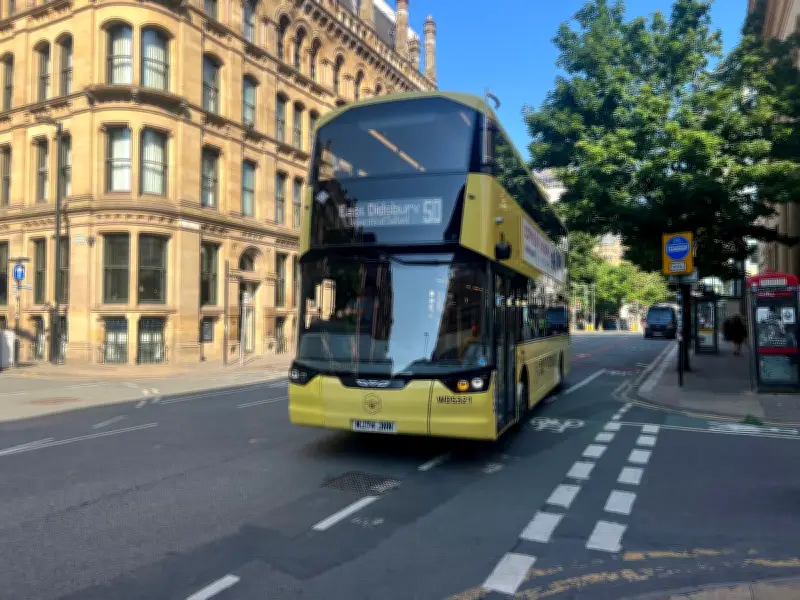
It's rush hour on one of Manchester's busiest roads, and a Bee Network bus hasn't turned up. The yellow-painted vehicle was due at a stop on Kingsway (A34) at 8:08 am for a journey towards the city centre, but was nowhere to be seen. Stood at the bus stop, a stream of cars whizzed past, destined to arrive well ahead of public transport users.
Kingsway: The Frontline of Manchester's Transport Battle
Kingsway cuts through the busy commuter suburbs of Burnage and Didsbury, areas popular with many young professionals working in central Manchester, as well as university students. In many ways, this part of Manchester is the frontline of a battle taking place every morning in the city over transport choices. For some commuters, the option of driving versus taking a bus or train can have a drastic impact on their day, and some feel public transport in the city has a way to go before it becomes the preferred mode of travel.
“I used to get this bus every day, but around half the time now I drive,” said Mollie, 29, who works at a hospital and takes a bus on Kingsway every day. The road is served by the number 50 and 51 buses, which go from East Didsbury to Manchester city centre and then to Salford Quays.
45 Minutes from Burnage to City Centre
The Local Democracy Reporting Service (LDRS) decided to test how long the bus takes to travel the 4.5-mile journey from Burnage to St Peter's Square. Sitting on the number 51 bus on a Thursday morning, Mollie added: “It’s fine in the mornings, but getting home after work can be really difficult. It once took 45 minutes for a bus to arrive. In winter it’s not nice waiting for the bus for long, so I tend to drive more in the winter and less in summer.”
Driving the same journey from Burnage to St Peter's Square would take around 20 minutes, according to Google Maps. Including waiting for the missing 8:08 am bus, the LDRS found it took around 45 minutes to get from Kingsway to central Manchester using the Bee Network. Some passengers said the buses are faster during summer when fewer university students are around, and that it can take longer during the academic year. Most of the journey involved the bus fighting through traffic, constantly leaving the road to find bus stops before waiting to re-join the carriageway.
Passengers Call for More Bus Lanes
Other passengers on the journey also shared concerns about the reliability of Bee Network services along Kingsway. Gary Prendergast, 58, was on the bus heading to work. He said: “It’s pretty good, but it depends on what time you get it. At seven o’clock in the morning it goes straight through, but at this time (8:15 am) it doesn’t. It’s when university students are in and getting it at this time in the morning it goes slower. I think it’s all the traffic that slows the bus down in the morning, especially at rush hour. I’d support more bus lanes, that would really help.”
Another passenger, a 31-year-old called Adam, explained that the real problem with the service is getting out of the city centre at 5 pm. He said: “The timetable is irrelevant, you just turn up and wait for whichever bus comes. I’ve waited 45 minutes for a bus sometimes getting home, so I stay later at work. There’s no point trying to get home before 6 o’clock. There are more buses in places like London, and more bus lanes too, which helps them there. I think because of the bus lanes it helps them get back the traffic in London, but we don’t have as many here.”
Number 50 Bus: One of the 'Worst' Bee Network Services?
This particular route has had a rough time recently, having been the focus of social media posts describing the number 50 bus as one of the 'worst' Bee Network services in Greater Manchester. To be fair, although the 8:08 am bus did not arrive on Thursday morning, the 8:13 am was bang on time and kept to schedule on the way to St Peter's Square. But comments from passengers were clear that they’d like to see it become more reliable and get to the city centre faster.
Since Greater Manchester brought buses back under local control, the story has been a major success. Passenger satisfaction has improved, and single journey fares were capped at £2, saving money for people who depend on public transport. It was one of the major pledges delivered by the region’s former mayor Andy Burnham, who is set to become the country’s next Prime Minister.
TfGM: Number 50 Punctuality at 87%
Transport for Greater Manchester (TfGM) explained that the number 50 bus service is one of the most reliable on the network. In the past four weeks, punctuality on the 50 has averaged around 87 per cent, above TfGM’s 80 per cent target, and well ahead of the 67 per cent average seen on the 50 in the year before bus franchising was rolled out. Transport bosses in the region are working with Manchester council and Salford council to improve performance in the city centre through a plan known as the city centre transport strategy.
Alison Chew, TfGM’s interim network director of bus, added: "The number 50 is a very popular service with growing numbers of people using it. Like many other routes, punctuality on the number 50 is much improved since coming under local control and joining the Bee Network. We are making further improvements, with plans to deliver quicker, more reliable bus journeys, including on the 50 service."