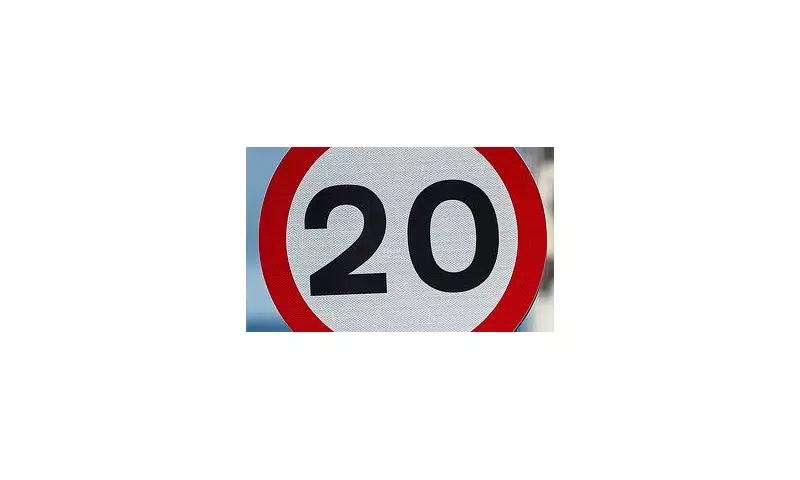
A London driver has spoken out after being caught driving at just 24 miles per hour on Park Lane, a major three-lane thoroughfare in the capital's centre, labelling the city's speed enforcement as "stalking" motorists for revenue.
The Rising Tide of Speeding Penalties
The driver, now on nine penalty points entirely for breaching 20mph limits, described the experience as being forced to drive "like a man carrying a tray of boiling soup." One more infraction would mean a six-month driving ban. This personal story highlights a national trend: the number of speeding endorsements issued in Britain skyrocketed from 2.8 million in 2021 to 9.6 million by 2024. With each typically carrying a £100 fine, this represents a colossal financial windfall for authorities.
The core of the controversy lies in the blanket application of 20mph zones. While widely accepted around schools, parks, and hospitals, these limits are now appearing on major arterial roads designed for faster traffic. The driver argues this creates an unnatural, inefficient driving experience. "Driving at 20mph is not instinctive on a major highway," he states, noting the constant, anxious monitoring of the speedometer to avoid creeping above 23mph.

Safety Claims Versus Practical Reality
Proponents insist the policy is solely about road safety. However, critics point to several counterarguments. On vast, multi-lane roads with few or no pedestrians, the safety benefit is questioned. Furthermore, the driver contends that the real dangers—drunk, angry, or distracted drivers and street racers—are not addressed by blanket low-speed zones.
There is also an environmental and mechanical argument. With 96% of vehicles on UK roads still petrol or diesel, many run less efficiently at 20mph, sitting in a lower gear at higher revs. This can lead to increased fuel consumption and higher emissions compared to a steady 30mph.
A European Comparison and Cyclist Concerns
The defence often points to European cities like Paris and Barcelona, which have 30km/h (approx. 19mph) zones. However, these are predominantly on residential, single-lane streets, not applied to six-lane main roads without accompanying redesigns.
Even the benefit for cyclists is disputed. The driver, who also cycles, argues that 20mph is detrimental. At 30mph, a car can overtake a cyclist quickly and cleanly. At 20mph, cyclists often become trapped between parked cars and a frustrated motorist unable to pass safely, creating a more dangerous, boxed-in situation.
The outcome, according to the motorist, is a perverse shift in driver attention. "London has turned its motorists into anxious speed accountants instead of present, attentive road users," he concludes. The overwhelming sensation for many is that the system is less about safety and more about slowing drivers down just enough to ensure they pay up.