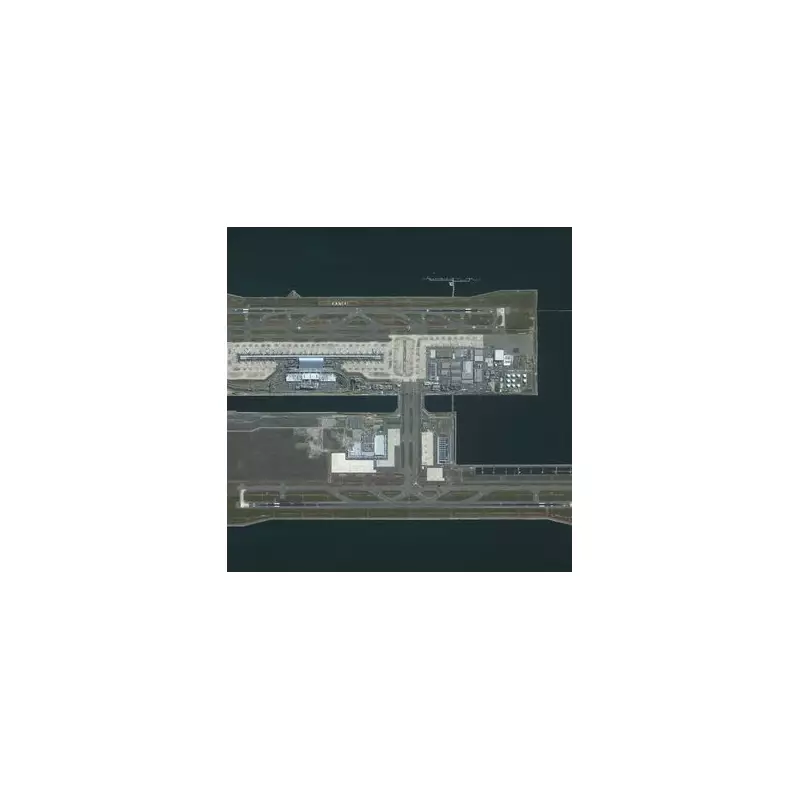
The future of one of Japan's most ambitious engineering projects hangs in the balance as Kansai International Airport continues its alarming descent into the waters of Osaka Bay. Constructed at a staggering cost of £15 billion, this record-breaking transport hub now faces the very real prospect of being submerged within the coming decades.
A Foundation Built on Clay
Kansai International Airport was engineered as a marvel of modern construction, built upon not one but two artificial islands. The seabed beneath these islands consists primarily of alluvial clay, a soft and malleable material that engineers fully expected to compress and settle over time. When the airport first opened its doors to passengers in 1994, expert projections estimated a subsidence of approximately 13 feet over a 50-year period.
However, reality has diverged dramatically from these initial calculations. Instead of the predicted 13 feet, the airport has already sunk a breathtaking 42 feet. This rapid descent has occurred even as the facility handles a rebounding volume of air traffic, with the hub recording 169,774 take-offs and landings alongside 25.9 million travellers in 2024 alone.

Engineering Surprises and Countermeasures
Discussing the unexpected scale of the problem with Smithsonian Magazine, Yukako Handa, Kansai Airports' former communications director, revealed that engineers were taken aback by the stark contrast between projected and actual subsidence levels. "When the Kansai Airport was constructed," Handa explained, "the amount of soil to reclaim the land was determined based on necessary ground level and subsidence estimation over 50 years after the construction."
In response to the accelerating sinkage, engineers implemented sand drains in an attempt to stabilise the structure. When this proved insufficient, an additional £112 million was invested to reinforce the critical seawall surrounding the airport. While this intervention did help to reduce the rate of subsidence, it has not halted the process entirely.
The Looming Timeline and Environmental Threats
Current forecasts paint a concerning picture for the airport's longevity. If the sinking continues at its present pace, analysts predict the facility could drop below sea level as soon as 2056. This precarious position, so close to sea level, leaves the airport acutely vulnerable to environmental threats.
The region's volatile weather and seismic activity have already demonstrated their destructive potential. In 2018, Typhoon Jebi inundated the runway, forcing a complete closure of the airport for a fortnight. On other separate occasions, two runways were flooded, and a dramatic incident saw a 2,500-tonne ship crash into the bridge connecting the airport to the Japanese mainland.
A Legacy of Operational Excellence
Despite its foundational challenges and potentially limited future, Kansai International Airport has simultaneously earned global acclaim for its operational excellence. In a remarkable achievement, the airport maintained a perfect luggage handling record for three full decades, not misplacing a single piece of passenger baggage since its opening.
This unparalleled feat earned the transport hub the prestigious title of 'World's Best Airport for Baggage Delivery' at the Skytrax World Airport Awards in 2024. It stands as a testament to the airport's day-to-day efficiency, even as its physical structure contends with the relentless forces of nature.
The story of Kansai International Airport thus presents a complex narrative of human ambition, engineering miscalculation, and environmental reality. It serves as a potent case study in the long-term challenges of building major infrastructure in demanding geographical locations, where initial cost and brilliance must be balanced against enduring sustainability.