The formidable reality confronting any American, NATO, or European plans for Greenland is its vast, frozen landscape. The relentless ice obstructs harbours, encases valuable minerals, and transforms coastlines into treacherous fields of white and blue shards, posing a year-round threat to shipping and access.
The Essential Arctic Tool: Icebreakers
Navigating this challenging polar environment necessitates a specific and powerful solution: icebreakers. These colossal vessels, equipped with powerful engines, reinforced hulls, and heavy bows, are engineered to crush and cleave through thick ice sheets. They are the indispensable keys to unlocking the Arctic.
However, the United States currently possesses only three such ships, with one reportedly in such disrepair as to be almost unusable. While agreements exist to acquire an additional eleven vessels, procurement faces significant geopolitical hurdles. Potential sources include either strategic adversaries or recently alienated allies, complicating the supply chain.

Trump's Greenland Vision Meets Icy Reality
Despite toning down his rhetoric, U.S. President Donald Trump appears steadfast in his ambition for the U.S. to control Greenland for security and economic reasons. His goals include keeping what he calls “the big, beautiful piece of ice” out of the hands of Moscow and Beijing, securing a strategic Arctic location for U.S. military assets, and extracting the island’s considerable mineral wealth, including rare earth elements.
Speaking at the World Economic Forum in Davos, Switzerland, Trump highlighted the challenge, stating, “to get to this rare earth you got to go through hundreds of feet of ice.” Yet experts point out there is no meaningful way to achieve this—or conduct any significant activity in the semiautonomous Danish territory—without icebreakers' crucial ability to cut trails through frozen seas.
“On a map, Greenland looks surrounded by sea, but the reality is that the sea is full of ice,” said Alberto Rizzi, a fellow at the European Council on Foreign Relations. He warned that even with a decision to surge resources, the U.S. would face “a two or three year gap in which they’re not really able to access the island most of the time.”
The Global Icebreaker Landscape
If the U.S. seeks more icebreakers, its options are limited to four nations: the shipyards of strategic adversaries China and Russia, or longtime allies Canada and Finland. The latter two have recently weathered blistering criticism and threats of tariffs from President Trump over Greenland, adding diplomatic tension to technical necessity.
These vessels are expensive to design, build, operate, and maintain, requiring a skilled workforce found only in certain specialised regions. Finland, with expertise forged in the frigid Baltic Sea, has built roughly 60% of the world’s fleet of more than 240 icebreakers and designed half the remainder.
“It’s very niche capabilities that they developed as a necessity first and then they have been able to turn it into geoeconomic leverage,” Rizzi explained.
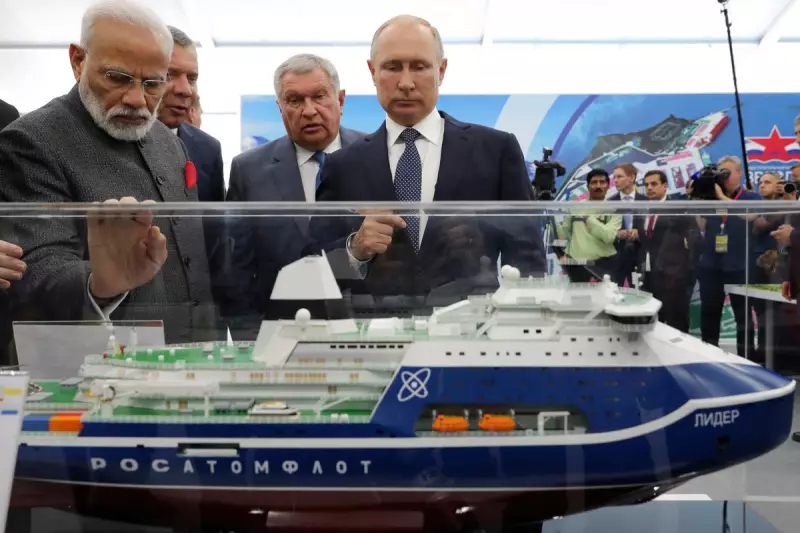
The global fleet is dominated by Russia, which possesses the world’s largest collection with about 100 vessels, including colossal nuclear-powered ships. Canada follows, with plans to double its fleet to around 50 icebreakers. China, with five vessels compared to America's three, is rapidly building more as it expands its Arctic ambitions.
“China is now in a position to develop indigenous icebreakers, and so the U.S. feels it must do the same,” said Marc Lanteigne, a professor at the University of Tromsø in Norway.
Playing Catch-Up in the Polar Race
Analysts stress that Washington must accelerate its efforts to close this capability gap. “President Trump has really bemoaned this lack of icebreakers, especially in comparison to Russia,” said Sophie Arts, a fellow at the German Marshall Fund. She noted the current U.S. fleet is “basically past their life cycle already.”
This has forced a reliance on allied expertise. “Both Canada and Finland are really, really vital to this,” Arts emphasised. “Cooperation is what makes this possible ... the U.S. doesn’t really have a pathway to do this on its own at this time.”

The previous Biden administration followed Trump's prioritisation by signing the Ice PACT with Helsinki and Ottawa. This agreement aims to deliver 11 new icebreakers constructed by corporate consortiums using Finnish designs. Four would be built in Finland, while seven would be constructed in North American shipyards, including a billion-dollar “American Icebreaker Factory” in Texas.
Broader Strategic and Economic Hurdles
Beyond the icebreaker shortage, any venture in Greenland faces monumental challenges. Mining critical minerals would incur high costs in the harsh polar conditions, with investments potentially taking decades to yield returns. Even with adequate icebreaking capability, the price to build and maintain mining or defensive facilities—like the proposed $175 billion Golden Dome missile defence network—would be enormous.
European leaders have underscored their pivotal role. European Commission President Ursula von der Leyen reminded audiences at Davos that “Finland — one of the newest NATO members — is selling its first icebreakers to the U.S.” She stated this demonstrates that “Arctic security can only be achieved together.”
Danish Prime Minister Mette Frederiksen has expressed openness to strengthening Arctic security, including the U.S. Golden Dome programme, “provided that this is done with respect for our territorial integrity.”
Yet the leverage held by allies is clear. As Rizzi pointedly observed, “if Europe wants to exercise significant leverage to the USA, they could say ‘We’re not going to give you any icebreakers and good luck reaching the Arctic, or projecting power there, with those two old ships that you have.’” This stark reality highlights the delicate balance of power and partnership defining the new Arctic frontier.