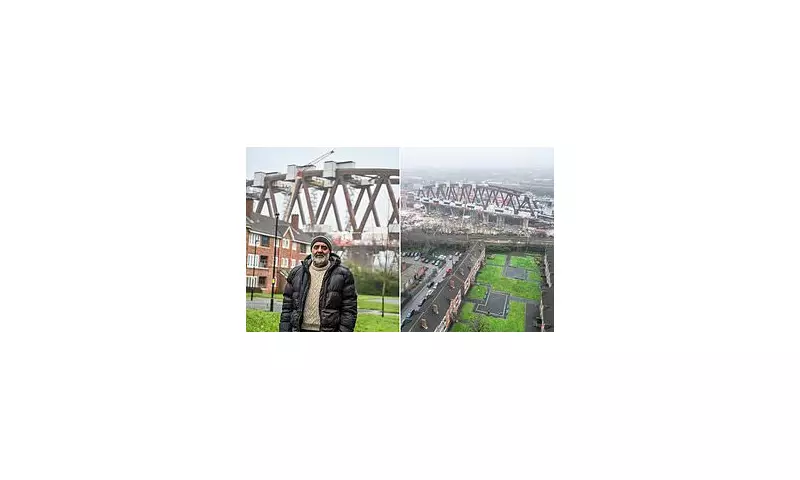
Residents living near a colossal new HS2 viaduct in Birmingham have described their lives as a 'daily hell', forced to live in the shadow of the 150-metre structure they have dubbed a 'metal Godzilla'. The Bellingham Bridge, named after Real Madrid and England footballer Jude Bellingham, is set to become one of the tallest bridges on the HS2 network once completed near the city centre.
A Skyline Dominated by Construction
The huge viaduct is already transforming the skyline in the footballer's home city, with locals complaining it is 'like having the Forth Bridge plonked in your garden'. Those living in nearby flats say the looming structure has ruined their lives, making them feel as if they are 'living on a permanent building site'. They claim the 'eyesore' blocks sunlight from reaching their homes and fear that once the controversial high-speed rail line is operational, the noise from thundering trains will make life unbearable.
Julian Paul, 39, a local resident, said: 'The HS2 works have become a daily hell for people around here. The bridge just looms over our homes like a metal Godzilla. It's absolutely enormous. It has blocked out our sunlight and we're basically living in a building site.' He expressed serious concerns about future noise and vibrations, adding, 'Once the work has finished I'm concerned about noisy trains going past, they are going to shake our homes as they are so close.'

Disruption and Daily Struggles
Beyond the visual impact, residents report that traffic and parking in the Duddeston area have become a 'daily nightmare', a situation they believe will only deteriorate. Raheema, 25, explained the social stigma and practical problems: 'It's a bit embarrassing, I don't like telling people I live here. When I take photos for social media I have to use ChatGPT to add a nice skyline background because the view is so bad.' She highlighted the parking crisis, stating, 'We can't park up outside our own home as the HS2 workers and students take all the spaces.'
The traffic congestion has reached severe levels, with Raheema noting a recent two-hour journey into central Birmingham over Christmas, a trip that normally takes ten minutes. 'If it is this bad now, goodness knows what it's going to be like once it has fully opened,' she added.
HS2's Vision vs. Local Reality
In stark contrast to residents' experiences, HS2 Ltd promotes the bridge as a project that will 'create a new icon on the city's skyline' and 'celebrate the area's industrial heritage'. Also known as the Curzon 2 bridge, it will feature a 25-metre-high curved truss as part of the viaduct leading to Birmingham's flagship Curzon Street Station. Once open, it will include a light installation titled 'Out Of The Blue' by artist Liz West.
Work on the bridge began in Autumn 2023, and it is the tallest structure in the one-mile stretch of connected viaducts being built through the city. The construction involves assembling a 150-metre-long deck on top of the seven piers of the adjacent Curzon 1 viaduct, using around 130 individual parts. The entire deck and truss structure, weighing over 4,000 tonnes, will then be slid 190 metres into place.
An HS2 Ltd spokesperson defended the project, stating: 'HS2 is already driving investment and creating new jobs in Birmingham, with a recent study predicting £10bn of benefits to the West Midlands economy over ten years, including the creation of around 30,000 jobs.' They added that modern noise barriers would be used to minimise disturbance.
However, for long-term residents like Parvaiz Rehman, who has lived in the area for 30 years, the bridge remains a 'total waste of time and money' and a 'real eyesore'. Another anonymous local, who is an Aston Villa fan, even objected to the bridge's name, saying: 'I don't really want a bridge named after a former Birmingham City player towering above my house.' For them, the 'massive bridge looming' is a permanent reminder of the disruption that has reshaped their community.