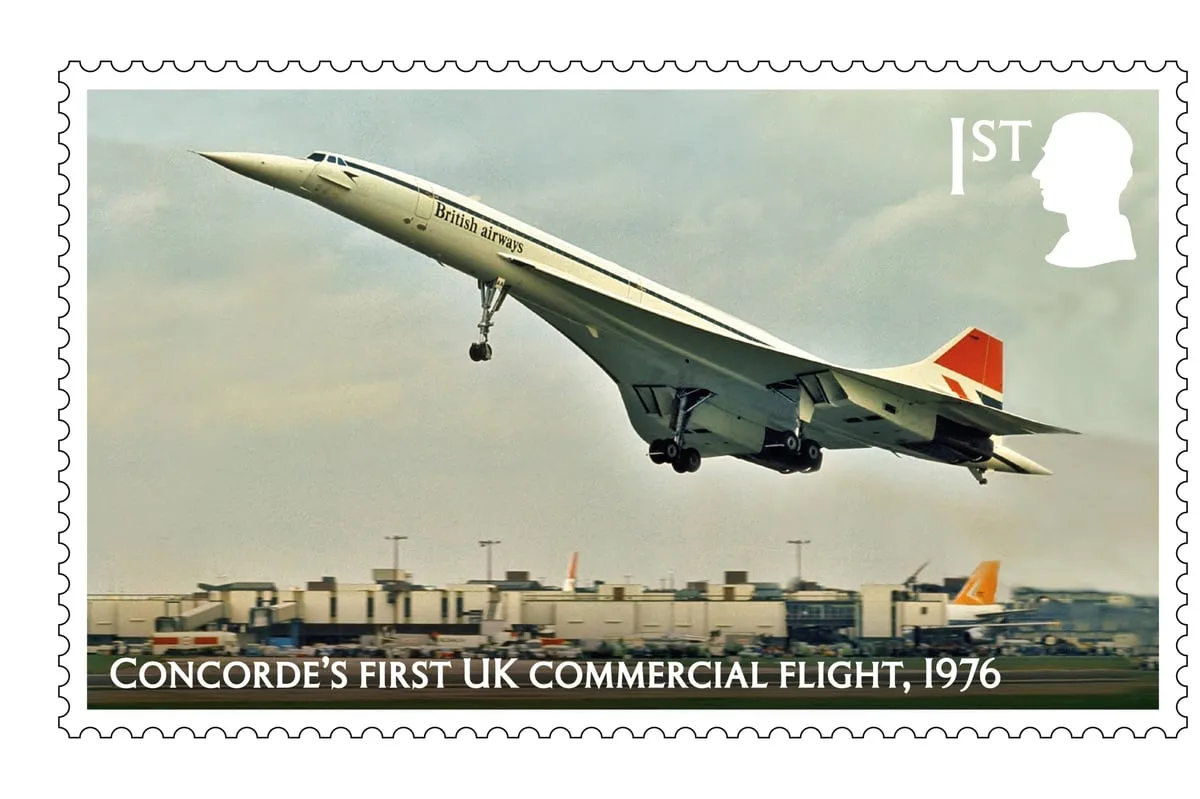
The Royal Mail has issued a set of 12 stamps to commemorate the 50th anniversary of the first commercial Concorde flights, which took off on January 21, 1976. The stamps celebrate the supersonic aircraft's 'innovation, elegance and engineering excellence'.
To mark the occasion, the nose cones of three Concorde planes exhibited in the UK will be lowered simultaneously at 11:40am on Wednesday, replicating the moment the first commercial flights departed. A British Airways flight left London's Heathrow airport for Bahrain, while an Air France flight departed from Paris's Charles de Gaulle airport for Rio de Janeiro.
The main set of eight stamps features photographs of British Airways' Concordes throughout their history, including the first and last commercial flights. One stamp depicts four Concordes flying in formation to celebrate 10 years of service.
David Gold, director of external affairs and policy at the Royal Mail, said: 'Concorde remains one of the most iconic achievements in aviation history, and we're proud to celebrate its legacy with this special set of stamps.' Hamish McVey, director of marketing for British Airways, added: 'Concorde represents a landmark chapter in our history at British Airways, embodying the pioneering spirit of British innovation and creativity.'
Concorde's distinctive hydraulically operated nose cones moved down during take-off and landing to give pilots better visibility. The aircraft at Aerospace Bristol, Manchester Airport Runway Visitor Park, and Imperial War Museum Duxford will drop their noses in front of spectators on Wednesday. Brooklands Museum in Surrey is hosting a dinner where aviation enthusiasts will hear from eight former Concorde pilots.
Last week, the Royal Mint launched a new 50p coin celebrating Concorde. The aircraft, born out of a joint Anglo-French project, was retired in October 2003 due to a downturn in passenger numbers and rising maintenance costs.