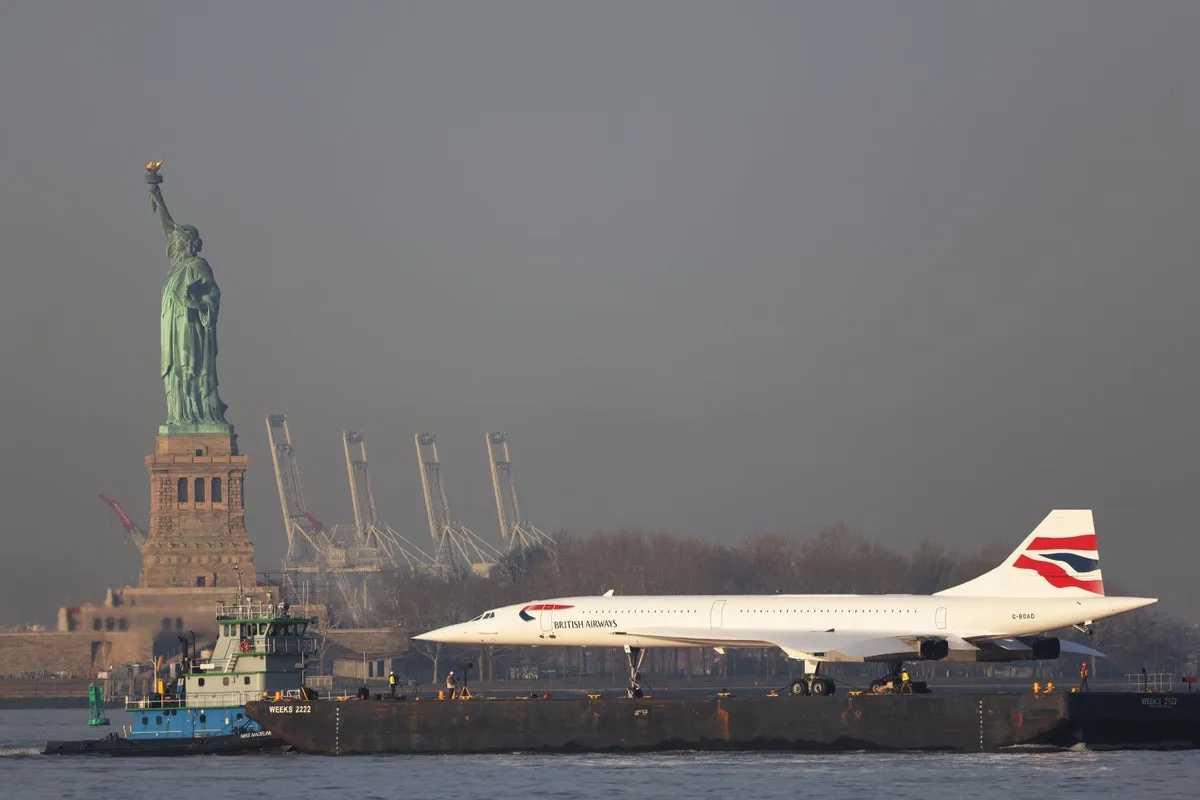
As the aviation world looks to a new era of potential supersonic travel, the legend of Concorde endures. This iconic aircraft, which graced the skies for 27 years, remains a pinnacle of engineering and luxury. Let's break down the staggering statistics that defined the world's most famous supersonic passenger jet.
The Cold, Hard Facts of High-Altitude Flight
Concorde operated at the very edge of the Earth's atmosphere, cruising at an astonishing altitude of 60,000 feet. At this height, the outside air temperature plummeted to a bone-chilling minus 60 degrees Celsius. Within its sleek, narrow fuselage, however, up to 100 passengers experienced subsonic comfort while travelling at twice the speed of sound.
The jet's cruising speed was Mach 2.02, which translates to roughly 1,350 miles per hour. This incredible velocity allowed it to complete the fastest-ever transatlantic crossing, with the record flight from New York to London taking a mere 173 minutes on 7 February 1996.
Production, Performance, and a Profound Legacy
Despite its fame, Concorde was a rarity. Only 20 Concordes were ever built. For stark comparison, the Boeing 737, which first flew two years before Concorde, has seen over 12,300 sales. Its commercial service life spanned 27 years, from 1976 until its retirement in 2003.
The operational reality was complex. Each British Airways Concorde averaged 2.33 hours of daily flight time, a figure encompassing test, training, and passenger flights. This pales next to modern workhorses like the Emirates A380, which routinely flies for over 12 hours a day. Efficiency told a similar story: Concorde managed 48 miles per ton of fuel, whereas today's Airbus A350 achieves nearly 200 miles and carries three times the passengers.
Cost, Tragedy, and Cultural Impact
Concorde travel was the epitome of exclusivity. At its launch in May 1976, a return fare from London to Washington DC opened at £431. By the time services were grounded, a return ticket from London to New York had soared to £9,179. Yet deals could be found; travel correspondent Simon Calder once paid just £150 to act as a courier on a London-New York flight in 1986.
The aircraft's history is marked by profound tragedy. The crash of Air France Flight 4590 in Paris on 25 July 2000 resulted in 113 deaths—109 on the aircraft and four on the ground—just two minutes after take-off.
Concorde also carved its niche in culture. While Oasis's 1994 debut single 'Supersonic' only reached number 31 in the UK charts, Queen's 1979 hit 'Don't Stop Me Now' is believed to be the highest-charting song featuring the word 'supersonic' in its lyrics.
The aircraft's story is also one of what might have been. Iran Air was among the carriers that placed orders, for two aircraft, but like all customers except British Airways and Air France, its order was cancelled. Notably, no female pilots or flight engineers were employed on British Airways' Concorde operation throughout its service.
From its 84-foot wingspan to its 4,500-mile range, and its three-person flight crew, every digit associated with Concorde tells a story of ambition, achievement, and a unique chapter in aviation history that has yet to be repeated.




