

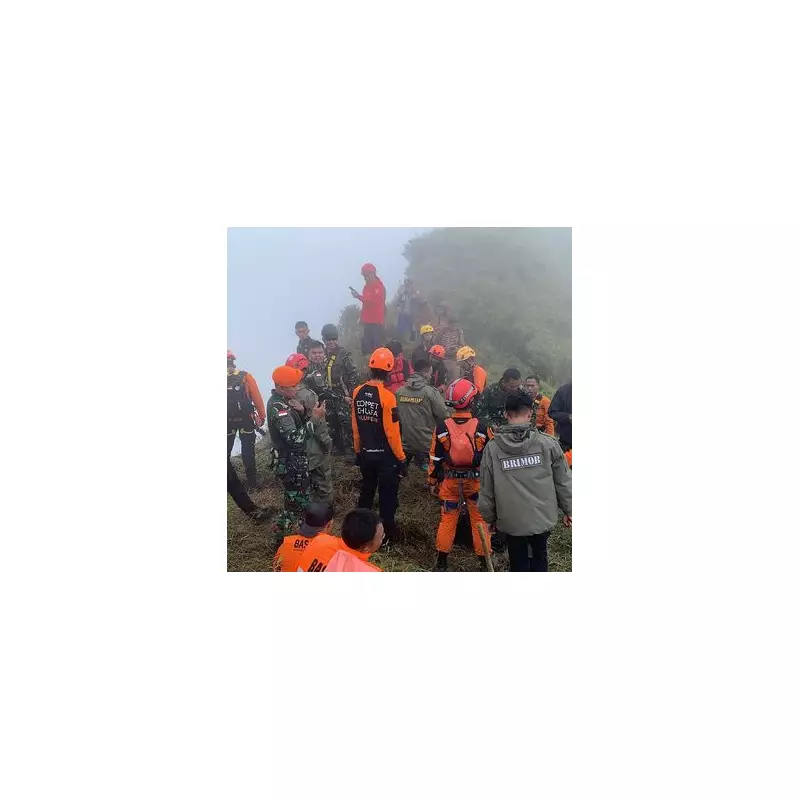
A body has been discovered during the search for a missing aircraft in Indonesia, which vanished from radar with 11 people on board. The grim find comes as rescue teams located significant wreckage believed to be from the plane on a treacherous mountainside.
Wreckage and Victim Located on Mount Bulusaraung
The search operation, coordinated by Muhammad Arif Anwar of Makassar’s Search and Rescue Office, made the breakthrough on Sunday afternoon. Rescuers retrieved the body of a man from a ravine approximately 200 metres deep on the slope of Mount Bulusaraung on Sulawesi island. The site was close to scattered debris from the aircraft.
The evacuation of the body is now underway, officials confirmed. Teams also found additional wreckage, including sections of the aircraft frame, passenger seats, and what is visually believed to be the engine.

Challenging Conditions Hamper Rescue Efforts
The plane, an ATR 42-500 turboprop operated by Indonesia Air Transport, disappeared on Saturday. It was flying from Yogyakarta on Java to Makassar, the capital of South Sulawesi province, when air traffic control instructed it to correct its approach alignment. It vanished shortly after, last tracked at 1:17 p.m. in the mountainous Leang-Leang area of Maros.
On board were eight crew members and three passengers from Indonesia's Marine Affairs and Fisheries Ministry, who were conducting an airborne maritime surveillance mission. The discovery of the main fuselage and tail sections on a steep northern slope has significantly narrowed the search zone.
"Our joint search and rescue teams are now focusing on searching for the victims, especially those who might still be alive," stated mission coordinator Muhammad Arif Anwar.
Treacherous Terrain and Weather Slow Progress
The rescue mission, involving over 100 personnel including army elite forces, has faced severe challenges. Maj. Gen. Bangun Nawoko, the South Sulawesi military commander, described strong winds, heavy fog, and steep, rugged terrain that have drastically slowed progress.
Visibility at the summit has been reduced to about five metres, with heavy rain further complicating operations. These conditions affected movement and forced the cancellation of a planned vertical descent for safety reasons, Nawoko explained.
Photos released by the National Search and Rescue Agency showed teams trekking along a narrow, fog-shrouded mountain ridge to reach the debris field. The incident highlights the perennial challenges of air travel in the vast Indonesian archipelago, which has suffered several transportation accidents in recent years.






