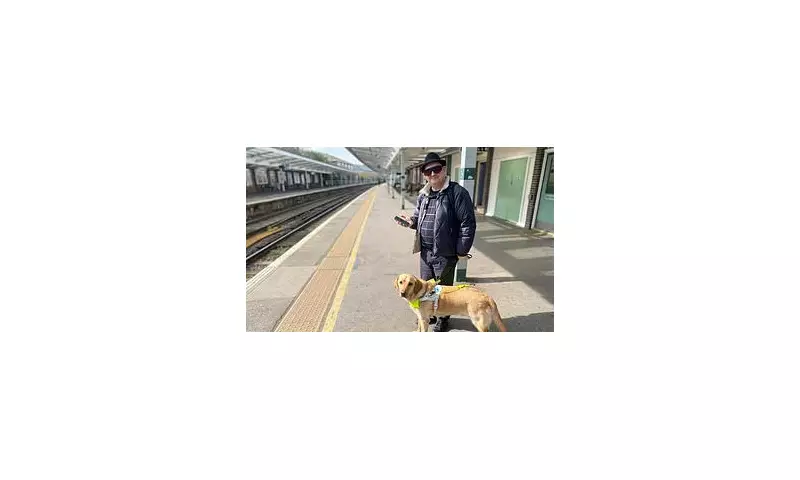
A blind passenger from East Sussex has publicly detailed the significant challenges and anxiety he regularly encounters when travelling by train to London, highlighting systemic failures in railway assistance programmes.
'Left to my own devices' at London Bridge
Paul Goddard, a railway campaigner from Crowborough who has been registered blind since 2008, frequently makes rail journeys to the capital but describes the experience as profoundly inconsistent and often distressing.
Despite utilising the national Passenger Assist scheme—designed to provide coordinated support across multiple train operators including GTR services at London Bridge—Goddard reports that pre-booked assistance frequently fails to materialise.

A widespread problem beyond one passenger
Alarmingly, Goddard's experience reflects a much broader national issue affecting blind and partially sighted travellers across the United Kingdom.
Recent research conducted by the Royal National Institute of Blind People reveals that four out of five visually impaired individuals have encountered difficulties navigating the gap between train carriages and station platforms, with many sustaining injuries during these attempts.
Furthermore, over sixty percent of respondents stated that station staff do not consistently meet them as arranged, even when assistance has been formally booked in advance through official channels.
Operator response and proposed improvements
Carl Martin, accessibility lead at Govia Thameslink Railway, acknowledged the seriousness of Goddard's complaints, stating: 'We care passionately about making our railway accessible for everyone and work closely with blind and partially sighted people to improve our services.'
'It was extremely disappointing to hear about Mr Goddard's experience, and we arranged a meeting to discuss his feedback,' Martin added.
In response to these accessibility failures, GTR has announced several corrective measures including the trial of a dedicated Assisted Travel Coordinator specifically for London Bridge station to oversee all assistance provision.
Technological and practical interventions
The operator outlined additional enhancements developed in collaboration with national sight loss charities and visually impaired passengers:
- Implementation of the Aira application to provide real-time navigational guidance for blind travellers
- Introduction of audio guides on trains with planned expansion to station environments
- Establishment of 'Try a train' events to familiarise visually impaired people with railway infrastructure
- Provision of free access across station facilities
Broader context of railway accessibility
These developments occur against a backdrop of mixed progress in national rail accessibility initiatives. The Access for All programme originally planned improvements at fifty stations, but recently announced that nineteen of these projects will not proceed.
Network Rail, responsible for Britain's railway infrastructure, declined to comment on these accessibility challenges or the reduction in planned station upgrades.
Paul Goddard's experience underscores the urgent need for reliable, consistent assistance for disabled passengers navigating Britain's complex rail network, particularly at major interchange stations like London Bridge where multiple operators converge.