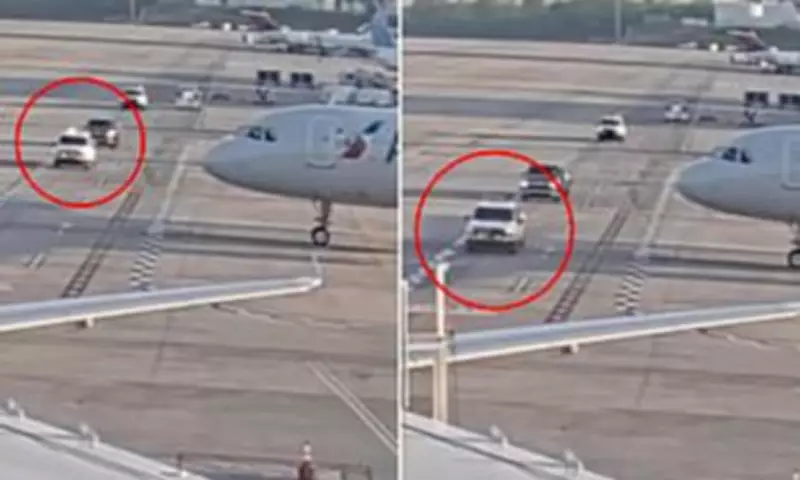
An American Airlines pilot was compelled to execute an emergency stop, described as 'slamming on the brakes,' after two vehicles came perilously close to colliding with his aircraft on a taxiway at Charlotte Douglas International Airport in North Carolina. The unidentified pilot was maneuvering the plane toward the runway early on Wednesday morning when he abruptly halted to avoid the vehicles, which passed directly in front of the aircraft seemingly unaware of its presence.
Pilot's Frustration and Immediate Response
According to audio obtained by CBS News, the male pilot communicated urgently with air traffic control, stating, 'They just went right in front of us. We nearly hit them, I had to slam on the brakes.' He emphasized that the plane had already begun moving before the vehicles crossed its path, adding, 'Somebody's going to be notified right away, that was really bad.' The air traffic controller acknowledged the report and promptly worked to identify the truck's direction using internal systems.
Flight Details and Safety Priorities
The incident involved Flight 1197, which was scheduled to depart from Charlotte to Washington, DC, in the early morning. Despite the alarming event, the flight arrived safely in DC around 9 a.m., on time. Charlotte Douglas International Airport issued a statement confirming awareness of the reported incident, underscoring that 'safety and security are top priorities of CLT.' Both the airport and the Federal Aviation Administration have launched investigations into the near-miss, with American Airlines also being contacted for comment.

Context of Recent Runway Incidents
This close call in Charlotte occurs merely weeks after a tragic collision at LaGuardia Airport in New York, where an Air Canada flight crashed into a fire truck on the runway, resulting in fatalities. Surveillance footage from that incident captured the Air Canada Bombardier CRJ-900 landing during heavy rainfall, striking the fire truck at approximately 150 mph and causing significant damage. The crash injured 41 individuals, including two occupants of the fire truck, with audio revealing desperate pleas from air traffic control for the truck to stop seconds before impact.
Broader Runway Safety Concerns in the US
Federal data highlights ongoing safety risks at airports across the United States, with the FAA identifying 291 high-risk 'hot spots' where runway incursions, near-collisions, and taxiing errors are notably elevated. California emerges as a particular concern, with 34 airports flagged for over 80 such hot spots, attributed to complex layouts at major hubs like San Francisco, Los Angeles, and San Diego that increase pilot error risks.
Other airports with documented safety issues include Phoenix Sky Harbor in Arizona, where crews have mistaken taxiways for runways, and major hubs such as Seattle-Tacoma, Harry Reid International in Las Vegas, Salt Lake City International, and Albuquerque International Sunport. These locations face challenges like wrong-runway departures, misalignment risks, and intricate designs that complicate navigation and heighten accident potential.
The Charlotte incident underscores the critical need for enhanced vigilance and safety protocols at airports nationwide, as authorities continue to probe these events to prevent future occurrences.