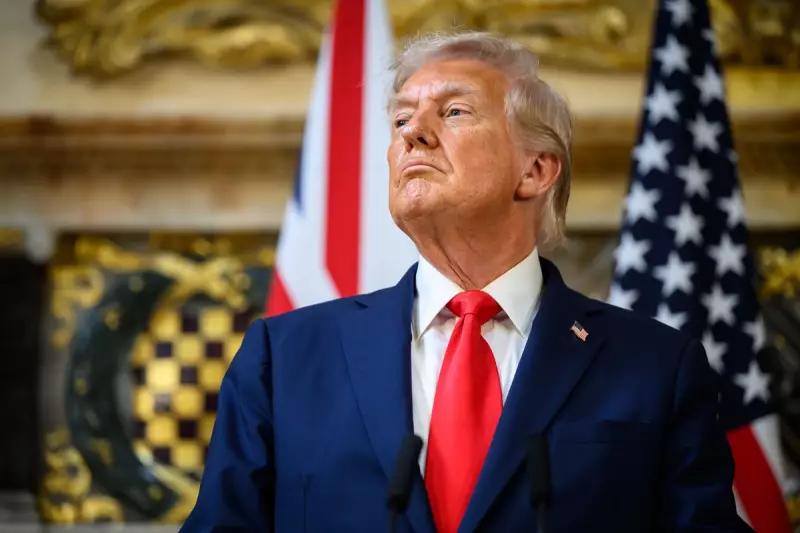
Former US President Donald Trump has provoked widespread condemnation from British politicians after announcing punitive tariffs on the United Kingdom, linked directly to his administration's stalled ambition to purchase Greenland.
Tariff Timeline and Transatlantic Tensions
In a post on his Truth Social platform on Saturday 17 January 2026, Mr Trump declared that the UK, along with several European allies, would face a 10% tariff "on any and all goods" sent to the United States, effective from 1 February 2026. He stated this levy would then be increased sharply to 25% from 1 June 2026. The measures, he said, would remain in place "until such time as a Deal is reached for the Complete and Total purchase of Greenland."
The move is framed as a response to European nations, including the UK, having "journeyed to Greenland, for purposes unknown." This follows confirmation earlier in the week that the UK had sent a single military officer to Greenland at Denmark's request, ahead of a planned Arctic exercise—a move Downing Street insisted did not constitute a formal deployment.

Cross-Party Condemnation from UK Leaders
The announcement triggered immediate and rare cross-party unity in criticism. Conservative Party leader Kemi Badenoch labelled the plan "a terrible idea," stating President Trump was "completely wrong" and that the tariffs would be "a burden for businesses across our country." She emphasised that "the sovereignty of Greenland should only be decided by the people of Greenland."
Nigel Farage, leader of Reform UK, agreed the tariffs would "hurt" Britain. Meanwhile, Liberal Democrat leader Sir Ed Davey accused Mr Trump of "punishing the UK and Nato allies just for doing the right thing" and called on the Prime Minister to "stand firm against the bully in the White House."
Geopolitical Gambit and Public Backlash
Mr Trump's post framed the acquisition of Greenland as a matter of global security, claiming "China and Russia want Greenland, and there is not a thing that Denmark can do about it." He asserted the US was "immediately open to negotiation" with Denmark or the other named nations.
This renewed push comes amid significant public opposition. On the same day as Trump's announcement, hundreds attended a rally in Nuuk, Greenland's capital, supporting self-governance, while thousands protested across Denmark against any potential US takeover.
The UK government, under Prime Minister Sir Keir Starmer, has been engaged in heightened discussions on Arctic security since the start of the year, raising the issue directly with Mr Trump, Danish PM Mette Frederiksen, and NATO's Mark Rutte. The situation presents a severe test for the transatlantic alliance, with the Trump administration having previously hinted at using force to annex the semi-autonomous Danish territory.