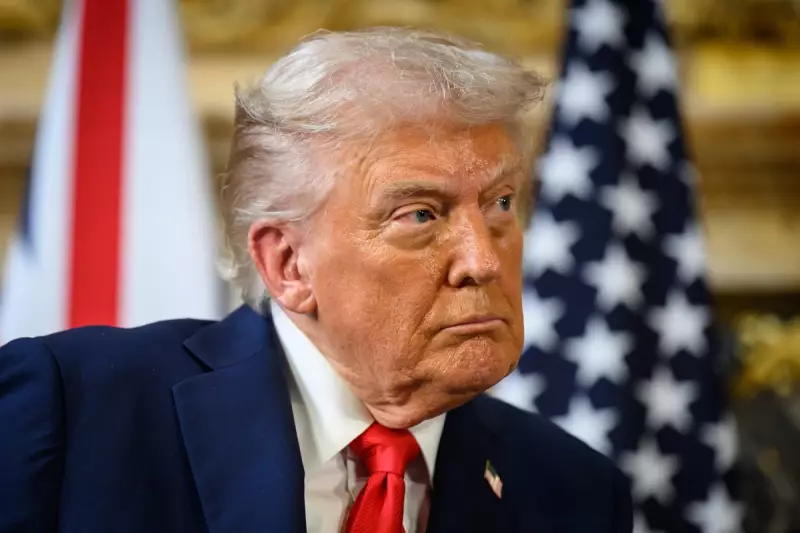
US President Donald Trump has intensified a diplomatic crisis by threatening sweeping new tariffs on European allies in his pursuit of acquiring Greenland, a move that risks reigniting a major transatlantic trade war.
Private Messages and Public Threats
In a provocative social media post on Tuesday, 20 January 2026, President Trump shared screenshots of an apparent private message from French President Emmanuel Macron. The message, posted to Trump's Truth Social platform, showed Macron expressing confusion over the US leader's actions regarding Greenland while proposing a meeting.
The French President's message read in full: “My friend, We are totally in line on Syria. We can do great things on Iran. I do not understand what you are doing on Greenland. Let us try to build great things: 1) i can set up a g7 meeting after Davos in Paris on thursday afternoon. I can invite the ukrainians, the danish, the syrians and the russians in the margins 2) let us have a dinner together in Paris together on thursday before you go back to the us. Emmanuel.”

Trump's reply was not shown, and the White House declined to comment. Alongside the messages, the US President also shared an AI-generated image depicting him talking to European leaders in the White House, with an American flag superimposed over Greenland.
Nobel Prize Snub Fuels Greenland Ambition
The confrontation follows Trump explicitly linking his drive to control Greenland to his failure to win the Nobel Peace Prize. In a text to Norway's Prime Minister Jonas Gahr Stoere on Sunday, Trump stated he no longer felt an obligation to think "purely of Peace" after Norway's Nobel Committee awarded the 2025 prize to Venezuelan opposition leader Maria Corina Machado instead of him.
Trump's message to Stoere said: "Considering your Country decided not to give me the Nobel Peace Prize for having stopped 8 Wars PLUS, I no longer feel an obligation to think purely of Peace, although it will always be predominant, but can now think about what is good and proper for the United States of America."
Norway's government released these messages on Monday. Trump has since vowed to implement a wave of increasing tariffs from 1 February on EU members Denmark, Sweden, France, Germany, the Netherlands, and Finland, along with Britain and Norway, until the US is allowed to buy Greenland, which is home to only 57,000 people.
European Backlash and Military Moves
The dispute threatens to severely strain the NATO alliance, already under pressure over Ukraine and defence spending. European leaders have reacted with defiance and concern.
Denmark's Foreign Minister Lars Lokke Rasmussen, speaking in London on Monday, asserted: "We are living in 2026, you can trade with people, but you don't trade people." Meanwhile, Greenland's Prime Minister Jens-Frederik Nielsen posted on Facebook that the territory must decide its own fate, stating: "We will not let ourselves be pressured. We stand firm on dialogue, on respect and on international law."
In a significant development, Denmark's military confirmed that Danish soldiers would land in Kangerlussuaq, western Greenland, on Monday as part of the Arctic Endurance exercise. Trump dismissed the deployment, telling reporters in Florida: "That wasn't a military... They sent a few people, and they say they sent them not for me, but to guard against Russia."
The European Union is preparing its response, with leaders set to discuss options at an emergency summit in Brussels on Thursday. Potential retaliatory measures include:
- A package of tariffs on €93 billion ($108 billion) of US imports, which could automatically kick in on 6 February.
- Deploying the never-used "Anti-Coercion Instrument" (ACI) to limit US access to public tenders, investments, or digital services trade.
German Chancellor Friedrich Merz said he would seek a meeting with Trump in Davos, warning that while a trade dispute was unwanted, Europe was "capable of responding" to unreasonable tariffs. British Prime Minister Keir Starmer called for calm discussion but said he did not believe Trump was considering military action.

The situation has rattled European industries and financial markets, with investors fearing a return to the volatility of the 2025 trade war. US Treasury Secretary Scott Bessent, speaking in Davos, claimed the President's motivation was strategic, not personal, stating it would be "very unwise" for Europe to retaliate.