

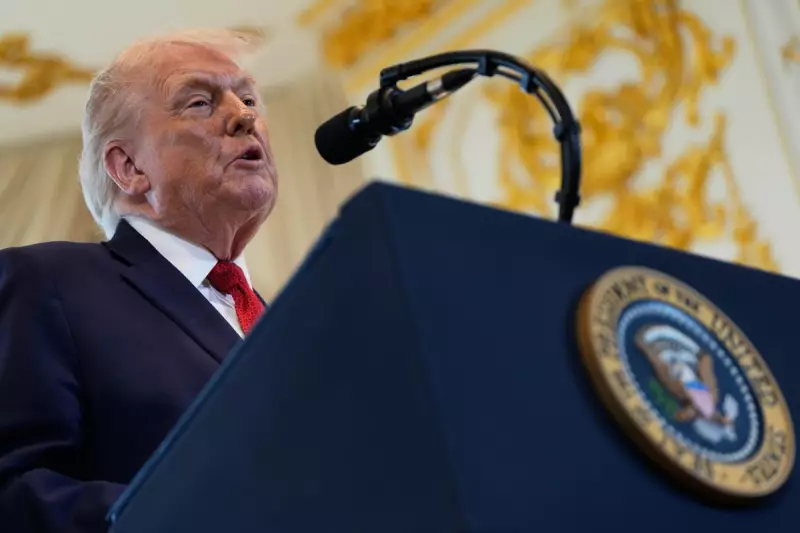
Former US President Donald Trump has ignited a fresh transatlantic trade row, announcing punitive new tariffs targeting the United Kingdom and key European allies. The move is a direct retaliation for their opposition to a controversial American plan to acquire Greenland.
Targeted Tariffs and a "Dangerous Game"
In a post on his Truth Social platform, Trump declared that a 10 per cent tariff will be applied to goods from eight nations starting 1 February 2026. The countries singled out are the United Kingdom, Denmark, Norway, Sweden, France, Germany, the Netherlands, and Finland.
The former president framed the economic measures as a necessary response to what he called a "very dangerous game" played by Denmark's allies. He explicitly linked the tariffs to the stalled proposal for the "Complete and Total purchase of Greenland" by the United States, a long-held ambition of Trump's that has been firmly rejected by Copenhagen.

Escalating Timeline and Stakes
The initial 10 per cent levy is only the first phase of the planned economic pressure. Trump stated that the tariffs are scheduled to increase significantly to 25 per cent on 1 June 2026. According to his announcement, the heightened tariffs will remain in force indefinitely, until a deal for Greenland is successfully reached.
In a stark warning, Trump claimed that far more than trade was on the line, asserting that "World Peace is at stake" in the confrontation over the vast Arctic territory. He also indicated he is in communication with NATO regarding the occupation of Greenland, further raising the geopolitical temperature.
Implications for UK and European Trade
This announcement marks a sudden and severe escalation in trade tensions between the US and its traditional partners. For the UK, which is navigating its post-Brexit economic relationships, the prospect of steep new tariffs on exports to one of its largest trading partners presents a major challenge.
The collective targeting of seven EU member states, alongside the UK, suggests a coordinated Western European stance against the Greenland proposal has provoked Trump's ire. The move threatens to disrupt supply chains and increase costs for businesses and consumers on both sides of the Atlantic, reviving fears of a full-blown trade war.
With the first tariffs due to take effect in a matter of weeks, and a steep hike looming in June, affected governments are now under pressure to formulate a rapid response to this unprecedented economic ultimatum tied to a territorial dispute.






