Scientists have identified a mathematical shortcut to the moon that could significantly reduce the cost of future missions by optimizing fuel consumption. Fuel is one of the most expensive components of space travel, with NASA's Space Launch System using over two million litres of propellant per launch, costing an estimated $4 billion (£2.8 billion).
Fuel-Efficient Routes
Space missions measure fuel by its ability to change a rocket's velocity, known as delta-v. The newly discovered route requires 58.8 metres per second less fuel than previously known efficient paths, a saving that, while seemingly small compared to the total journey's 3,342.96 metres per second, translates to substantial fuel savings. Lead author Dr Allan Kardec de Almeida Júnior of the University of Coimbra explains: 'When it comes to space travel, every meter per second equates to a massive amount of fuel consumption.'
Lagrange Points
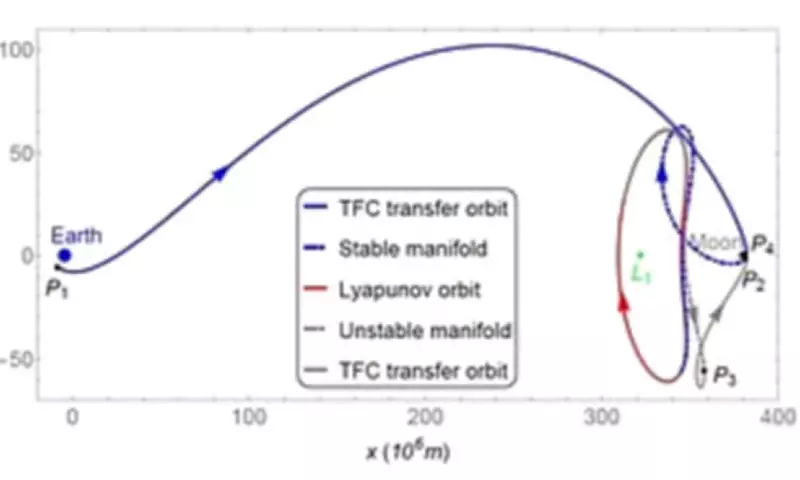
One of the most efficient ways to reach the moon is to use Lagrange points—positions where gravitational forces from Earth, the moon, and the sun balance. Spacecraft can 'park' at these points with minimal fuel. However, orbits around Lagrange points are unstable, making trajectory calculations complex. The researchers employed a new mathematical framework called 'the theory of functional connections' to calculate millions of possible trajectories, far more than previously feasible.

Dr Almeida Júnior and his team simulated 30 million different trajectories to find the optimal route. Their approach defied conventional wisdom by approaching the L1 Lagrange point from the side closer to the moon rather than Earth. Using a control system, a spacecraft could remain in this orbit indefinitely before proceeding to the moon.
Tourism and Mining Hub
The stopping point at L1 offers a unique perspective, with Earth and moon visible on opposite sides of the ship. Dr Almeida Júnior suggests this could transform space missions into a thriving tourism industry, with spacecraft staying in orbit around L1 in multiples of 13 days, allowing for crew rotation and potential mining activities.
Communication Benefits
Another advantage is uninterrupted communication with Earth, as the spacecraft remains in line of sight. Co-author Dr Vitor Martins de Oliveira notes that unlike the Artemis 2 mission, which experienced a blackout behind the moon, this orbit ensures constant contact.
Limitations and Future Work
The calculations currently consider only Earth and moon gravity, excluding the sun's influence. Including the sun could yield even more efficient orbits but would restrict launch windows to specific dates. Despite this, the savings scale with spacecraft size, making the route particularly beneficial for heavy cargo missions like SpaceX Starship.