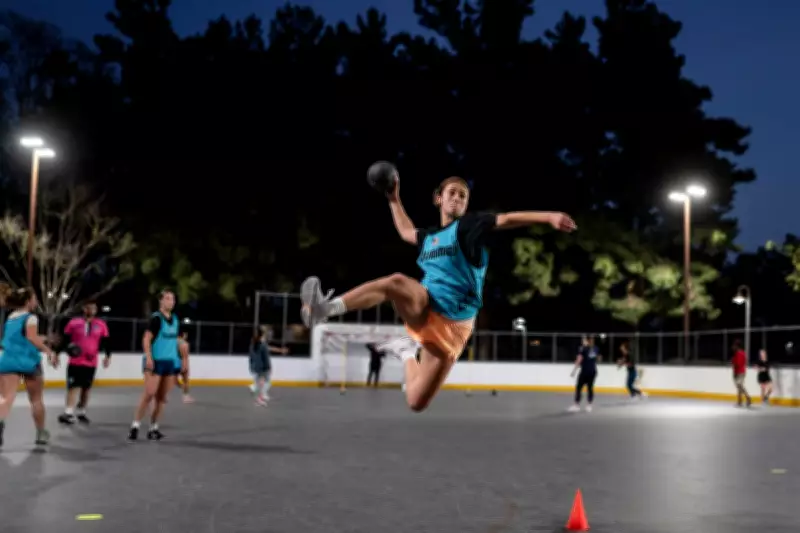
Rylee White had never even heard of the fast-paced sport of handball until her roommate mentioned a TikTok video about tryouts in Los Angeles for the U.S. Olympic women's team — no experience necessary.
White, a 27-year-old screenwriter, knew she had to go. She wasn't the only one. More than 150 women — buoyed by the viral video — attended the tryouts in January, a five-fold increase from previous turnouts.
Five months later, White is one of a handful of women who have packed their bags and moved to Florida to join USA Handball's national residency program, hoping to eventually be selected to represent the United States at the 2028 Summer Olympics in Los Angeles.

Handball is popular overseas but not in the US
As the host nation, the U.S. automatically qualifies for every sport. The last time the United States had a women's handball team at the Games was in 1996. Finding the money and resources needed to field a competitive U.S. team is a constant challenge. Athletes are often dual citizens from Europe who play professionally overseas.
While handball is little known in the U.S., it is popular in Germany, France, Norway and Denmark as well as Balkan nations in southeastern Europe. These countries usually dominate at the Olympics.
Men's handball was introduced in the 1936 Olympics, and women started participating at the 1976 Games. But while many Olympic athletes start training in childhood to compete for their country, handball athletes in the U.S. often pivot to the sport later in life.
The game involves two teams of six players who use their hands to pass a ball — covered in a sticky resin — to get it into the other team's goal, protected by a goalkeeper. It's fast, full-contact and can draw tens of thousands of spectators overseas.
Former athletes take a gamble
Many female handball players were Division One athletes in college or are former professional basketball players. Most are in their 20s and 30s, but some play into their 40s.
White had hoped to have a college athlete career playing basketball and lacrosse but was hindered by injuries and several surgeries on her knees. Handball felt like her chance to play competitive sports again.
“I think a lot of people would describe me as the most competitive person they'd ever met,” White said. “I definitely was raised in a house where we had big, big dreams.”
She told the coach after tryouts: “I'm ready to go do this and I will work as hard as you want me to work.”
The goal of the residency is for players to improve enough to be paid to play professionally overseas.
Many have left partners behind to pursue their dreams, including White.
“I told him I'm going to take him to Europe with me,” she said.
As for the Olympic team roster, that won't be finalized until a few months ahead of the LA Games. While dozens of women are training in the residency, only about 14 to 18 can represent the country in a tournament. It's a big gamble.
Multisport athletes tend to make the best handball players
Sarah Gascon, who played on the women's national team for years, recently became its head coach. Her goal is to rebuild the team and the program in the U.S. after years of decline.
“We've had great successes in my career and some really great moments but still didn't get an opportunity to play in the Olympic Games because we just weren't good enough,” Gascon said.
The best players, Gascon has found, are multisport athletes. Basketball teaches you how to dribble, volleyball teaches you how to block a ball when someone is shooting, and softball or rugby teaches you how to throw. Handball incorporates all of these skills.
“It's really about their athleticism,” Gascon said. “Do they have a good foundation that we could build upon? And how are they able to adapt with learning something new at 22 or 23 years old?”
A lack of funding is the biggest hurdle
While Gascon has rounded up enthusiastic athletes in Florida, the biggest challenge they face is resources.

USA Handball is the only national governing body for an Olympic sport that doesn't receive any funding from the U.S. Olympic & Paralympic Committee, and the women's team is the only one that doesn't receive any support, such as access to elite athlete health insurance, Gascon said. The committee did not respond to an Associated Press email request for comment.
Gascon and her staff are all volunteers, and the athletes have to work full-time while training.
“Some of our best athletes haven't been able to go to tournaments or go to events because they can't afford it,” Gascon said.
Devyn Holbrook had also never heard of handball before the tryouts.
The 30-year-old self-proclaimed “queen of side quests” grew up doing ballet, soccer, basketball, softball, and javelin for track and field. She quickly became obsessed with handball after playing for just a few days.
“I just loved it and then I couldn't stop watching videos online of past Olympic Games,” Holbrook said. “You don't get a lot of chances to do like women's team sports later in life.”
She figured she had nothing to lose.
“There will never be a chance again that I could go to the Olympics in this capacity,” Holbrook said. “So why not give it everything that I have? And if I don't make it, then I don't make it.”