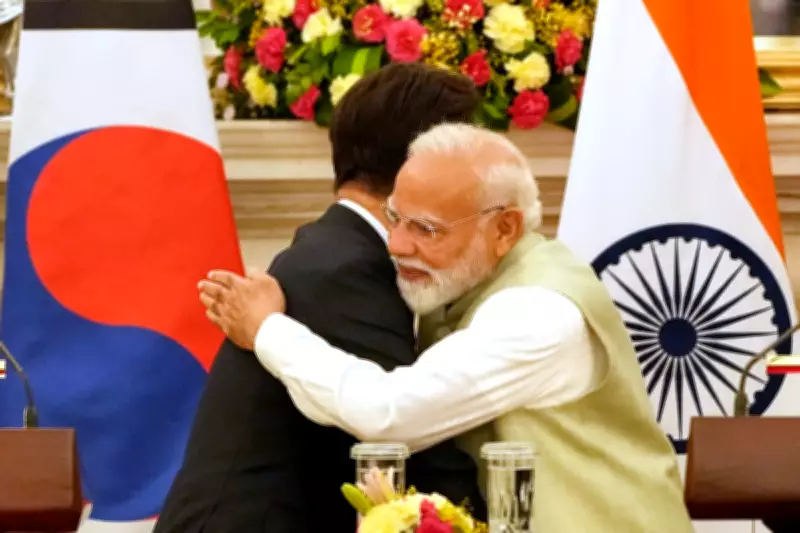
In a significant move to deepen economic and strategic partnerships, India and South Korea have formally agreed to nearly double their bilateral trade, targeting an ambitious $50 billion by the year 2030. This agreement was solidified during a high-level meeting between South Korean President Lee Jae Myung and Indian Prime Minister Narendra Modi in New Delhi on Monday, 20th April 2026.
Ambitious Trade Expansion Goals
The current trade volume between the two nations stands at approximately $27 billion. Prime Minister Modi announced the shared objective to elevate this figure to $50 billion within the next six years. He emphasised that this transformation is part of a broader vision to evolve their trusted relationship into a futuristic partnership, leveraging enhanced supply chains, improved market access, and increased investment flows.
Strategic Context and Global Uncertainties
The talks between Modi and Lee occur against a backdrop of global economic instability and supply chain disruptions, largely triggered by ongoing conflicts such as the Iran war. Both countries are actively seeking to fortify their ties to navigate these challenges more effectively, ensuring resilience in their economic interactions.

Key Sectors for Enhanced Cooperation
President Lee outlined several critical areas where economic cooperation will be significantly upgraded. These include:
- Shipbuilding and Defence: Strengthening collaboration in these traditional sectors to boost mutual security and industrial capabilities.
- Artificial Intelligence (AI): Fostering innovation and technological advancements through joint ventures and research initiatives.
- Advanced Manufacturing: Expanding industrial collaboration to enhance productivity and competitiveness on the global stage.
- Sensitive Areas: Increasing trade and investment in critical minerals and nuclear energy, highlighting the strategic depth of the partnership.
Supply Chain Resilience Initiatives
As part of efforts to bolster supply chains, South Korea plans to increase its imports of naphtha, a crude-oil derivative, from India. This move aims to cushion potential disruptions linked to tensions in the Middle East, with India having accounted for about 8% of South Korea's naphtha imports last year. This step underscores the practical measures being taken to ensure economic stability amid geopolitical risks.
Broader Implications and Future Steps
The agreement not only sets a clear numerical target but also reflects a deeper commitment to mutual growth and security. By focusing on high-value sectors and sensitive industries, both nations are positioning themselves as key players in the global economy, ready to adapt to evolving market dynamics. Following his visit to India, President Lee is scheduled to travel to Vietnam, indicating South Korea's broader regional engagement strategy.
This partnership is expected to drive innovation, create jobs, and enhance bilateral trade flows, contributing to economic prosperity in both countries while addressing global challenges through coordinated action.