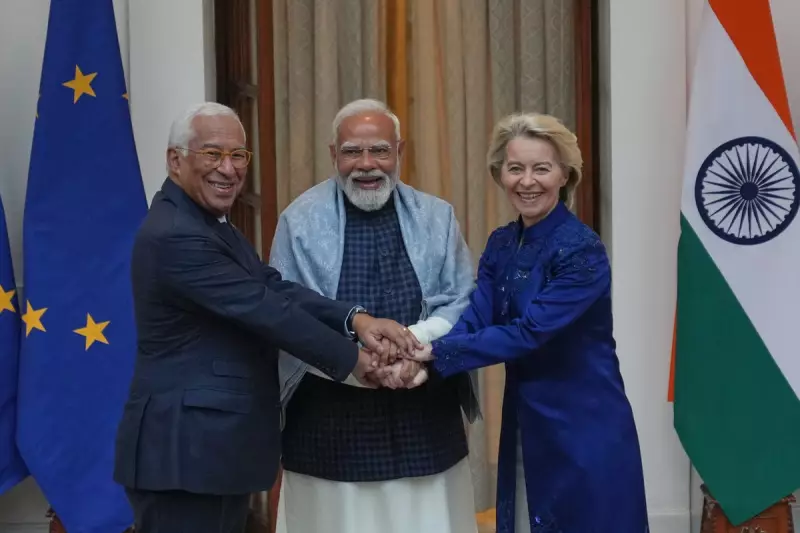
In a landmark development for global commerce, India and the European Union have successfully concluded negotiations on a historic free trade agreement, ending nearly two decades of complex discussions. The accord, which has been dramatically dubbed the "mother of all deals", represents one of the most significant bilateral trade engagements in modern history and is poised to reshape economic relations between two of the world's largest democratic entities.
A Monumental Economic Partnership
The agreement, announced jointly on Tuesday, is designed to substantially deepen economic and strategic ties between India and the 27-nation European bloc. Indian Prime Minister Narendra Modi, speaking via virtual address to an energy conference, emphasised the transformative potential of the pact, stating it "will bring major opportunities for the people of India and Europe." He further highlighted that the agreement encompasses a remarkable 25% of global GDP and approximately one-third of worldwide trade, underscoring its monumental scale and potential influence on international markets.
Strategic Dimensions Beyond Commerce
Beyond the core trade provisions, the partnership extends into crucial strategic areas. The two parties have also agreed on a framework agreement for enhanced defence and security cooperation, signalling a comprehensive alliance that transcends mere economic interests. Additionally, a separate pact has been established aimed at facilitating mobility for skilled professionals and students, fostering greater people-to-people connections and knowledge exchange between the regions.

European Commission President Ursula von der Leyen, in a post on social media platform X, proclaimed that "Europe and India are making history today." She later elaborated in a speech, characterising the accord as a tale of "two giants" – referencing the world's second and fourth largest economies – "who chose partnership, in a true win-win fashion." Von der Leyen asserted that the deal sends "a strong message that cooperation is the best answer to global challenges," particularly during a period of significant international turmoil.
Substantial Tariff Reductions and Sectoral Gains
The agreement promises substantial economic benefits through sweeping tariff eliminations. According to official statements, India is expected to reduce or eliminate tariffs for 96.6% of EU exports, while Brussels will reciprocate with similar reductions covering nearly 99% of India's shipments by trade value, implemented in a phased manner. This is projected to cut up to 4 billion euros (approximately $4.7 billion) in annual tariffs for exporters and generate millions of new jobs across both India and Europe.
Key Sectoral Impacts
Specific sectoral advantages have been clearly outlined. Indian industries poised to gain significantly include textiles, apparel, engineering goods, leather, handicrafts, footwear, and marine products. Conversely, European gains are anticipated in wine, automobiles, chemicals, and pharmaceuticals. A detailed quota system has been established for automobiles, wines, and whisky, leading to dramatic duty reductions.
Notably, tariffs charged by India on cars will gradually decrease from 110% to as low as 10%, with car parts tariffs being fully abolished after a period of 5 to 10 years. Additional tariffs ranging up to 44% on machinery, 22% on chemicals, and 11% on pharmaceuticals will also be largely eliminated. For European wine, Indian tariffs will drop from 150% to 20% for premium ranges.
Sensitive Exclusions
The agreement does include specific exclusions reflecting domestic sensitivities. New Delhi has excluded dairy products such as milk and cheese, along with cereals, from the deal. Similarly, the EU has secured provisions that prevent concessional tariffs on imports of Indian sugar, meat, poultry, and beef products, as confirmed by officials at the Indian Trade Ministry.
Geopolitical Context and US Pressure
The timing of this agreement is deeply intertwined with broader geopolitical shifts and trade tensions. Prime Minister Modi, speaking at a joint news conference in New Delhi alongside European Commission President Ursula von der Leyen and European Council President António Costa, stated the partnership "will strengthen stability in the international system" amidst current global disorder.

A significant driving force behind the accelerated negotiations has been pressure from Washington. The United States is currently targeting both India and the EU with steep import tariffs, disrupting established trade flows and compelling these major economies to seek alternative, resilient partnerships. The negotiations received renewed impetus following former U.S. President Donald Trump's aggressive tariff policies and related geopolitical manoeuvres.
For India, the deal is a strategic move to diversify export destinations and offset the impact of higher U.S. tariffs, including an additional 25% levy on Indian goods related to its ongoing purchases of discounted Russian oil, which brings combined U.S. tariffs on its Asian ally to 50%.
The EU's Quest for Strategic Autonomy
For the European Union, the agreement offers expanded access to one of the world's fastest-growing major economies and helps European exporters and investors reduce their reliance on more volatile markets. The bloc is actively pursuing a policy of "strategic autonomy," accelerating its outreach to global markets following what is widely perceived as an aggressive and erratic approach from its traditional transatlantic ally.
Over the past year, the EU has signed similar deals with Japan, Indonesia, Mexico, and South American nations. This agreement with India represents a cornerstone of this strategy, which in practice involves decoupling from a United States viewed by many European leaders as increasingly unpredictable. There remains a palpable sense of betrayal within the 27-nation bloc stemming from Trump's tariff onslaught, embrace of far-right parties, and belligerent stance on issues like Greenland.
Economic Projections and Future Implementation
Bilateral trade between India and the EU stood at $136.5 billion in the 2024-25 period. Officials from both sides have expressed optimism that the new agreement could increase this figure to approximately $200 billion by 2030, marking a significant boost to mutual prosperity.
Indian trade analyst Ajay Srivastava summarised the pact's broader significance, noting, "Ultimately, the agreement is about creating a stable commercial corridor between two major markets at a time the global trading system is fragmenting."
The formal signing of the deal is anticipated later this year following a legal review of the text. It is expected to come into effect early next year, pending ratification by the European Parliament. This historic accord between India and the European Union, therefore, stands not merely as a trade deal, but as a profound geopolitical realignment with far-reaching consequences for the future of global economics and diplomacy.