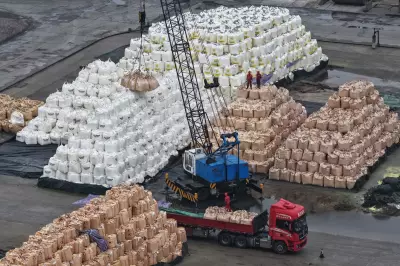
The global energy crisis triggered by the closure of the Strait of Hormuz is merely the opening act in a far broader economic drama. As tensions with Iran escalate, with Qatar's minister warning the situation is "very close to spiraling out of control," the next casualty is set to be the world's food supply chain, with sustained price increases looming for consumers everywhere.
The Fertilizer Lifeline Severed
This critical maritime chokepoint is not just a conduit for 20% of the world's crude oil and a similar share of liquefied natural gas. Crucially, it also facilitates the transit of approximately one-third of all internationally traded fertilizer. Modern agriculture is utterly dependent on the precise, timely delivery of these nutrients to crops. When shipments are delayed or become prohibitively expensive, farmers face a grim trilemma: reduce fertilizer application, plant fewer acres, or switch to less nutrient-demanding crops. Each choice inevitably slashes overall productivity, diminishing supplies of staple foods, livestock feed, and key ingredients found in countless processed products.
Three Crops, Three Nutrients Under Threat
The world's dietary foundation rests on three staple crops—corn, wheat, and rice—which collectively provide over half of all calories consumed. To achieve maximum yields, these crops require three primary nutrients: nitrogen, phosphate, and potassium. The Hormuz blockade has severely disrupted the supply and inflated the cost of all three.

Nitrogen, vital for plant growth, is directly tied to natural gas prices, which constitute 70-90% of production costs. The conflict has already cut gas production by 20%, with prices soaring up to 70%. Compounding this, Russia has suspended exports of ammonium nitrate, a key nitrogen source.
Phosphate, essential for energy transfer and seed development, has seen 25% of global supply vanish after China, the world's largest producer, blocked exports.
Potassium (potash), which aids water retention and protein content, was already in short supply due to sanctions on major producers Belarus and Russia. The cumulative effect has been a dramatic global price surge. In the United States, some fertilizer costs skyrocketed by more than 40% in just one month following the war's outbreak in late February 2026.
Farmers Bear the Initial Brunt
The impact strikes at the farm level first. Cereal crops absorb most of their nitrogen during early growth stages; delaying application by just two to four weeks or reducing it by 10-15% can slash corn yields by 10-25%. Lower production of corn and wheat reduces not only direct human food but also livestock feed, driving up the cost of raising animals and making meat and dairy more expensive.
When feed costs become unsustainable, farmers may be forced into devastating herd reductions. A precedent exists: in 2022, U.S. producers, squeezed by drought and high costs, culled 13.3% of the national beef cow herd—the highest rate ever—dropping inventory to its lowest level since 1962. Such decisions constrain meat supplies for years.
A Problem Money Cannot Easily Solve
By mid-March 2026, U.S. fertilizer supplies were at only 75% of normal levels, coinciding with the critical Corn Belt planting and initial fertilization window. Subsequent applications are due through mid-June. Faced with uncertainty, farmers may plant less corn or switch to soybeans, further tightening corn supplies. While government aid can help with costs, it cannot remedy the fundamental issue of fertilizer simply not being available at the precise time it is agronomically required.
The Consumer Impact: Delayed but Inevitable
While American consumers may not face immediate shortages, their wallets will feel the pressure. The effects on the food supply manifest more slowly than spikes in fuel prices, but they are inexorable. Even with robust domestic harvests, the U.S. is not insulated from global markets. A smaller 2026 global crop, coupled with rising feed demand in populous nations like China and India, will exert upward pressure on corn prices worldwide.

In March 2026, the U.S. Department of Agriculture, using pre-war data, projected an average food price increase of 3.1%. The real question is the speed and magnitude of passthrough to shoppers. Research indicates retail price adjustments lag behind wholesale changes, sometimes by two to four months. Less processed items like corn tortillas may reflect cost increases within months, while cereals, poultry, and especially beef—with its longer production cycle—will take considerably longer to show price hikes.
A Looming Global Food Emergency
The crisis extends far beyond Western supermarkets. Over 300 million people globally already lack sufficient food. The U.N. World Food Program warns an additional 45 million could be pushed into hunger by late 2026 if the Middle East conflict persists. Lower-than-normal crop yields are expected in India and Brazil, while East African farmers, who struggled to afford fertilizer even before the crisis, will be forced to make do with even less.
For lower-income households everywhere, who spend a larger share of their income on food, even relatively affordable proteins like chicken may become regular luxuries. The war's economic aftershocks, transmitted through the fragile arteries of global trade, are set to reshape dinner tables and strain budgets across the planet for the foreseeable future.