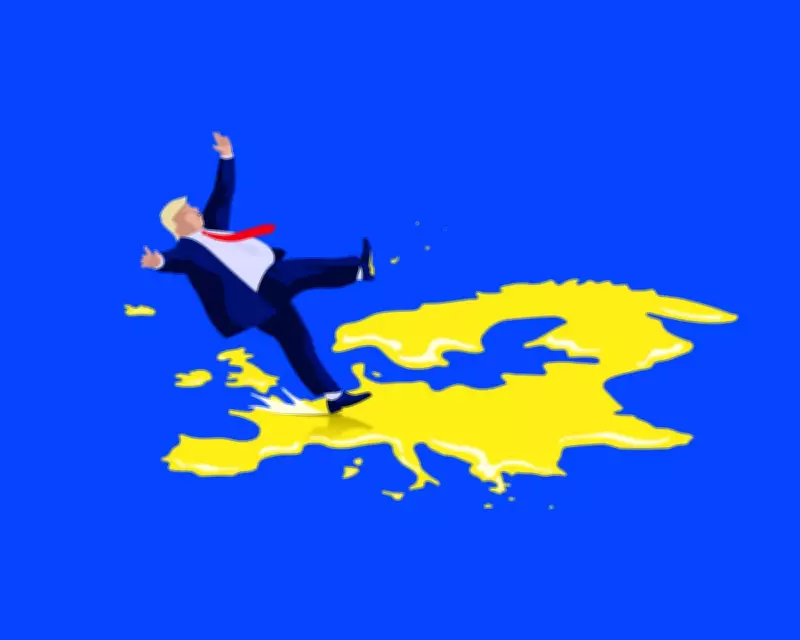
In February of last year, Donald Trump convened the first full cabinet meeting of his second presidential term. He boldly declared his intention to impose sweeping tariffs on America's closest allies in Europe. When questioned by a reporter about potential European retaliation, Trump responded with unwavering confidence. "They can't," he asserted. Pressed further, he elaborated: "We are the pot of gold. We're the one that everybody wants. And they can retaliate, but it cannot be a successful retaliation." From Trump's perspective, Europe appeared weak and ineffectual—a minor player compared to the colossal American economic machine. He believed that when faced with a US president willing to leverage his nation's immense power, Europe would inevitably capitulate.
Europe's Current Predicament
Over the subsequent year, Trump has repeatedly deployed America's economic strength against European nations. This has ranged from coercing the European Union and the United Kingdom into accepting unbalanced trade agreements to pressuring Denmark to sell Greenland. Time and again, Trump's assessment has proven accurate: European countries have often approached negotiations with a sense of deference, seemingly eager to secure a deal at almost any cost. To endure another three years of a Trump administration, European leaders must fundamentally alter their strategy. Drawing from extensive experience as a state department official involved in designing and negotiating sanctions, I have witnessed firsthand how economic pressure operates in practice—and how it can falter when the targeted entity is prepared to endure hardship and push back forcefully.
Lessons from Global Powers
Countries such as India, Brazil, and China have all confronted similar forms of Trumpian economic coercion. Each managed not only to survive but also to protect their core national interests. In doing so, they demonstrated their status as serious geoeconomic actors who cannot be easily intimidated. Although their specific tactics varied, each nation's approach incorporated three critical components: resolve, resilience, and retaliation. Europe must adopt and integrate all three elements to withstand Trump's pressures while maintaining its dignity and autonomy.

The First Step: Cultivating Resolve
The initial step involves mobilising public support for a stance of defiance. While losing access to the vast US market is undoubtedly painful—the United States remains the world's largest importer—for most nations, it is a survivable blow. India serves as a prime example. Last summer, irritated by Prime Minister Narendra Modi's refusal to nominate him for the Nobel Peace Prize, Trump imposed a substantial 50% tariff on Indian goods, rendering India one of the most heavily tariffed countries globally. Rather than hastily submitting a nomination, Modi stood firm. He declared, "India will never compromise on the interests of its farmers, livestock rearers and fisherfolk."
Modi's steadfast resolve energised the Indian populace. Lawmakers coordinated boycotts of American products, and businesses refused to lower prices merely to continue selling into the US market. Eventually, Trump's frustration grew, and he shifted his focus elsewhere. By rejecting appeasement and demonstrating a willingness to endure short-term economic discomfort, India not only survived Trump's aggressive tactics but also earned a measure of grudging respect within the White House.
The Second Step: Building Resilience
The second crucial step is to redirect trade flows effectively. Around the same period that his relationship with Modi deteriorated, Trump initiated a conflict with Brazil's President Luiz Inácio Lula da Silva. Lula had committed the perceived transgression of allowing his government to prosecute his predecessor, right-wing populist Jair Bolsonaro, for allegedly plotting a coup following his 2022 electoral defeat. In an attempt to compel Lula to drop the charges, Trump imposed steep tariffs on Brazilian exports and sanctioned the supreme court judge overseeing Bolsonaro's case.

Brazil's response focused on adaptation and resilience. Instead of desperately attempting to regain access to the US market, Lula's administration acted swiftly to reorient trade towards alternative destinations. Shipments of beef and coffee originally bound for America were redirected to China, the Gulf states, and Southeast Asia. This reorientation was facilitated by state-backed financial support and discreet coordination with international buyers. By the year's end, Brazilian exports had reached record highs, while American consumers complained about rising prices for their morning coffee. Having failed to force Lula's hand, Trump ultimately removed the tariffs and lifted sanctions on the Brazilian judge. By showcasing Brazil's resilience to US pressure, Lula effectively neutralised Trump's leverage.
The Third Step: Strategic Retaliation
The third and final step involves calculated retaliation. During Trump's first term, Chinese President Xi Jinping met with a group of CEOs before the initial round of US tariffs took effect. Xi remarked, "In the west, you have the notion that if somebody hits you on the left cheek, you turn the other cheek. In our culture, we punch back." At that time, Beijing was not fully prepared for an economic confrontation. However, it began meticulously identifying potential choke points that could eventually be weaponised against the United States.
When Trump returned to the White House and promptly unleashed a new wave of tariffs and technology restrictions on China, Beijing unveiled its prepared strategy. In addition to reciprocating with equally high tariffs, China cut off America's access to rare-earth minerals essential for manufacturing everything from automobiles to fighter jets. Given that China refines approximately 90% of the global supply of these critical minerals, the impact was immediate and severe. Companies like Ford and Suzuki were forced to close factories. The combined effect of tariffs and rare-earth restrictions wiped trillions of dollars from the US stock market and sparked fears of a recession. Trump hastily agreed to a truce, and within months, he was permitting Chinese firms to purchase powerful Nvidia AI chips and referring to the US and China as the "G2."
Europe's Path Forward
The Greenland crisis was neither the first nor the last time Trump has threatened economic warfare against Europe. Europe urgently requires a coherent and robust strategy. Like Modi, European leaders must demonstrate resolve by rallying their publics to accept some economic pain in defence of their autonomy and sovereignty. Several leaders have begun moving in this direction, but efforts remain inconsistent. Trump will inevitably interpret any division as a sign of weakness.
Similar to Lula's approach, Europe must also enhance its economic resilience. This is an area where significant progress has been made, with the European Union concluding new trade agreements with South American nations and India. However, any European strategy is destined to fail unless it also incorporates lessons from Xi. The concept of retaliation makes many in Europe uneasy, and for valid reasons. Yet, the transatlantic relationship is not one of unilateral dependence; it is fundamentally interdependent.
Silicon Valley derives a substantial portion of its profits from the European market. American ambitions to domestically manufacture advanced semiconductors would collapse without Dutch chipmaking equipment. European investors hold approximately $8 trillion in US stocks and bonds. Europe's objective should not be to play all these cards simultaneously, as doing so would precipitate economic calamity for both sides. Instead, Europe needs something simpler and more credible: a concrete plan to deploy some of these leverage points when the next crisis inevitably arises.
Over the past year, Europe has learned a harsh lesson: Trump's economic threats will not simply dissipate on their own. They cease only when they become prohibitively expensive. The time for a passive, cautious approach has passed. Europe must embrace a strategy of resolve, resilience, and measured retaliation to safeguard its interests and maintain its standing on the global stage.