The European Union has secured a landmark free trade agreement with India, marking a significant strategic pivot for the world's largest trading bloc after nearly two decades of complex negotiations. This ambitious pact underscores Brussels' determined efforts to establish new global economic partnerships at a time when traditional alliances are being tested.
A New Geopolitical Reality
The agreement, announced on Tuesday 28 January 2026, reflects a fundamental shift in priorities for the 27-nation EU. This development follows President Donald Trump's recent threats to impose tariffs over opposition to American control of Greenland, tensions which have rattled European capitals long accustomed to stable trans-Atlantic relations.
"The international order we relied upon for decades is no longer a given," stated Nikos Christodoulides, President of Cyprus, during a speech at the European Parliament last week. As Cyprus begins its six-month term presiding over the EU, Christodoulides emphasised that "this moment calls for action, decisive, credible and united action. It calls for a union that is more autonomous and open to the world."

The Mother of All Deals
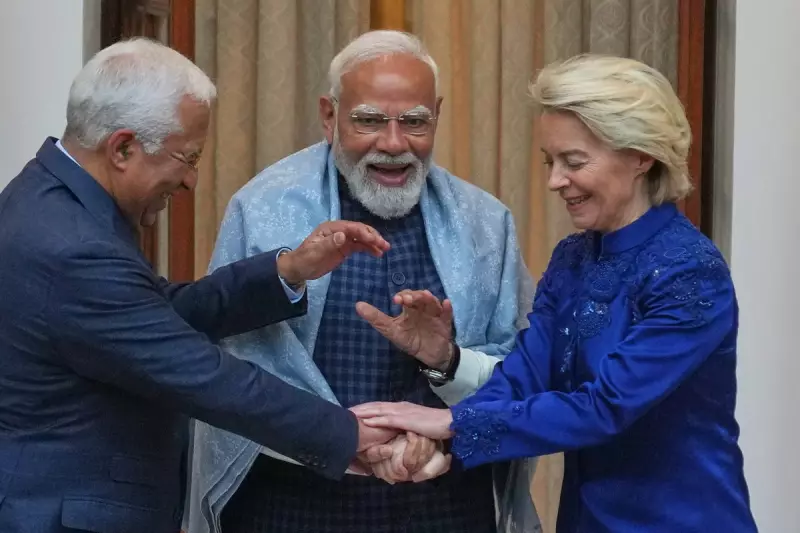
European Commission President Ursula von der Leyen signed the comprehensive agreement during her visit to New Delhi, describing it as the "mother of all deals." The pact has far-reaching implications, potentially affecting approximately 2 billion people across both economic regions.
The agreement will significantly reduce trade barriers, eliminating tariffs on nearly 97% of EU exports to India including automobiles and wine, while removing duties on 99% of India's shipments to the EU covering textiles and pharmaceutical products.
Strategic Counterweights
Garima Mohan, a senior fellow at the German Marshall Fund, observed that "Europe and India need each other today like never before." Both Brussels and New Delhi have long sought closer economic ties as a strategic counterbalance to China's growing global influence, but the increasing abrasiveness of the Trump administration on economic and security matters ultimately accelerated the agreement.
"This movement towards diversification, looking for new partners as well as building self-reliance was precipitated by the tensions with China and really driven home by the fracture of the trans-Atlantic partnership," Mohan explained. She added that the deal "only came to pass at this particular geopolitical juncture, and that says something of the world we live in."
Expanding Global Footprint
The EU-India agreement represents just one component of Brussels' expanding global trade strategy. Over the past year, the European Union has either finalised or advanced trade negotiations with multiple significant partners including:
- Japan
- Indonesia
- Mexico
- The five Mercosur nations of South America
- South Korea
- Australia
These Pacific nations share concerns about Beijing's strategic ambitions and Washington's increasingly turbulent political landscape. The Mercosur agreement alone aims to create a free trade market encompassing more than 700 million people, despite facing objections within the European Parliament.
Defence and Energy Independence
Beyond trade, the EU is pursuing greater autonomy in defence and energy sectors. Russia's invasion of Ukraine prompted the bloc to develop financial mechanisms supporting European defence industries and critical infrastructure. However, the Trump administration's criticism of inadequate European defence spending has accelerated these initiatives.
EU leaders have committed to increasing defence budgets, designating 150 billion euros (£128 billion) in loans for air and missile defence systems, artillery, ammunition, drones, air transport capabilities, alongside cyber systems, artificial intelligence and electronic warfare technologies.
Simultaneously, the EU is addressing energy security concerns. While reducing dependence on Russian energy, the bloc has increased imports from the United States, now accounting for 14.5% of EU oil imports and 60% of liquefied natural gas supplies according to Eurostat.

European Commissioner for Energy Dan Jørgensen cautioned that "we do not want to replace one dependency for another — we need to diversify." Brussels is consequently exploring alternative energy sources in the Eastern Mediterranean and Gulf regions, including ongoing free trade negotiations with the United Arab Emirates.
A Changing World Order
Ivano di Carlo, senior policy analyst at the European Policy Centre, captured the prevailing sentiment across European institutions: "There is a hope that things will change given the importance of the U.S. for us ... but there is a realization now that we are a bit more alone in this world."
As Garima Mohan concluded, while "decoupling is easier said than done," forging these new global relationships provides the European Union with enhanced strategic leverage in navigating complex relationships with Beijing, Moscow and Washington. This landmark agreement with India represents both a significant economic achievement and a profound statement about the evolving geopolitical landscape.