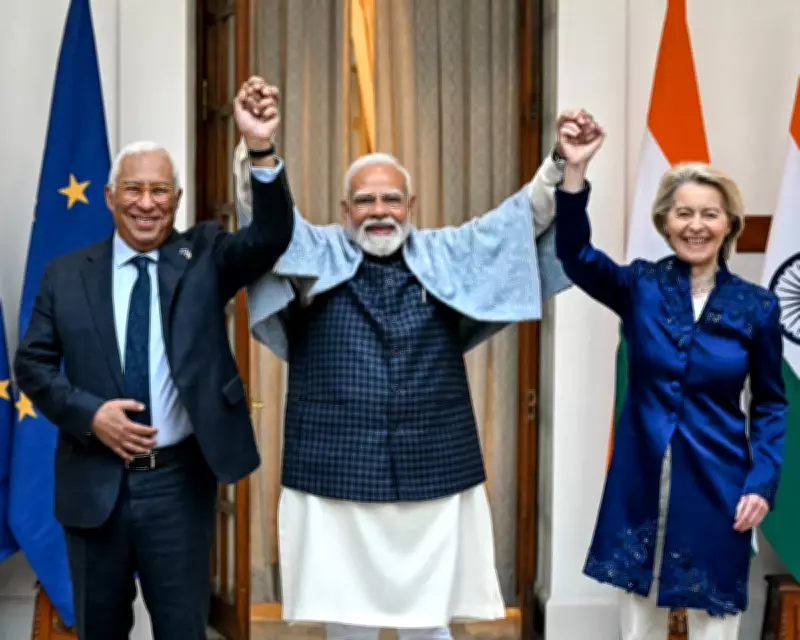
The landscape of global trade and diplomacy is undergoing a profound transformation, as evidenced by the recent signing of a monumental free trade agreement between the European Union and India. Dubbed the "mother of all deals," this pact was formally announced on Tuesday, 27 January 2026, in New Delhi by European Commission President Ursula von der Leyen, European Council President António Costa, and Indian Prime Minister Narendra Modi. The agreement marks a pivotal moment after nearly two decades of intermittent negotiations, bringing together approximately 2 billion consumers and accounting for a quarter of the world's GDP.
Geopolitical Catalysts Behind the Accelerated Deal
Why did this deal, which had languished since talks began in 2007, suddenly reach fruition? The answer lies squarely in the shifting geopolitical dynamics, particularly influenced by the policies of former US President Donald Trump. The EU-India free trade agreement unveils the emerging silhouette of a post-US world order, characterised by relentless threats to territorial sovereignty, punitive tariffs, and the weakening of multilateral institutions.
Originally, negotiations stalled over disagreements on sectors such as cars, alcohol, agriculture, and dairy, leading to their abandonment in 2013. They were revived in 2022 as the post-pandemic world sought to "de-risk" and diversify supply chains away from China. However, it was the looming shadow of Trump's second presidency that ultimately propelled the deal to completion. In December 2024, even before his inauguration, Trump alarmed Europe by reviving the idea of owning Greenland, fostering a sense of Europe being "home alone" amid strained transatlantic relations.

Trump's Tariff Policies and Their Global Impact
Adding to the chaos, Trump imposed punishing tariffs on neighbours like Canada and Mexico on his first day in office, culminating in "liberation day" taxes levied on 90 countries worldwide. India faced one of the highest tariff rates at 50%, including an additional 25% due to its purchase of discounted Russian oil. More recently, tariffs were wielded against the EU and UK when eight countries deployed NATO soldiers to Greenland. Consequently, public opinion surveys in Europe now view the US not just as undependable but as an outright threat.
This has reignited concepts of "de-risking" and "decoupling" in Europe, but with a new target: Trump's America, rather than China. The stakes extend beyond supply chains to the strategic capacity to resist coercion. For instance, the French government's ban on US video-conferencing software like Zoom in favour of its home-grown Visio platform exemplifies this shift towards greater autonomy.
Scope and Implications of the EU-India Partnership
The EU-India comprehensive strategic agenda encompasses far more than trade, including defence and security, commitments to multilateralism, mobility, and cooperation in areas such as research and connectivity. With the US withdrawing to the western hemisphere through the so-called Donroe doctrine, the Indo-Pacific region, once central to US engagement in Asia, is now more open to collaboration with the EU.
The trade deal opens parts of India's protectionist domestic market, focusing on exporting manufacturing and services, while making European cars and wine more affordable for India's middle-class consumers. It is the largest of its kind and part of a growing trend of nations forging new alliances. Brussels recently concluded a deal with the South American Mercosur trade bloc, and India has made agreements with the UK and New Zealand in recent months.
A Shift Towards Multipolarity and Strategic Autonomy
While ratification and implementation may face delays, as seen with the EU-Mercosur deal, the direction is unmistakable. The world many outside the West have long dreamed of—characterised by multipolarity, strategic autonomy, and even de-dollarisation—is taking shape, first slowly and now rapidly. A day before the EU-India summit, EU leaders were honoured guests at India's Republic Day celebrations, projecting an image of bonhomie and optimism amidst European gloom.

As the world moves on, the "America first" policy increasingly appears as "America alone." This landmark deal not only reshapes economic ties but also signals a broader realignment in global power structures, driven by geopolitical tensions and a quest for resilience in an uncertain era.