

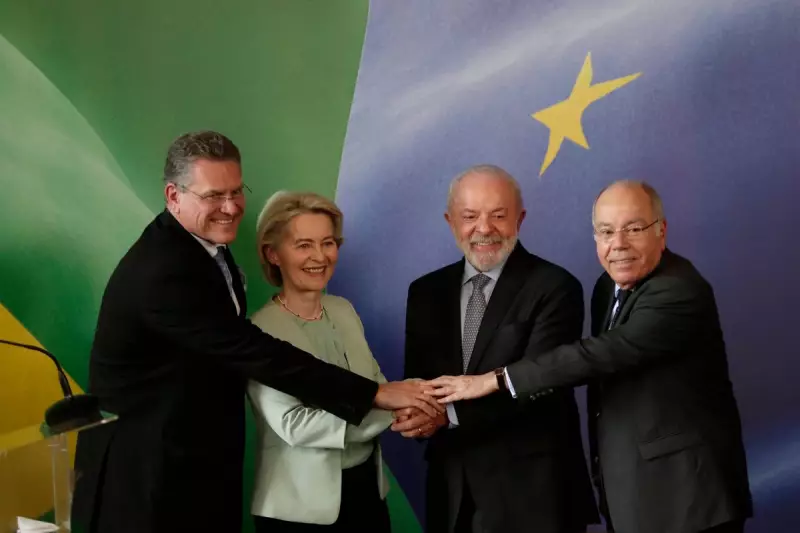
In a landmark moment for global trade, the European Union and the South American Mercosur bloc have formally signed a historic free trade agreement, culminating over a quarter-century of complex negotiations. The pact, inked on Saturday in Asuncion, Paraguay, creates one of the world's largest free trade zones, though the ceremony was notably missing one of its key architects: Brazilian President Luiz Inácio Lula da Silva.
A Deal Decades in the Making
The agreement, first conceived more than 25 years ago, was finalised on Saturday 17 January 2026. It links the EU with Mercosur's core members: Brazil, Argentina, Paraguay, and Uruguay. Bolivia, the newest Mercosur member, was not part of the talks but can join the pact in future years.
Speaking in Rio de Janeiro on Friday alongside European Commission President Ursula von der Leyen, President Lula hailed the deal's significance despite his impending absence. "It was more than 25 years of suffering and attempts to get a deal," Lula stated at the Itamaraty Palace. He emphasised the pact's scale, uniting approximately 720 million people and representing a combined GDP exceeding $22 trillion.

Lula's Strategic No-Show
President Lula's decision not to attend the signing in Paraguay, sending Foreign Minister Mauro Vieira instead, raised eyebrows given his vigorous advocacy for the agreement since returning to office in 2023. Experts suggest the move may signal diplomatic discontent. Flavia Loss, an international relations professor in Sao Paulo, interpreted it as a message: "'The deal is important but we’re not going to change everything for them.'" Some analysts believe Lula was disappointed the signing did not occur in December when Brazil held Mercosur's rotating presidency.
Von der Leyen, however, paid warm tribute to Lula's efforts. "The political leadership, the personal commitment and passion that you have shown in the last weeks and months, dear Lula, are truly second to none," she said. The European Council also acknowledged the crucial role played by Brazil's recent presidency of Mercosur in advancing the final negotiations.
Economic Impact and Global Repercussions
The EU-Mercosur trade deal is a major economic and geopolitical shift. It grants South American nations, famed for agricultural prowess, preferential access to the vast European market for goods like instant coffee, poultry, and orange juice. Brazil's Apex investment agency estimates these agricultural exports could generate an additional $7 billion in revenue.
Lula was quick to note that Mercosur seeks more than just a role as a commodity exporter. "We want to produce and sell industrial goods with higher added value," he asserted on Friday.
The deal's timing is particularly significant against a backdrop of shifting global alliances. As U.S. President Donald Trump pursues a more isolationist trade policy, the EU-Mercosur pact is seen as a victory for multilateralism. Von der Leyen framed it as "the power of partnership and openness" and a rebuttal to the idea that international trade is a zero-sum game. Experts note the accord strengthens both blocs' positions relative to the economic influence of the United States and China in the resource-rich region.






