

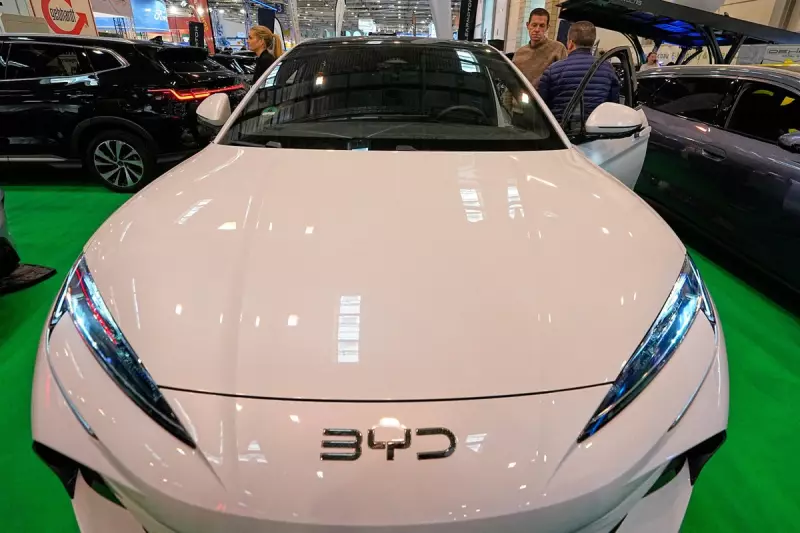
The global automotive landscape is shifting dramatically as Chinese electric vehicle (EV) manufacturers gain a significant new foothold in North America. This follows Canada's recent agreement to reduce its tariffs on imported EVs, a move that has sent ripples of concern through the industry, particularly among American competitors.
A Strategic Gateway to North America
This week, Canada agreed to cut its import duties on electric vehicles as part of a broader trade negotiation, securing concessions for its agricultural sector in return. For Chinese automakers, who have been achieving remarkable global sales with their high-tech, stylish, and affordable EVs, this represents a pivotal opportunity. Experts warn it could provide a major boost to their ambitions of dominating the global market, especially as growth in their domestic market shows signs of softening.
"This tells us that Chinese automakers continue to be really popular and are doing better and better," said Ilaria Mazzocco of the Center for Strategic and International Studies. "They are not just something that’s sold in global markets that are more marginal."

The Competitive Edge: Price, Tech, and Strategy
The appeal of Chinese EVs lies in a powerful combination of factors. They are not only competitively priced but also technologically advanced, often featuring sophisticated software and connectivity that consumers desire. Crucially, their cost advantage is stark: Chinese models can cost as little as $10,000 to $20,000, compared to an average new vehicle price in the US nearing $50,000.
Sam Fiorani, Vice President at AutoForecast Solutions, highlighted a key strategic gap. "They’ve found a way to make small and mid-sized cars—cars that people want—at a reasonable price," he said. "These are the segments where GM and Ford and almost everybody else have abandoned" in favour of larger, more profitable trucks and SUVs.
Furthermore, Chinese companies possess distinct advantages in manufacturing efficiency and producing lighter vehicles, which directly extends driving range—a critical factor for EV buyers.
A Widening Global Gap and Policy Headwinds
The threat to US automakers is magnified by contrasting global trends. While plug-in hybrid and electric vehicle sales grew 17% in China and 33% in Europe in 2025, US sales saw a meagre 1% increase. Compounding this, US manufacturers have scaled back ambitious multi-billion dollar electrification plans under the Trump administration's policy shift, opting instead for hybrids and more efficient petrol vehicles.
This retreat coincides with Chinese rivals accelerating. In a symbolic shift, Tesla lost its crown as the world's top EV maker in 2025, delivering 1.64 million vehicles against Chinese rival BYD's 2.26 million.
Mark Wakefield of AlixPartners, whose firm predicts Chinese brands will seize 30% of the global market by 2030, framed the challenge starkly for US carmakers: "They don’t want to end up as a Brazil with your ethanol-based cars that aren’t sellable anywhere else in the world."
Regulatory Fears and the Path Ahead
The Canadian deal has ignited fears beyond pure market competition. US Transportation Secretary Sean Duffy, speaking in Ohio, accused the Chinese Communist Party of investing to "control this industry" and take away American jobs, warning Canada "will live to regret the day they partner with China."
Concerns also centre on data security, with Chinese EVs described as "data centres on wheels," and the strategic leverage that access to driving data could provide. These fears have prompted widespread regulatory pushback. The European Union hiked tariffs last year, and former President Joe Biden set a 100% tariff on Chinese EVs in 2024, which Canada had matched until this week's reversal.
Despite these barriers, experts like Sam Fiorani believe the advance is inevitable. "Everybody is negotiating to put up the roadblocks... but eventually they’re going to make their way into all Western markets," he concluded. For now, Canada's decision has brought that reality one step closer to the heart of the American auto industry.






