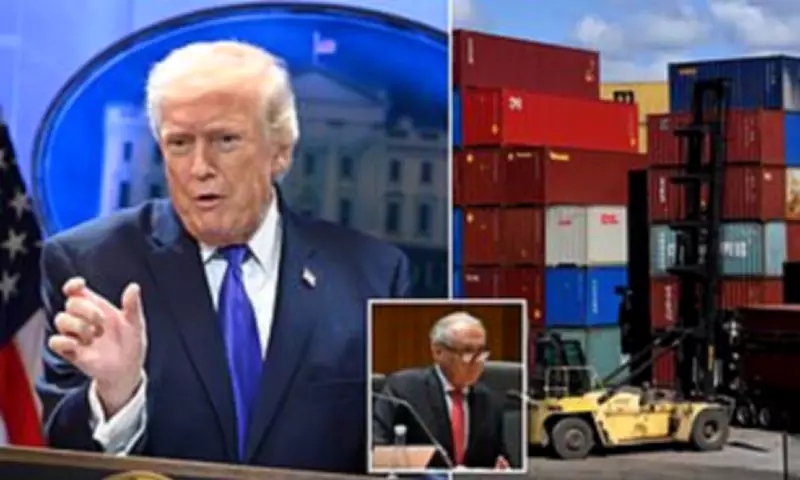
Australia Pledges Action as Trump Deploys Obscure Trade Law to Reinstate Sweeping Tariffs
The Australian government has vowed to respond accordingly after former US President Donald Trump utilised a rarely invoked trade statute to reimpose his extensive global tariffs, which are scheduled to take effect within days. This decisive move follows a landmark ruling by the US Supreme Court, which declared Trump's trade policies unconstitutional in a significant 6-3 decision on Friday.
Trump Invokes Section 122 of the Trade Act of 1974
In an unprecedented action, Trump became the first president to invoke Section 122 of the Trade Act of 1974. This provision permits Congress to authorise the imposition of tariffs of up to 15 per cent for a maximum of 150 days, specifically to address fundamental international payments problems. Trump announced the measure via a post on Truth Social, stating, 'It is my Great Honor to have just signed, from the Oval Office, a global 10 per cent Tariff on all Countries, which will be effective almost immediately. Thank you for your attention to this matter.'
According to the White House, these temporary import duties are set to commence on February 24. It is important to note that tariffs implemented under this statute can only remain in place for 150 days without obtaining explicit congressional approval.

Australian Government's Firm Stance Against Tariffs
This development occurs just ten months after the United States imposed a 10 per cent 'baseline' reciprocal tariff on the majority of goods imported from Australia. At the time, Australian Prime Minister Anthony Albanese strongly criticised the move, labelling it as 'not the act of a friend'. Presently, certain Australian exports, including steel, aluminium, cars, vehicle parts, and upholstered furniture, continue to be subject to larger duties under other established US laws.
In response to Trump's latest action, Australian Trade Minister Don Farrell has pledged to persist in lobbying against what he describes as unjustified tariffs. 'Australia believes in free and fair trade,' Minister Farrell declared in a statement to Daily Mail on Saturday. 'We have consistently advocated against these unjustified tariffs. We are working closely with our Embassy in Washington to assess the implications and examine all available options.'
Economic Experts Analyse the Potential Impact
Monash University economist Professor Robert Brooks has expressed the view that the newly announced global tariffs are unlikely to have a substantial direct impact on Australia beyond the existing measures already in place under US trade policy. However, Professor Brooks acknowledged that the persistent uncertainty surrounding these policies is undesirable for global trade and the international economy.
'The 10 per cent rate is consistent with the base rate applied to many countries, including those with existing trade agreements,' Professor Brooks explained. 'There is also the issue that these tariffs are only temporary, lasting 150 days, without congressional action. Such action by Congress is complex in the current political climate in the United States. The most significant impact is the ongoing uncertainty about the settings of US trade policy. In general, uncertainty is undesirable for both consumer confidence and business investment.'
Business Leaders and Legal Experts Voice Concerns
EY partner and global trade Oceania leader Luke Branson emphasised that while tariffs may not directly affect every Australian business, the prevailing uncertainty will undoubtedly impact them. 'That's why I've been spending so much time tracking and monitoring these developments - because business leaders are already carrying the burden of uncertainty, and staying up to date is critical to making confident decisions in an increasingly volatile global market,' Mr Branson told the Australian Financial Review.
Furthermore, there is a possibility that Australian businesses could be entitled to refunds, given that Trump's previous tariffs were deemed illegal. EY Australia modelling indicates that Australian exporters would collectively be owed more than $1.4 billion in refunds if the tariffs were ultimately struck down. However, the responsibility would fall upon Australian exporters to actively seek these refunds.

Legal Challenges and Potential Evasion Tactics
Mr Branson also highlighted significant legal doubts regarding the powers granted under this specific legislation. 'Legal analysts are doubtful about the powers under this particular legislation providing the president the authority to impose tariffs,' he stated in an interview with the ABC. 'This particular statute allows the president to regulate imports … but it doesn't explicitly say that the president can impose tariffs.'
Additionally, Mr Branson issued a warning that the Trump administration may attempt to avoid reimbursing exporters. 'There's a lot of talk by legal analysts in the US that the president might impose other measures … under other legal avenues, lawful legal avenues that he has used in the past, to basically backdate tariffs so that he doesn't have to provide refunds,' he cautioned.
Michigan Professor Justin Wolters, who is currently a visiting professor at the University of New South Wales, offered a different perspective, suggesting that future tariffs may be levied on specific products rather than targeting entire countries. This approach could further complicate the international trade landscape and add to the existing uncertainty faced by global businesses and economies.