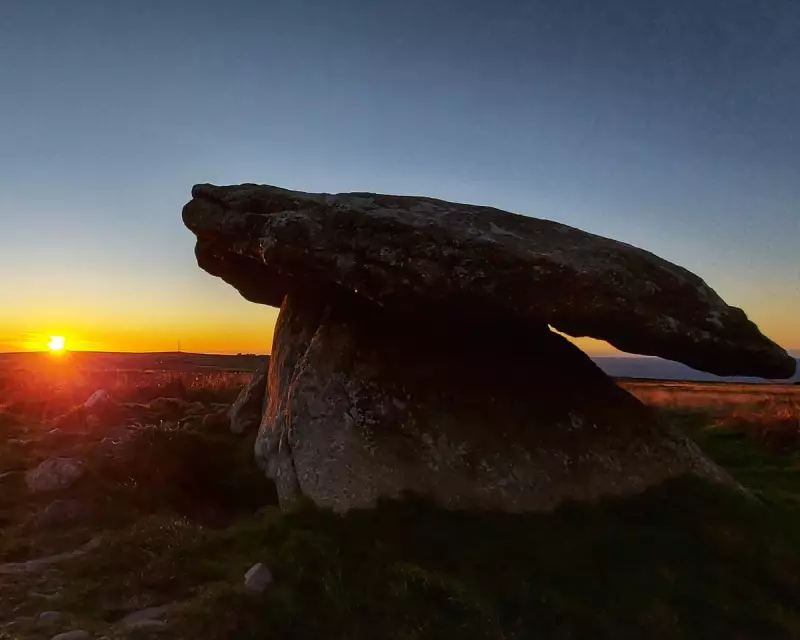
As the midwinter sun dips below the horizon at Chûn Quoit, casting long shadows across the Cornish moor, a timeless connection to the past is felt. The West Penwith peninsula, a rugged finger of land pointing towards the Atlantic, transforms into a landscape of profound magic and mystery during the darkest days of the year. Here, ancient standing stones and vibrant modern festivals combine to mark the winter solstice, celebrating the pivotal turn towards longer days.
A Landscape Aligned with the Sun
Standing within the Tregeseal stone circle near St Just as daylight fades, the granite monoliths appear like spectral guardians. The brooding silhouette of Carn Kenidjack dominates the skyline, a place local lore associates with pixies and darker forces. Yet the real enchantment lies in the celestial alignment. Archaeoastronomer Carolyn Kennett, whose work explores Cornwall's prehistoric relationship with the sky, describes the entire Land's End peninsula as an ancient winter solstice landscape.
This is due to the unique southwest orientation of the peninsula's granite spine. From vantage points like the Neolithic burial chamber of Chûn Quoit, the midwinter sun sets precisely over Carn Kenidjack. "This is exactly as the builders intended," Kennett explains. The Tregeseal stone circle itself is positioned to frame the sunset behind the distant Isles of Scilly, which may have been viewed by its creators 4,000 years ago as an otherworldly realm associated with death and rebirth.

Ancient Calendars and Enduring Stones
The region is dotted with enigmatic monuments whose purposes are still being deciphered. A short walk from Tregeseal lies a unique row of holed stones at Kenidjack. Unlike the famous Mên-an-Tol, these holes are small and close to the ground. Carolyn Kennett proposes a fascinating theory: the alignment could have functioned as a solstice countdown calendar. From late October until December, the rising sun would shine through the holes, casting distinct beams of light and marking the sun's incremental journey towards its lowest point.
This deep connection to the solar cycle was vital for prehistoric farming communities reliant on its light and warmth. That significance endures. As filmmaker Christopher Morris, who documented a year at the solitary Boscawen-Ros stone, notes, the solstice remains "a moment of pure hope – the promise of the ending of darkness." His film, A Year in a Field, begins and ends with this pivotal astronomical event.
Modern Solstice: Fire, Folklore and Festivity
On 21 December, this ancient landscape comes alive with contemporary ritual. People walk to stone circles, holy wells, and hill forts. Carolyn Kennett leads guided walks to Chûn Quoit to witness the sunset alignment. Christopher Morris makes his annual pilgrimage to the Boscawen-Ros stone for reflection.
The celebrations culminate in Penzance with the Montol midwinter festival. A relatively modern invention dating from 2007, Montol brilliantly revives old Cornish traditions of guise dancing, where elaborate masks and costumes conceal identities. Morris describes it as "a wild night of misrule," featuring 'obby 'osses (hobby horses like Penglaz), dragons, fire-dancers, and spirited merrymaking—"A lot of sprout-throwing, too," he adds.
The climax sees a papier-mâché sun set ablaze before a torchlit parade carries the Mock (the Yule log) down Chapel Street to the sea. It is a fittingly uproarious, darkly magical celebration to welcome back the light. In West Penwith, where legend says dancers were turned to the stone circles known as the Merry Maidens, the threads of folklore, storytelling, and community ritual remain powerfully woven together, especially at midwinter.